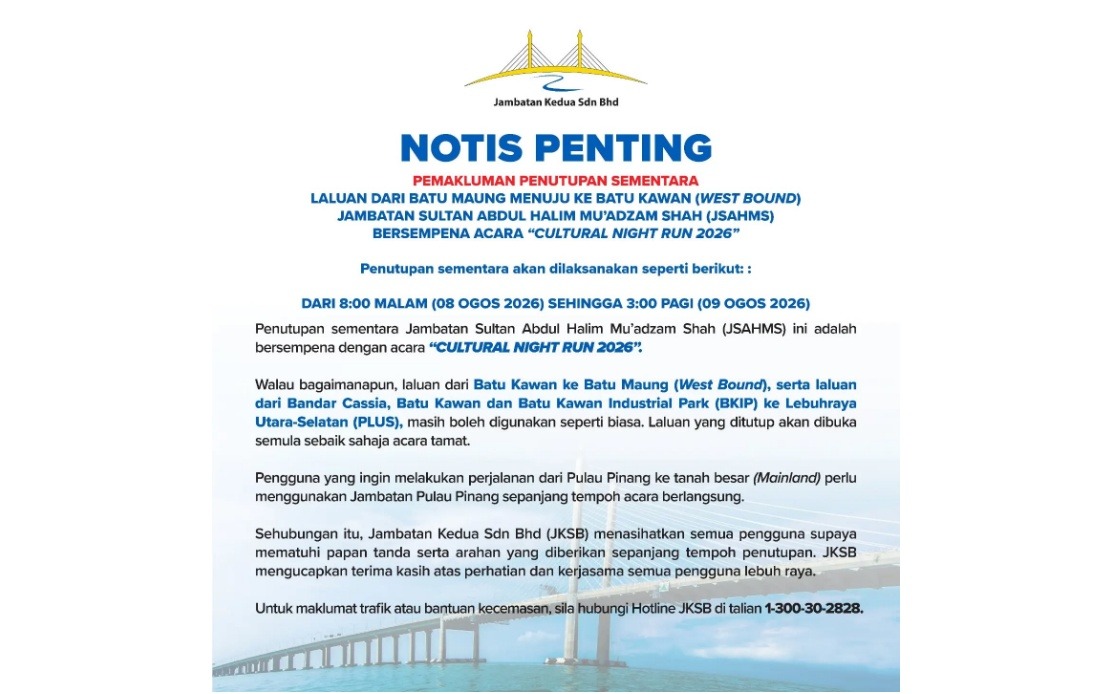
The westbound carriageway of the Sultan Abdul Halim Mu'adzam Shah Bridge linking Batu Maung and Batu Kawan will undergo a temporary operational suspension spanning seven hours, beginning at 8 pm on August 8 and extending until 3 am on August 9, to facilitate the Cultural Night Run 2026 event. Jambatan Kedua Sdn Bhd (JKSB), the bridge operator, announced the arrangement through an official statement, emphasising that the disruption targets only the Batu Maung-to-Batu Kawan direction while maintaining full service capacity on the opposing eastbound route throughout the scheduled period.
The decision to restrict traffic flow in one direction reflects a deliberate operational approach designed to balance event logistics with maintaining regional connectivity. While the westbound lane undergoes closure, the reverse carriageway from Batu Kawan towards Batu Maung will continue functioning at normal capacity, ensuring that traffic volumes can be accommodated through this alternative path. This strategy represents a common traffic management practice adopted for major events that require road infrastructure utilisation while simultaneously preserving regional mobility.
For commuters and commercial operators requiring access between Penang Island and the mainland during the event window, JKSB has explicitly recommended utilising the Penang Bridge as the primary alternative route. This guidance acknowledges the significant traffic capacity available through the older crossing, which routinely handles substantial vehicle volumes and possesses the infrastructure capability to absorb additional demand generated by the temporary Sultan Abdul Halim Mu'adzam Shah Bridge restrictions. The recommendation effectively distributes potential congestion across multiple crossing points rather than concentrating pressure on any single facility.
Access routes serving the broader northern corridor remain operationally available throughout the closure period. Specifically, traffic movements originating from Bandar Cassia, Batu Kawan, and the Batu Kawan Industrial Park (BKIP) heading towards the North-South Expressway (PLUS) will experience no disruption, meaning logistics operations and commercial movements dependent on these corridors can proceed without impediment. This preservation of alternative access points proves particularly significant for industrial and economic activities concentrated in the Batu Kawan region, ensuring that event hosting does not unnecessarily restrict business operations or supply chain movements.
The Cultural Night Run 2026 represents a significant recreational and community event that necessitates dedicated infrastructure allocation. By implementing the seven-hour closure window during overnight hours—a period traditionally characterised by lower traffic volumes compared to daytime peaks—JKSB has sought to minimise disruption impact on commuting patterns while providing adequate space and safety parameters for the organised running event. The overnight scheduling reflects pragmatic event management that balances celebration opportunities with operational considerations affecting the broader motoring public.
JKSB has committed to restoring full operational capacity on the affected carriageway immediately following the Cultural Night Run 2026 conclusion, signalling that the closure represents a temporary, event-specific measure rather than any structural or maintenance-related interruption. This assurance provides certainty to regular bridge users that normal bidirectional traffic flows will resume without extended delays or complications once the event concludes. The company's explicit reconfirmation of this commitment addresses potential concerns among frequent users regarding prolonged access restrictions.
Highway users transiting the affected zone during the closure period have been directed to maintain strict compliance with all traffic signage and official instructions deployed throughout the area. This compliance emphasis serves dual purposes: ensuring smooth traffic redistribution across available alternative routes and maintaining safety standards for all road users navigating the bridge infrastructure and surrounding arterial roads. The instruction reflects standard traffic management protocol that acknowledges how adherence to directional guidance contributes meaningfully to overall system efficiency during temporary operational modifications.
For motorists seeking real-time information regarding traffic conditions, incident reports, or emergency assistance during the Cultural Night Run 2026 period, JKSB has established dedicated support infrastructure accessible through the company hotline at 1-300-30-2828. This communication channel enables rapid dissemination of updates regarding traffic flow status, potential delays, or route recommendations, while simultaneously providing emergency response coordination for incidents occurring within bridge jurisdiction. The availability of professional traffic information supports informed decision-making by commuters regarding route selection and departure timing.
The planned closure demonstrates how Malaysia's major infrastructure facilities increasingly accommodate diverse community activities beyond conventional transportation functions. The Sultan Abdul Halim Mu'adzam Shah Bridge—commonly referred to as the Second Penang Bridge—constitutes critical connectivity infrastructure linking Penang Island's urban centres with mainland industrial and residential zones. Its design capacity and strategic positioning make it an increasingly attractive venue choice for large-scale organised events seeking to leverage existing infrastructure for community engagement purposes while avoiding dedicated event venue construction requirements.
For regional observers monitoring Penang's infrastructure utilisation patterns, this event closure exemplifies how toll bridge operators balance revenue-generating transportation functions with community event collaboration opportunities. JKSB's willingness to implement controlled access restrictions for sanctioned community events reflects broader infrastructure policy trends across Southeast Asia, where operators increasingly recognise that strategic event hosting contributes to regional reputation development and community stakeholder relationship building beyond pure toll revenue considerations. This approach positions major infrastructure not merely as transportation conduits but as integrated community facilities supporting diverse economic and social activities.

