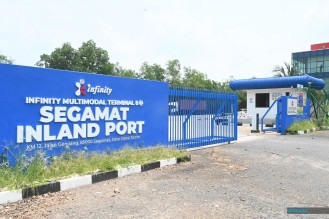
Segamat Inland Port (SIP) has set its sights on processing more than 6,000 twenty-foot equivalent units (TEUs) of containers before the year concludes, marking a significant push forward since the facility resumed full operations in late June following over a decade of dormancy. The ambitious target reflects growing confidence in the facility's role within Malaysia's evolving logistics landscape, particularly as the government intensifies efforts to shift cargo movement away from congested highways towards more efficient rail-based networks.
During the inaugural month following the facility's reactivation, SIP moved approximately 1,000 TEUs of containerised and bulk cargo, establishing a foundational throughput that managers believe can be substantially increased as operational efficiency improves and market awareness grows. Samuel Ho, who oversees the inland port's operations under Infinity Logistics & Transport, characterises this opening performance as validation of the facility's renewed commercial viability, especially given the prolonged period during which the site operated at minimal capacity.
The strategic positioning of SIP addresses the logistics requirements of a distinctive regional cluster stretching across northern Johor, southern Pahang, southern Negeri Sembilan, and Melaka. This geographic concentration of industrial activity had previously relied heavily on trucking as the primary transport mode, but the inland port's reactivation now presents shippers with a rail-based alternative that substantially reduces per-unit transport costs and environmental impact. The facility thus represents a critical link in the supply chain for manufacturers and traders throughout this economically significant corridor.
The government's commitment to revitalising SIP reflects a broader strategic initiative termed the Road to Rail programme, executed in partnership with Keretapi Tanah Melayu Bhd. This initiative recognises that Malaysia's highway infrastructure, particularly major arteries connecting industrial zones to ports, faces mounting pressure from burgeoning logistics traffic. By channelling containerised cargo onto rail lines, policymakers aim to simultaneously reduce accident rates, mitigate the disruptions caused by traffic congestion, and lower the fuel consumption associated with operating large freight fleets. A single cargo train journey performs equivalent work to approximately 80 container trucks, a comparison that underscores the operational leverage available through rail transport.
Critically, SIP's resurrection became feasible only after infrastructure improvements removed the operational constraints that had rendered the facility impractical for decades. Previously, single-track rail operations necessitated that freight movements defer to passenger services, creating unpredictable scheduling windows that discouraged shippers from committing cargo to the facility. The completion of double-tracking infrastructure extending to Johor fundamentally altered this equation, enabling SIP to accommodate up to four separate cargo operations weekly compared to the single weekly cycle possible under the earlier configuration. This expanded capacity directly enables the facility to integrate seamlessly with major ports including Port Klang, Port of Tanjung Pelepas, and Johor Port in Pasir Gudang.
Managers view the operational expansion as instrumental in catalysing broader economic development across northern Johor, particularly in less industrialised districts such as Batu Pahat and Kluang. By establishing SIP as a primary inland gateway for rail-based cargo, the facility creates compelling advantages for manufacturers seeking to establish production facilities within the surrounding region. The reduced logistics costs and improved connectivity to major ports reduce the geographic penalty for locating away from coastal industrial hubs, potentially triggering greenfield investments in warehousing, manufacturing, and distribution operations. Ho noted that such secondary economic effects constitute an equally important outcome compared to direct cargo volumes processed.
The present operational footprint encompasses 20.23 hectares utilising the first phase of a three-phase development programme situated immediately adjacent to Segamat Railway Station. This phased approach permits incremental expansion as market demand consolidates and operational proficiency deepens. Already, the initial phase has generated employment for more than 200 local residents, with the expectation that completing subsequent development phases will substantially multiply job creation across security, logistics coordination, and ancillary services. This employment generation addresses regional economic concerns while building local stakeholder support for further expansion.
Beyond direct operational activities, SIP management has initiated knowledge-exchange collaborations with Universiti Tun Hussein Onn Malaysia (UTHM), providing students and faculty exposure to contemporary inland port practices whilst simultaneously conducting applied research into optimising rail-based cargo operations. Such academic partnerships strengthen the knowledge base available to Malaysia's emerging logistics workforce whilst generating practical insights potentially applicable across other inland ports or transport corridors. This approach recognises that Malaysia's long-term competitiveness depends on developing technical expertise proportionate to the infrastructure being deployed.
The facility's original conception dated to 1997, but limited commercial uptake in those early years led to the extended dormancy that lasted until Transport Minister Anthony Loke Siew Fook's official launch ceremony on June 25, 2026. During that ceremony, Loke reframed SIP as a critical component of Malaysia's transport modernisation agenda, emphasising the facility's potential to strengthen domestic logistics networks whilst improving supply chain efficiency across multiple sectors. His remarks reflected recognition that inland ports, properly configured and operationally supported, represent essential infrastructure for a middle-income economy seeking to enhance productivity whilst reducing environmental and congestion costs associated with transport activities.
Projections suggest that SIP operations, when reaching optimal capacity, will eliminate approximately 18,000 lorry movements including trailers and container trucks from regional roads on a monthly basis. This reduction translates into meaningful improvements in highway safety, diminished fuel consumption across commercial transport, and reduced infrastructure wear on roads serving the region. The cumulative effect across multiple inland ports progressively implemented through the Road to Rail initiative therefore offers potential benefits extending far beyond the immediate operating zone of any single facility, contributing to broader national objectives around transport efficiency and sustainability. These figures demonstrate that SIP represents far more than a single logistics operation, functioning instead as a strategic component within Malaysia's evolving approach to managing goods movement through rail-centric rather than road-centric systems.

