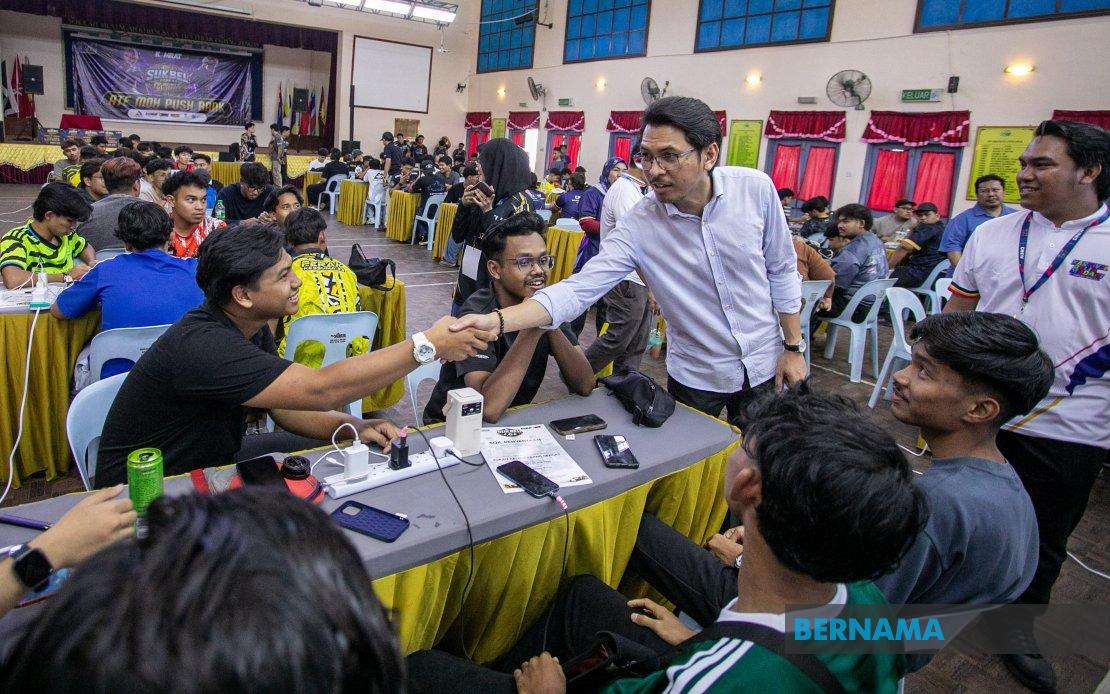
The Sejahtera MADANI initiative in Perak has reached a significant milestone, channelling RM2.3 million in targeted assistance to approximately 2,000 residents since its launch, with the programme now poised for substantial expansion following an allocation of RM3 million in fresh funding. The enhanced budget will enable the government to deepen its reach into communities across the state, focusing particularly on vulnerable segments including small-scale business operators, households living below the income threshold, and academically accomplished young people pursuing further education.
Muhammad Kamil Abdul Munim, the Finance Minister's political secretary, outlined the government's vision for the programme during his address at the Padang Rengas parliamentary constituency roadshow held at the Millennium Hall in Lubok Merbau. He emphasised that the Sejahtera MADANI framework represents more than a simple cash transfer mechanism, instead positioning itself as a comprehensive support ecosystem designed to address multiple dimensions of economic and social disadvantage simultaneously.
The initiative's approach extends beyond financial disbursements to encompassing direct provision of productive assets and targeted incentives. Thirteen high-performing students who successfully completed their Sijil Pelajaran Malaysia examinations and gained admission to tertiary institutions received laptop computers to facilitate their studies, while five small-scale entrepreneurs were handed business equipment to enhance their operational capacity and revenue-generating potential. This combination of cash support, hardware provision, and performance-based incentives reflects a deliberate shift away from traditional welfare models toward what officials frame as capability-building interventions.
For Malaysian policymakers and observers, the Sejahtera MADANI model carries particular significance given persistent debates around the effectiveness of targeted versus universal welfare schemes in Southeast Asia. The Perak programme's focus on micro-entrepreneurs addresses a critical gap in Malaysia's broader economic landscape, where informal and semi-formal business operators—often numbering in the hundreds of thousands—remain underserved by conventional financial institutions and capacity-building programmes. By equipping these operators with tangible tools and resources, the initiative attempts to strengthen the informal economy's productivity and contribution to household income generation.
Muhammad Kamil acknowledged, however, that the initial implementation phase of Sejahtera MADANI had encountered operational challenges requiring systemic correction. The original design had granted considerable autonomy to local communities in setting project priorities, reflecting a decentralised governance philosophy. Yet in practice, this approach generated supervision deficits that permitted some initiatives to falter or divert resources improperly. The Finance Minister's political secretary signalled that future phases would feature substantially heightened monitoring mechanisms and tighter controls over fund deployment.
The disclosure of implementation weaknesses in an earlier iteration of the scheme carries broader implications for how Malaysian federal and state governments conceptualise development programme delivery. While community-led prioritisation ostensibly embeds local knowledge and democratic accountability into resource allocation, the Perak experience demonstrates that insufficient institutional oversight can create conditions enabling project collapse or financial mismanagement. This tension between empowering grassroots stakeholders and maintaining accountability through hierarchical supervision remains unresolved in many development contexts across Southeast Asia.
Muhammad Kamil's emphasis on preventative monitoring represents an attempt to square this circle—allowing communities meaningful input while ensuring compliance frameworks prevent malfeasance or incompetence. He acknowledged that implementation flaws are an inevitable feature of large-scale programmes operating across diverse communities with varying administrative capacity. Rather than accepting such failures as permanent, the revised approach commits to continuous oversight capable of detecting and correcting course deviations before significant leakage occurs or funds disappear through fraud or negligence.
For Perak residents, the RM3 million injection translates into expanded eligibility windows and deeper support depths for each beneficiary category. Micro-entrepreneurs can anticipate more generous equipment allocations or supplementary business development training. Low-income households may receive larger cash tranches or access to complementary services addressing barriers to employment and income growth. Students from disadvantaged backgrounds entering university will benefit from more comprehensive technology access, potentially improving their capacity to compete academically with better-resourced peers.
The initiative's evolution also reflects broader government positioning regarding economic resilience in the post-pandemic period. With cost-of-living pressures persisting across Malaysia, and employment prospects remaining uncertain in certain sectors, programmes targeting income augmentation and economic participation directly address citizen concerns about household financial security. By directing resources toward entrepreneurship support and educational advancement, the Sejahtera MADANI scheme attempts to build medium-term resilience rather than merely cushioning immediate hardship.
Peering ahead, the success of the expanded Sejahtera MADANI initiative in Perak will likely influence whether similar funding expansions and monitoring reforms are rolled out to other states already operating the programme. The state's experience offers a natural experiment in balancing community empowerment with institutional accountability—lessons potentially applicable throughout Malaysia's federal system. As the RM3 million additional allocation flows into Perak's economy over coming months, attention will focus on whether improved oversight mechanisms genuinely reduce failures while maintaining the programme's motivating commitment to grassroots engagement and localized development priority-setting.
For regional observers tracking Malaysia's social protection architecture, the Sejahtera MADANI trajectory demonstrates both the promise and pitfalls of attempting to combine centralised funding with decentralised implementation. Success requires not merely adequate financial resources but equally robust institutional mechanisms capable of learning from early implementation difficulties and adjusting operational models accordingly—a challenge many developing nations continue to confront as they seek more effective and equitable development assistance models.

