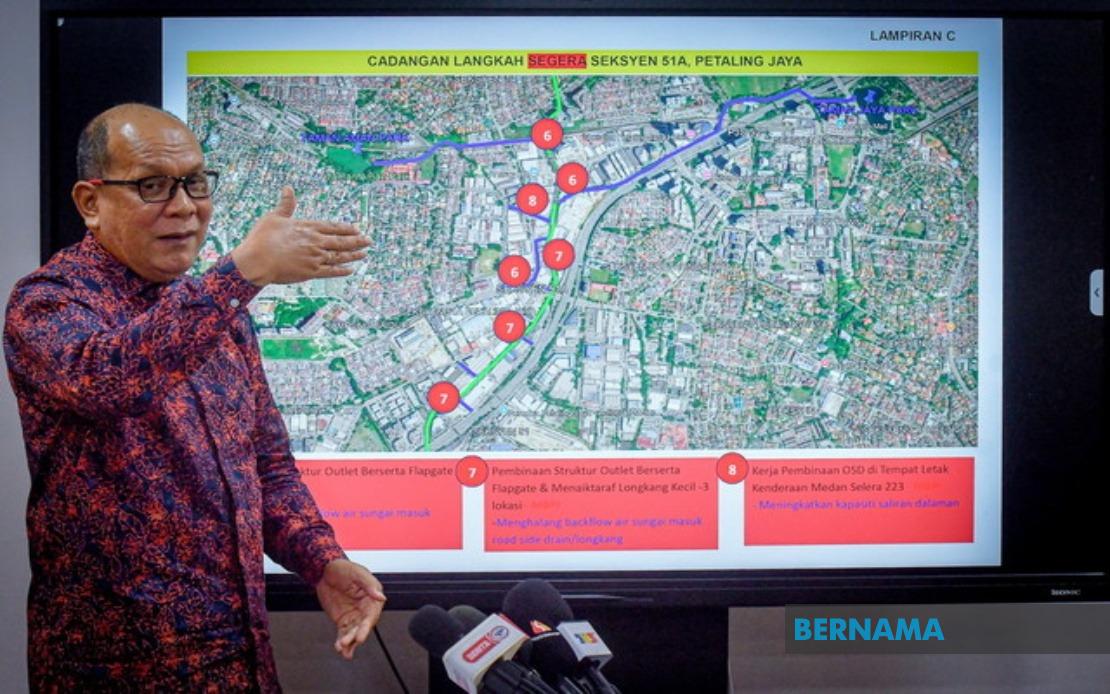
The Selangor state government has committed RM40.5 million to combat recurring flash flood disasters afflicting Petaling Jaya, rolling out an ambitious mitigation strategy that addresses both immediate vulnerabilities and structural weaknesses across the municipality. The Immediate and Moderate Flood Mitigation Plan Project encompasses 39 distinct initiatives distributed across hotspot and elevated-risk zones administered by the Petaling Jaya City Council (MBPJ), representing a coordinated government response to escalating urban inundation crises that have devastated commercial and residential quarters.
Datak Izham Hashim, chairman of the Selangor State Infrastructure and Agriculture Committee, outlined the strategic framework during a special press conference on flood management, emphasising that the allocation splits into two operational categories designed to deliver results at different timescales. Quick-win interventions, categorised as immediate measures, target completion within six months and account for 26 projects worth RM20.1 million in aggregate spending. Medium-term initiatives, spanning up to twelve months and representing 13 separate undertakings, command RM20.4 million, enabling more intricate structural improvements that require comprehensive planning and community adjustment periods.
The intensification of urban flash flooding across Selangor reflects a confluence of structural and environmental factors that have accelerated markedly in recent years. Rapid metropolitan development has displaced natural water absorption zones, replacing permeable surfaces with concrete and asphalt that accelerate run-off velocities and overwhelm drainage infrastructure designed for pre-development precipitation patterns. Simultaneously, climate change has amplified rainfall intensity and frequency, generating volumes that conventional drainage systems cannot accommodate, whilst poor spatial planning in earlier development phases created bottlenecks where water concentrates destructively. These systemic challenges demand interventions that extend beyond traditional engineering fixes to encompass integrated water management philosophies.
Three localities have been designated as critical priority zones requiring expedited attention: Section 51A along Jalan 223, Kampung Cempaka, and the FAS Tunnel vicinity near Jalan PJU 1A. These neighbourhoods experienced particularly severe inundation during recent catastrophic rainfall events in April and May, with commercial establishments sustaining significant inventory losses and operational disruptions. The geographical concentration of priority interventions allows authorities to deploy resources strategically whilst establishing demonstration projects that showcase mitigation effectiveness to surrounding communities, potentially creating templates for broader application across other vulnerable precincts.
The technical arsenal assembled for this initiative reflects contemporary advances in flood management engineering. Flood barrier construction will provide structural defences against water encroachment, whilst flap gates—one-way valves installed in drainage outlets—prevent backflow when municipal sewers exceed capacity. Retention ponds function as temporary water reservoirs that absorb surplus runoff during peak precipitation, releasing accumulated water gradually during dry periods and reducing downstream surge pressures. Advanced materials including German-manufactured ecoblocks enhance drainage system efficiency through improved permeability and structural integrity, introducing innovation that complements traditional concrete infrastructure.
Implementation protocols emphasise rigorous technical preparation before ground-breaking commences. Each project undergoes thorough engineering assessment and design optimisation to navigate complex urban environments where underground utility networks—electrical conduits, water mains, telecommunications cables, gas pipelines—create construction hazards and coordinate demands. Land ownership verification and acquisition negotiations must conclude before contractors mobilise equipment, preventing costly delays and disputes that undermine project timelines. This deliberate, methodical approach reflects lessons learned from infrastructure mishaps elsewhere in Malaysia where inadequate planning spawned unforeseen complications and budget overruns.
Petaling Jaya Mayor Datuk Mohamad Zahri Samingon articulated complementary relief measures addressing the immediate hardship sustained by traders whose businesses flooded during catastrophic inundation events on April 20 and May 6. Commercial premise rental exemptions and thirty percent reductions—applicable from July through December—represent direct financial assistance enabling affected merchants to stabilise operations whilst absorbing inventory and fixture losses. These palliative measures, whilst addressing acute economic suffering, underscore the profound economic consequences of recurrent flooding that extend far beyond infrastructure damage, encompassing lost revenue, inventory destruction, customer defection, and operational disruption.
Technological supplementation complements infrastructural investment through alarm systems and drain water level detectors that provide early warning capability to traders and residents. When sensors detect water elevation approaching critical thresholds, automated alerts trigger notification cascades enabling occupants to implement protective measures—relocating merchandise, closing gates, evacuating vulnerable individuals—that minimise damage exposure and preserve life safety. These monitoring installations represent relatively modest capital expenditure delivering disproportionate risk reduction benefits, exemplifying cost-effective approaches to disaster mitigation that extend preparedness beyond infrastructure hardening.
Coordination mechanisms linking the Irrigation and Drainage Department (JPS), MBPJ administration, Public Works Department (JKR), and allied technical agencies establish collaborative frameworks essential for mitigation efficacy. Fragmented agency jurisdictions historically undermined flood response effectiveness when municipal councils, state water authorities, and federal public works departments pursued parallel initiatives without strategic alignment. This integration protocol ensures resource deployment optimisation, prevents duplicative spending, and establishes unified command structures facilitating rapid adaptation when circumstances demand tactical adjustments or resource reallocation.
The Selangor initiative reflects growing state-level recognition that flood mitigation transcends conventional drainage engineering to encompass integrated urban water management encompassing retention infrastructure, permeable surfacing, green corridors, and land-use planning that preserves water absorption capacity. Whilst this particular project concentrates on MBPJ precincts, successful implementation creates blueprint potential for replication across Klang Valley and other high-density metropolitan zones confronting similar vulnerabilities. The RM40.5 million allocation, whilst substantial, represents only preliminary investment, as comprehensive mitigation across Selangor's flood-prone regions ultimately demands multi-billion ringgit commitments sustained across planning horizons extending beyond conventional budgetary cycles.
Longer-term implications warrant consideration regarding whether mitigation investments can sustain effectiveness as urbanisation continues accelerating and climate variability intensifies. Engineering solutions designed for historical rainfall frequencies may require periodic recalibration as precipitation patterns shift and development pressures intensify. Strategic land acquisition preserving water absorption zones, mandatory green infrastructure standards in building codes, and regional water management frameworks transcending municipal boundaries represent systemic interventions complementing discrete infrastructure projects. Without parallel attention to development controls and spatial planning philosophy, engineering interventions risk becoming merely temporary palliatives rather than genuine solutions addressing fundamental vulnerabilities.

