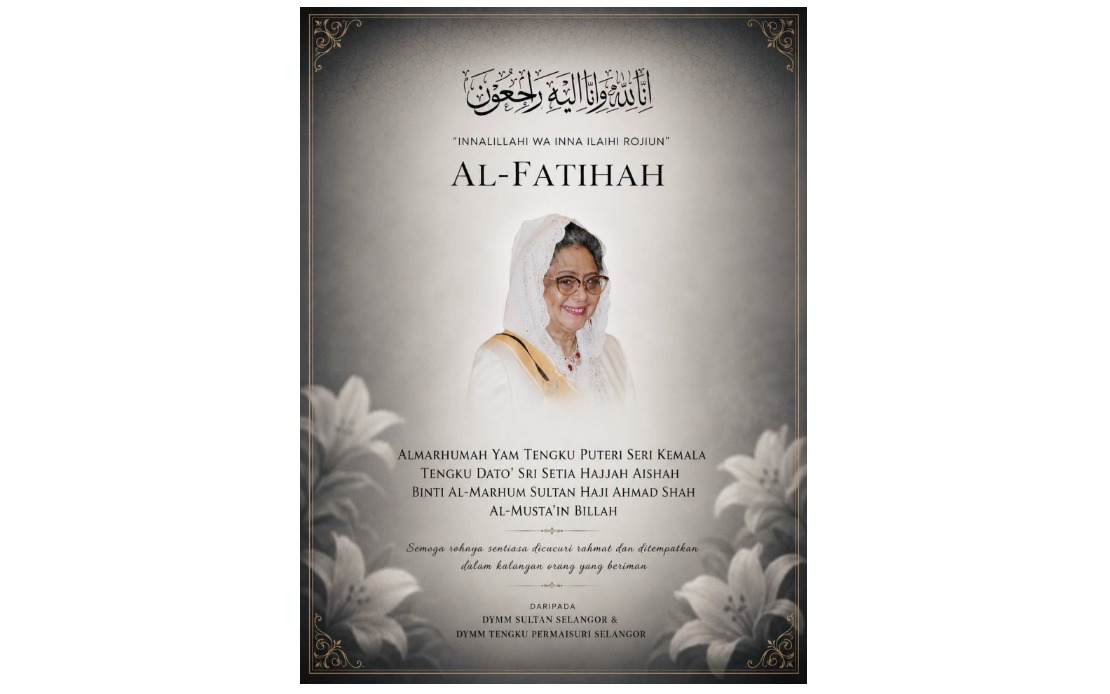
The royal household of Selangor has formally expressed deep condolences to the Sultan of Pahang, Al-Sultan Abdullah Ri'ayatuddin Al-Mustafa Billah Shah, following the death of his sister Tengku Datuk Seri Aishah, who was the daughter of the late Sultan Ahmad Shah. Sultan Sharafuddin Idris Shah and his consort, Tengku Permaisuri Norashikin, conveyed their grief through an official statement released by the Selangor Royal Office, offering prayers for the repose of the deceased's soul.
Tengku Datuk Seri Aishah passed away on the evening of August 26 at a medical facility in the capital, with her death occurring at 9.15 pm. The passing marks a significant loss within Malaysia's royal circles, as members of the extended royal family who hold historical significance within the sultanate system frequently command widespread respect and public recognition. Her role as an elder sibling within one of Malaysia's most prominent royal houses means her departure will be felt across the corridors of state governance and ceremonial occasions.
The formal statement issued by the Selangor palace articulated the emotional response of the state's senior royalty. Sultan Sharafuddin and Tengku Permaisuri Norashikin expressed their profound sadness over the development, while simultaneously offering spiritual comfort through traditional Islamic well-wishes. The invocation of Al-Fatihah, the opening chapter of the Quran recited in remembrance of the deceased, underscores the religious dimensions of royal mourning practices within Malaysia's constitutional monarchy framework.
Following customary royal protocols, the remains of Tengku Datuk Seri Aishah were transported to Pekan, the traditional heartland of Pahang's royal administration and symbolism. The interment was scheduled to take place at the Pahang Royal Mausoleum, a cemetery reserved exclusively for members of the Pahang royal lineage and historically significant figures connected to the state's ruling dynasty. This location choice reflects the formal recognition of her standing within Pahang's royal hierarchy.
The funeral arrangements adhered to established royal customs and ceremonial standards that govern the treatment of deceased members of the sultanate. Full state honours were extended during the burial procedures, a gesture that acknowledges both her bloodline connections and her historical significance within Malaysia's royal institution. Such protocols represent more than mere formality; they embody the constitutional and cultural recognition of the monarchy's role in Malaysian society.
The condolences extended by Selangor's royal household exemplify the interconnectedness and mutual respect that characterize relationships among Malaysia's various sultanates. Despite each state maintaining its own independent sovereignty and governance structures, the royal families frequently demonstrate solidarity during occasions of significant loss. These gestures of sympathy reinforce the bonds that link Malaysia's nine royal houses and contribute to the institutional stability of the constitutional monarchy system.
Tengku Datuk Seri Aishah's passing comes at a time when Malaysia's royal institutions continue to adapt to contemporary challenges while maintaining their traditional roles. Members of the extended royal families frequently undertake ceremonial duties, patronize charitable organizations, and serve as cultural ambassadors for their respective states. The loss of such figures, particularly those of advanced years who embody historical continuity with earlier eras of Malaysian statehood, carries significance beyond the immediate family circle.
The succession and continuation of royal duties within individual sultanates typically ensure that state governance remains unaffected during periods of mourning. However, the passing of prominent family members does create occasions for reflection on the evolution of Malaysia's royal institutions and their adaptation to contemporary society. The ceremonial and spiritual responses demonstrated by senior royalty during such losses illustrate the enduring cultural importance placed on filial piety and respect for familial hierarchies within Malaysian royal circles.
The incident also highlights the manner in which Malaysia's constitutional framework accommodates the ceremonial and symbolic roles of the monarchy alongside executive governmental functions. While the Sultan of Pahang maintains his constitutional position regardless of personal grief, the formal acknowledgment of loss through organized condolences and ritual observances constitutes an important dimension of royal life and public ceremonialism that remains central to Malaysian governance and cultural identity.

