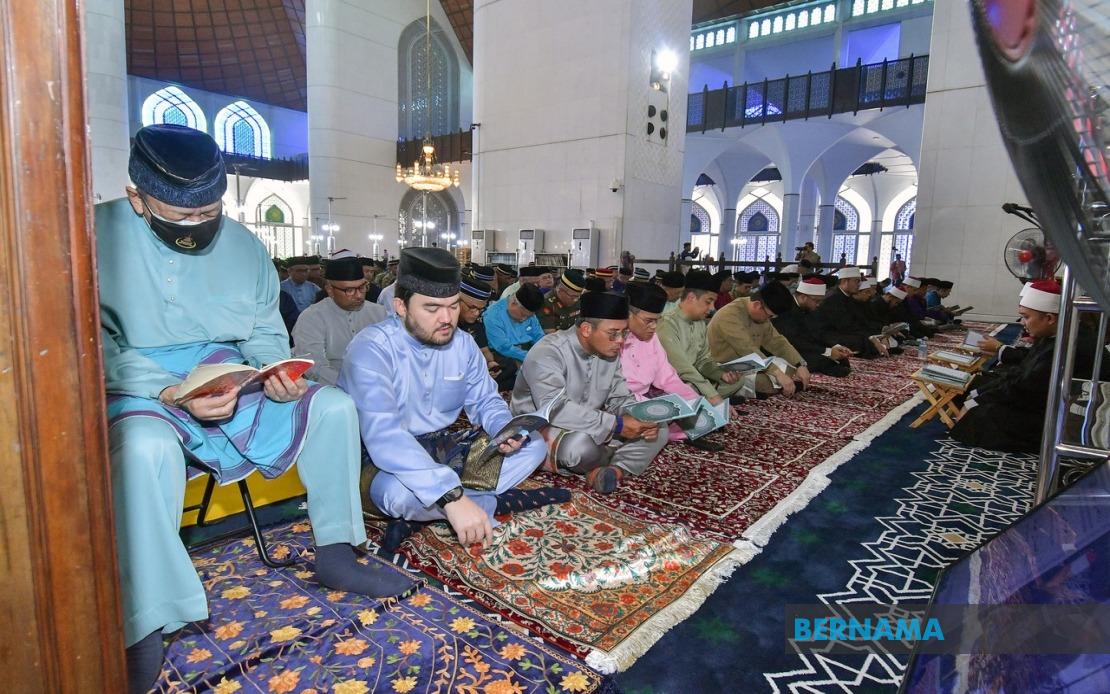
The Sultan of Selangor, Sultan Sharafuddin Idris Shah, participated in religious observances on Thursday morning at one of the state's premier mosques, underscoring the monarchy's role in bridging ceremonial and spiritual dimensions of public life ahead of Malaysia's 67th National Day. Accompanied by Raja Muda of Selangor Tengku Amir Shah Sultan Sharafuddin Idris Shah, the Sultan attended a Surah Yassin recitation at Masjid Sultan Salahuddin Abdul Aziz Shah in Shah Alam, reflecting the continued tradition of state leadership engaging in communal Islamic practices during the lead-up to major national observances.
The gathering brought together around 1,000 worshippers, a significant proportion of whom were drawn from the security forces stationed across Selangor. This composition highlights the deliberate inclusion of uniformed personnel in the state's religious and civic activities, reinforcing the message that national observance transcends sectarian or departmental boundaries. The participation of security services in such events carries particular symbolic weight in Malaysia's context, where the armed forces and police have historically served as custodians of national unity and constitutional monarchy.
Selangor Menteri Besar Datuk Seri Amirudin Shari and State Islamic Affairs and Innovation Culture Committee chairman Dr Mohammad Fahmi Ngah received the Sultan upon arrival, demonstrating the coordinated participation of the state's executive and religious administration. This formal reception protocol underscores the ceremonial dimensions of such occasions, where the visible presence of senior officials signals governmental sanction and institutional backing for the religious gathering. The attendance of Selangor Islamic Religious Department director Datuk Mohd Shahzihan Ahmad and Selangor Islamic Religious Council chairman Datuk Salehuddin Saidin further illustrated the comprehensive mobilisation of state Islamic structures to facilitate the event.
Following the Surah Yassin recitation, Sultan Sharafuddin performed Friday prayers and heard a sermon titled "Merdeka Daripada Belenggu Kerakusan" (Freedom from the Shackles of Greed), delivered by mosque Grand Imam Muhammad Farhan Wijaya. The sermon's thematic focus on liberation from material excess carried implicit resonance with Malaysia's ongoing discourse on ethical governance and societal values. The deployment of such messaging during pre-Merdeka observances reflects efforts by religious authorities to infuse nationalist celebration with moral and spiritual dimensions, positioning National Day not merely as a commemoration of political independence but as an opportunity for collective reflection on principles of restraint and social responsibility.
The religious programme functioned as a curtain-raiser for Selangor's state-level National Day celebrations, scheduled for August 30 at Kajang Stadium. The temporal proximity between these events—separating the spiritual preparation from the public festivities by approximately 36 hours—suggests a calculated sequencing designed to frame national celebration within a framework of religious observance and moral introspection. This approach aligns with broader regional trends in Malaysia, where Islamic institutions have become increasingly integrated into the ceremonial apparatus of statehood and nationalist commemoration.
The theme adopted for Selangor's celebrations, "Malaysia MADANI: Kesejahteraan Dinikmati" (Malaysia MADANI: Shared Prosperity), mirrors the national theme and emphasises prosperity as a collective good rather than an individualistic pursuit. This messaging carries particular relevance for a state like Selangor, which encompasses both densely urbanised metropolitan areas and more rural constituencies, and where economic disparities remain a salient political concern. The emphasis on shared welfare and the earlier sermon's critique of avarice suggest a deliberate effort to pitch National Day celebrations as opportunities for stakeholder reflection on inclusivity and equitable development.
The inclusion of approximately 1,000 worshippers, particularly the deliberate representation of security services, reflects the Malaysian state's consistent approach to nationalism as a fundamentally inclusive project requiring participation across institutional and sectoral lines. Security personnel attending such events embody the state apparatus itself, effectively transforming religious observance into an expression of institutional commitment to national values. This practice, while ostensibly administrative, carries profound symbolic implications for how the state conceives of national unity and the channels through which it mobilises public sentiment.
Selangor's positioning as Malaysia's economically most significant state lends particular weight to its National Day observances and pre-celebration activities. Home to the federal territories of Kuala Lumpur and Labuan, and serving as the industrial and commercial heartland of the Klang Valley conurbation, Selangor's celebration patterns often establish broader templates for national practice. The integration of Islamic religious observance into the ceremonial countdown to National Day reflects the state's—and by extension, the nation's—ongoing negotiation of religious identity within the framework of multiethnic nationalism and constitutional monarchy.
The participation of the Raja Muda alongside the Sultan represents a continuity of institutional succession and signals to the public that both generations of the monarchy remain actively engaged in the ceremonial and spiritual life of the state. Such multi-generational involvement in official functions serves educational and normalising purposes, embedding constitutional monarchy and religious observance within frameworks of continuity and institutional stability. For Malaysian audiences accustomed to viewing the monarchy as the custodian of Islam and symbol of national identity, such participatory events validate and reinforce these institutional roles.
The scheduled timing of the Kajang Stadium celebrations at 8 pm on August 30 suggests an evening programme potentially incorporating fireworks, cultural performances, and ceremonial components. The choice of venue—a major sports stadium capable of accommodating large crowds—indicates an expectation of substantial public attendance and reflects post-pandemic confidence in mass gathering capabilities. The evening timing, rather than a daytime slot, aligns with contemporary Malaysian practice of scheduling major public events during cooler hours and may also permit more elaborate lighting and visual effects to accompany the celebrations.
For Southeast Asian observers, Selangor's approach to National Day preparation illustrates the broader regional pattern whereby Islamic institutions have become increasingly embedded within nationalist ceremonial frameworks, particularly in Muslim-majority states. This integration, while generally consensual and officially sponsored, reflects ongoing processes of state consolidation and the deployment of religious institutional authority in service of nation-building objectives. The emphasis on moral reflection alongside celebratory nationalism suggests an attempt to give depth and substance to abstract notions of national unity and prosperity, grounding these concepts in religious and ethical language accessible to diverse population segments.

