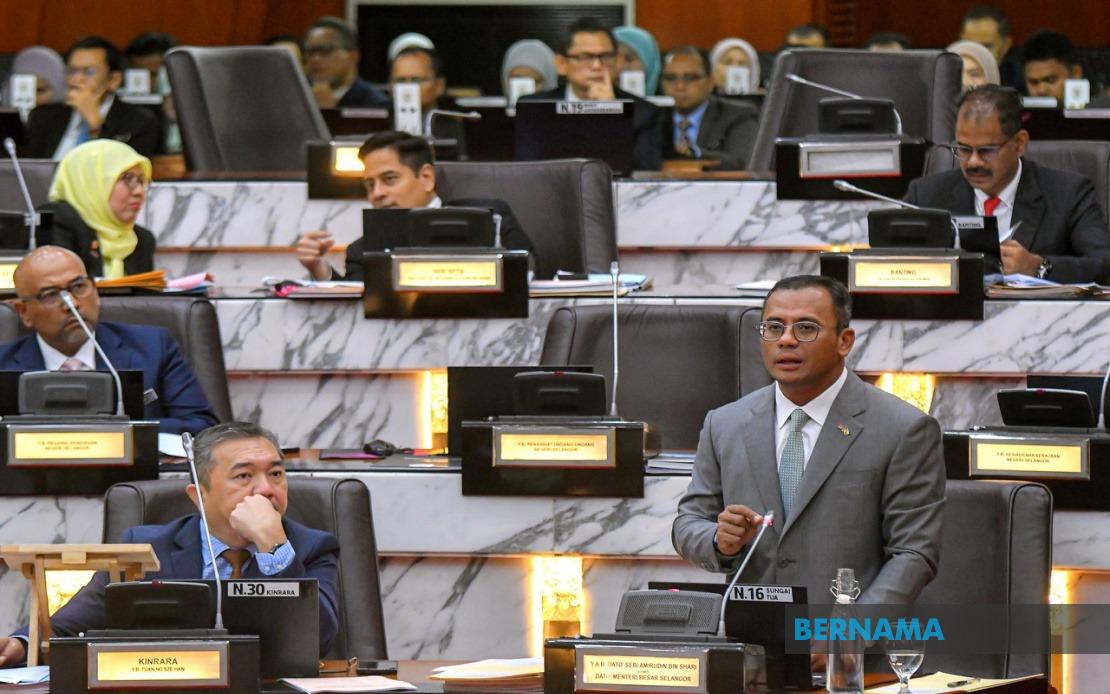
The Selangor government is moving to significantly expand its financial assistance for higher education students, with Menteri Besar Datuk Seri Amirudin Shari announcing plans to increase the number of Higher Education Institution Study Incentive (HPIPT) recipients to 5,000 in the 2027 Budget. This represents a substantial jump from the current 3,000 recipients, reflecting growing pressure on state coffers to support more students pursuing tertiary qualifications across recognised public and private institutions.
Amirudin's announcement came during a State Legislative Assembly sitting in response to a question from Datuk Noorazley Yahya of Bukit Melawati, who raised concerns about capacity constraints limiting access to the programme. The Menteri Besar acknowledged that demand far outstrips current availability, with applications exceeding 5,000 in both 2025 and the current year. This persistent surge signals that the RM1,000 annual incentive remains an attractive lifeline for Selangor families managing the mounting costs of higher education.
The state government is currently evaluating its fiscal position to determine whether expansion can stretch even further, with officials assessing the feasibility of accommodating between 5,000 and 6,000 recipients once the 2027 budget is finalised. Amirudin emphasised that while the state previously supported 5,000 beneficiaries, budgetary constraints had forced a reduction to 3,000. The pendulum appears to be swinging back as Selangor's revenue base permits renewed generosity towards a demographic that faces escalating university fees and living expenses.
Beyond simply increasing recipient numbers, the state government is undertaking a comprehensive review of the programme's operational framework. A key concern is the application window itself, which currently may not provide adequate time for students to submit their applications after receiving formal admission confirmations from institutions. This administrative lag can disadvantage deserving candidates whose admission letters arrive close to application deadlines, effectively shutting out otherwise eligible students through procedural timing rather than merit or need.
To address this bottleneck, Selangor officials are exploring a more flexible application schedule that could potentially open the HPIPT process twice annually. This reform would accommodate students entering higher education at different points throughout the academic year and allow those who miss initial deadlines a second opportunity to apply. For students enrolling in second semester programmes or through alternative pathways, such flexibility could prove transformative in accessing state support that might otherwise remain inaccessible.
The HPIPT itself is a modest but meaningful assistance package, providing RM1,000 to eligible Selangor students enrolled in recognised higher education institutions. The scheme caters to students across multiple qualification levels, including those pursuing Level 4 Skills Certificates, diplomas, and bachelor's degrees. This breadth reflects recognition that tertiary education encompasses diverse pathways beyond traditional university degrees, with vocational and skills-based qualifications increasingly important in Malaysia's evolving labour market.
For Malaysian policymakers and families, the Selangor initiative carries significant implications. Rising tertiary education costs remain a barrier to social mobility across Southeast Asia, with tuition fees, accommodation, and living expenses forcing many capable students to abandon or defer their studies. Financial incentives, though modest in absolute terms, can tip the balance for borderline cases and signal state commitment to human capital development. Selangor's expansion demonstrates recognition that education investment yields longer-term economic returns through a more skilled workforce.
The political context matters too. Amirudin's responsiveness to backbench concerns and willingness to revisit budget allocations suggests a government attuned to ground-level pressures facing constituents. By committing to restoration of previous recipient levels once fiscal conditions permit, he frames the expansion not as new largesse but as fulfilling prior commitments deferred by temporary constraints. This narrative positioning allows the government to claim consistency whilst acknowledging past limitations.
Sector observers will watch closely whether the promised expansion materialises in the 2027 Budget and whether procedural reforms to application timings proceed as mooted. Bureaucratic implementation can often lag political commitments, and students depending on these grants deserve certainty rather than aspirational announcements. The twice-yearly application window, in particular, requires careful coordination between state education officials and institutional admissions teams to function seamlessly.
The broader policy question facing Selangor and other Malaysian states involves whether targeted financial assistance should be means-tested or merit-based, and how programme scope should expand given limited budgets. As applications consistently exceed capacity by roughly 70 percent, the state faces genuine demand that cannot be entirely satisfied regardless of funding levels. Prioritisation criteria become critical: should support flow to the neediest students, highest achievers, or a balance thereof? Transparent eligibility frameworks would strengthen programme credibility.
Regionally, Selangor's experience echoes challenges across Southeast Asia where education financing strains public budgets even as tertiary enrolment expands. Malaysia's relatively developed higher education sector still grapples with affordability questions that persist even in middle-income contexts. State-level interventions like HPIPT expansion, whilst politically popular, operate within structural constraints that individual state governments cannot unilaterally resolve without federal support or reformed funding mechanisms.
For students and families in Selangor, the announcement offers genuine hope that access to state assistance will improve. The RM1,000 incentive, whilst not transformative alone, can offset portions of living costs or provide psychological reassurance that the state recognises their ambitions. Coupled with complementary federal schemes and institutional scholarships, such layered support can prove decisive in enabling talented youth to realise educational aspirations that poverty alone might otherwise constrain. The Menteri Besar's commitment to programme expansion thus reflects not merely fiscal adjustment but acknowledgment that education equity remains central to good governance.

