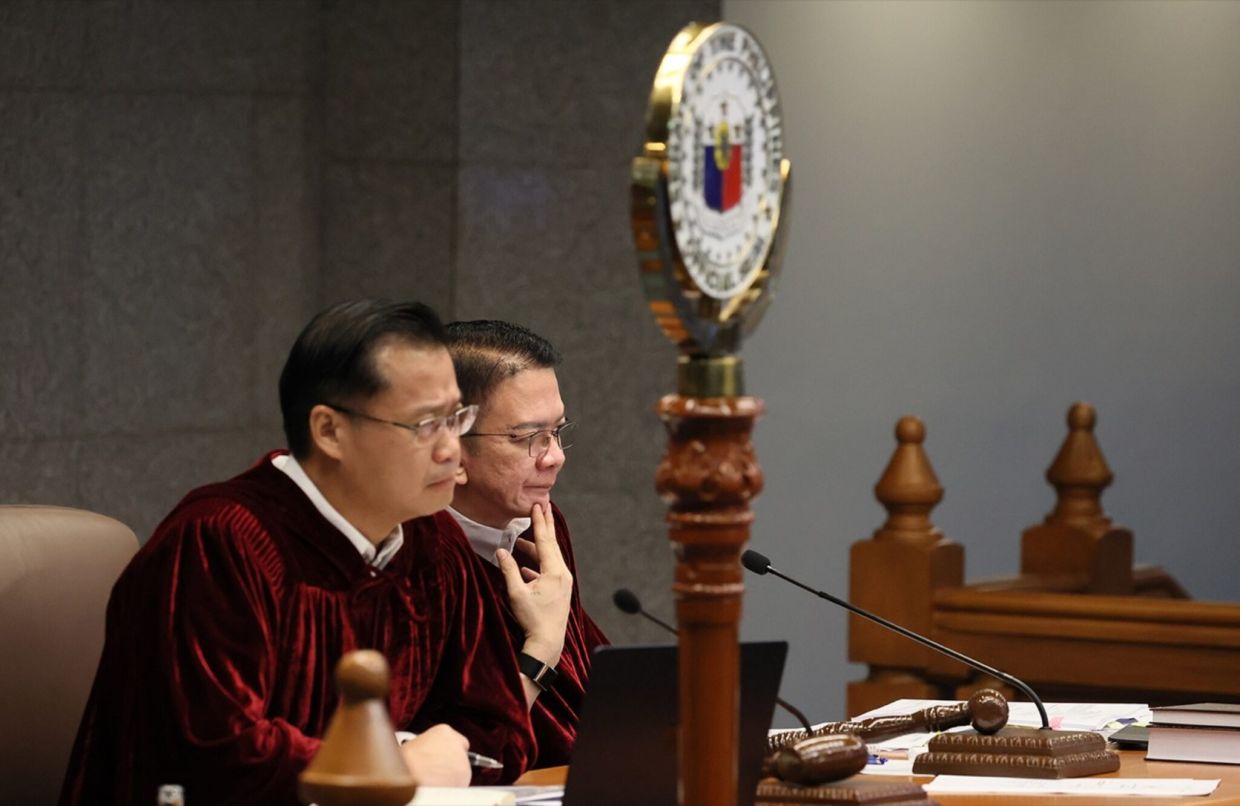
The impeachment trial of Philippine Vice President Sara Duterte has reached a critical juncture, with the Senate scheduled to vote on Monday afternoon on whether prosecutors may access her financial documents—a ruling that could substantially shape the direction of proceedings now in their seventh day. House prosecutors have signalled confidence that the court will grant their request to subpoena Duterte's bank accounts, tax records, and documents from the Anti-Money Laundering Council, alongside similar records belonging to her husband, lawyer Manases Carpio. Prosecutors contend these papers are indispensable to establishing whether Duterte accumulated wealth disproportionate to her legitimate income, one of the core allegations underpinning Article II of the impeachment articles.
The prosecution's legal foundation rests on established precedent and statutory language that explicitly exempts impeachment proceedings from the nation's bank secrecy protections. Benjamin Tolosa Jr., the House prosecution spokesperson, invoked Republic Act No. 1405, the bank secrecy law, which prosecutors argue creates a clear exception when an impeachment court requires disclosure. They further referenced the 2012 impeachment trial of former Chief Justice Renato Corona, when the Senate successfully compelled the production of bank records despite confidentiality concerns, demonstrating that financial privacy can yield to the demands of constitutional accountability.
Prosecutor Chel Diokno has argued extensively that the Senate, functioning as an impeachment court, derives authority directly from the Philippine Constitution to compel disclosure of confidential financial materials. Diokno presented evidence that Duterte's financial activity exceeded 3 billion Philippine pesos between 2007 and 2013—a figure drawn from Anti-Money Laundering Council reports submitted to the House—and contended that records spanning her tenure as Davao City vice mayor and mayor are relevant because the impeachment complaint alleges she accumulated unexplained wealth throughout her service as a public official. Beyond the bank secrecy exception, prosecutors have pointed to provisions in the Data Privacy Act permitting disclosure under valid subpoena authority, constructing a multi-layered legal argument for why financial transparency should prevail.
The defense team, led by counsel Michael Poa, has mounted a vigorous constitutional challenge, arguing that the prosecution's request amounts to an impermissible fishing expedition divorced from the proper scope of impeachment proceedings. Poa contends that while the Senate possesses subpoena authority, deploying it to access nearly two decades of financial records—including periods when Duterte served as Davao vice mayor, a position he argues falls outside impeachable offices—violates due process protections and statutory privacy safeguards. The defense has invoked a 2025 Supreme Court ruling in Duterte v. House of Representatives holding that impeachable offenses must have been committed while the accused occupied an impeachable office, positioning this principle as a constraint on the temporal scope of financial discovery.
Crucially, the defense has noted that while the bank secrecy law recognises impeachment as an exception, disclosure does not occur automatically and must still satisfy fundamental fairness requirements. Poa further argued that the Anti-Money Laundering Act and the National Internal Revenue Code contain no express impeachment exception for AMLC reports and tax records, distinguishing these categories from bank account information governed by Republic Act No. 1405. The defense also objected to the inclusion of Manases Carpio's records on the grounds that as a private citizen and non-impeachable official, his financial privacy warrants protection absent direct evidence of his involvement in misconduct.
Civil society organisations have weighed in heavily on the prosecution's side, warning senator-judges against repeating what they characterise as a pivotal misstep in Philippine constitutional history. The August Twenty-One Movement recalled the controversial "second envelope" vote during the 2001 impeachment trial of former President Joseph Estrada, when the Senate voted to withhold key evidence, a decision that ultimately precipitated public outrage and hastened Estrada's downfall. The group has urged senator-judges to approve the subpoena, arguing that if Duterte is genuinely innocent of accumulating ill-gotten wealth, transparency would vindicate her rather than expose wrongdoing.
The Faith-based coalition Kingdom Keepers, led by activist priest Fr. Robert Reyes and social anthropologist Dr Melba Padilla Maggay, has similarly pressed the Senate to compel production of Duterte's bank, tax, and AMLC records on accountability grounds. The group framed public officials' financial disclosures as a constitutional obligation, contending that Duterte cannot legitimately invoke privacy and confidentiality protections to shield information directly bearing on whether she used her office to accumulate illicit wealth. Their rhetorical challenge—if Duterte harbours no unlawful financial activity, why would transparency threaten her—reflects a broader democratic principle that the burden of proof regarding official integrity rests upon those wielding state power.
The impeachment proceedings themselves involve four articles charging Duterte with misusing confidential funds, accumulating unexplained wealth, and threatening President Ferdinand Marcos, First Lady Liza Araneta-Marcos, and former House Speaker Martin Romualdez. Conviction on any article would result in removal from office and permanent disqualification from holding future public positions—sanctions of extraordinary constitutional consequence. This backdrop explains why the financial records vote, though ostensibly procedural, carries such significance; the availability and content of these documents could prove determinative in establishing the factual predicate for the wealth-related charges.
For Malaysian readers and broader Southeast Asian observers, the Duterte impeachment reflects recurring tensions in presidential democracies regarding the intersection of executive accountability, financial privacy, and constitutional oversight mechanisms. The proceedings illuminate how different jurisdictions balance transparency demands against confidentiality protections, and the extent to which impeachment proceedings override ordinary legal safeguards. The precedent established by the Senate's decision—whatever direction it takes—will likely reverberate through Philippine constitutional practice and may influence how other democracies in the region approach similar questions of official accountability when financial misconduct allegations arise.
The prosecution has also indicated that National Bureau of Investigation Director Melvin Matibag is scheduled to testify on Tuesday regarding the agency's investigation into Duterte's alleged threats against President Marcos and his family. According to prosecutors, Matibag's testimony will present findings that the remarks in question were not spontaneous outbursts but formed part of a coordinated plan, directly addressing one of the four impeachment articles. This sequential presentation of evidence—potentially culminating in the financial records vote on Monday and continuing with testimony on threats the following day—demonstrates the prosecution's strategy of building layered proof across multiple allegations rather than resting its case on any single evidentiary pillar, as Tolosa emphasised in his public statements.

