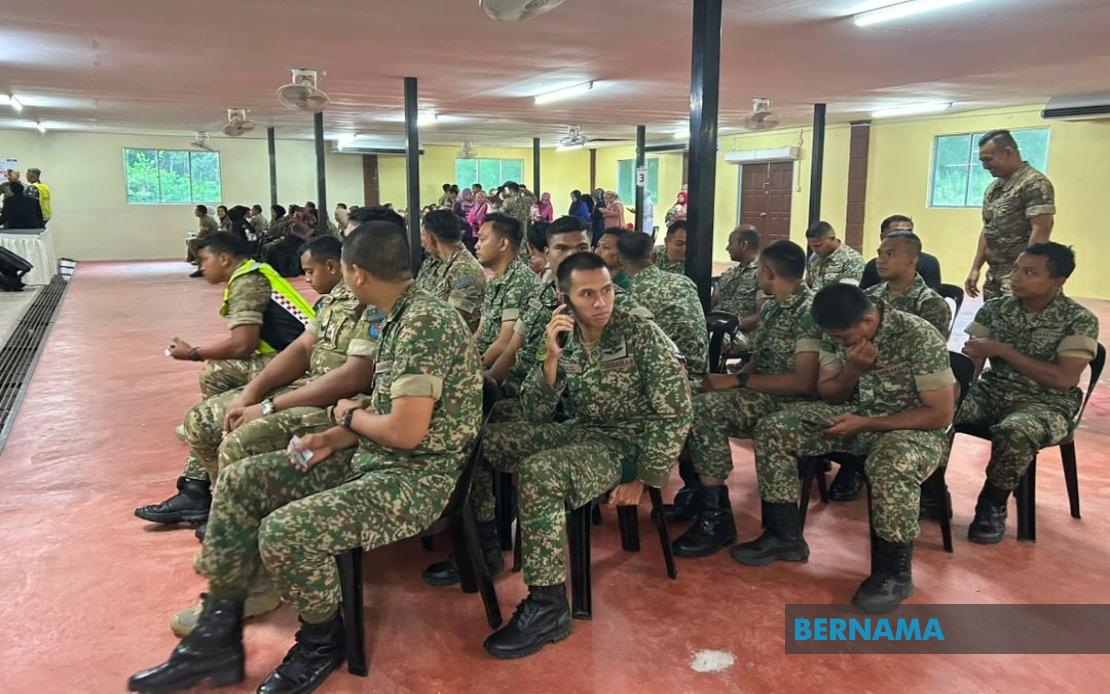
Malaysia's Home Minister Datuk Seri Saifuddin Nasution Ismail and Defence Minister Datuk Seri Mohamed Khaled Nordin have jointly called upon early voters participating in the 16th Johor State Election to approach the ballot with a strong sense of civic responsibility and respect for democratic principles. The appeal came as security personnel—including armed forces members, police officers, and their spouses—cast their votes ahead of Saturday's general polling day, underscoring the particular emphasis placed on ensuring orderly participation from uniformed services.
Across 64 polling centres that opened at 8 am, a total of 24,751 eligible early voters were processing through the voting system, reflecting the logistical accommodation made for personnel unable to vote on the main election day. The breakdown reveals 12,041 voters from the Malaysian Armed Forces and their families, alongside 12,710 police personnel and their dependents. This bifurcated structure acknowledges the operational demands on security services during high-profile electoral exercises and demonstrates the administrative flexibility embedded in Malaysia's electoral framework to ensure maximum participation across all demographics.
Saifuddin Nasution, who additionally serves as secretary-general of the Pakatan Harapan coalition, articulated his message through social media platforms, emphasising that voters should exercise their franchise with full responsibility while embodying the spirit of democratic participation. His dual role as both a senior minister and senior opposition figure illustrates the cross-partisan nature of appeals around electoral integrity—a consistent messaging thread that transcends factional divides during polling periods. The minister's specific invocation of democratic principles reflects broader efforts to frame electoral participation not merely as a mechanical administrative exercise but as a substantive engagement with fundamental civic institutions.
Defence Minister Mohamed Khaled extended the appeal by connecting electoral participation to broader state interests, urging early voters to fulfil their responsibilities in order that Johor might sustain its trajectory of progress and development. This framing links individual voting decisions to collective state outcomes, positioning electoral engagement as intrinsically connected to governance performance and public welfare. The Defence Ministry's particular prominence in early voting oversight reflects both the constitutional role of military institutions in maintaining electoral security and the symbolic importance of demonstrating the armed forces' institutional commitment to democratic processes.
Menteri Besar Datuk Onn Hafiz Ghazi, representing the Barisan Nasional state administration, deployed the early voting moment to consolidate support for his coalition's candidates, appealing to voters to entrust BN representatives with advancing stability, development, and public welfare agendas. His messaging strategy mirrors the opposition's rhetorical approach—translating individual voting acts into endorsements of broader political visions and programmatic commitments. The competitive articulation of these messages by both major coalitions across the same voter population reflects the intensified contest for support in what has become a keenly contested state electoral cycle.
The logistical architecture supporting early voting illuminates Malaysia's approach to inclusive electoral administration. The staggered closure of polling centres between noon and 6 pm, calibrated according to location and voter registration density, demonstrates sophisticated planning to accommodate diverse operational schedules across military and police installations. This temporal flexibility recognises that security personnel operate across dispersed geographical and temporal domains, requiring electoral systems that adapt to institutional realities rather than forcing participation into standardised frameworks. Such administrative considerations often operate invisibly but substantially shape electoral participation patterns, particularly among population segments with institutional constraints on mobility.
The 16th Johor State Election involves competition across all 56 state assembly seats, with 172 candidates fielded by Pakatan Harapan and Barisan Nasional contesting the entirety of available positions. This comprehensive contestation reflects both coalitions' strategic commitment to the state and suggests high stakes in the outcome. Johor's political significance extends beyond its demographic weight; as Malaysia's second-largest state by population and a traditional BN stronghold, any substantial shift in electoral outcomes would carry implications for federal-level political calculations and the trajectory of coalition alignments.
The appeals from government and opposition figures to approach voting with integrity and democratic consciousness occur against a backdrop of global democratic contestation and domestic political polarisation. By explicitly invoking democratic values and personal responsibility, Malaysian political leaders position electoral participation not as a coercive obligation but as an expression of citizenship rooted in voluntary civic engagement. This rhetorical choice reflects broader efforts to sustain democratic legitimacy during periods of competitive electoral struggle, particularly when outcomes remain uncertain and coalitions perceive genuine stakes in participation patterns.
For Malaysian voters generally, the Johor exercise offers a barometer of evolving electoral dynamics and coalition support trajectories. The early voting process involving military and police personnel carries particular symbolic weight, as these institutionalised voting blocs historically demonstrated consistent support patterns that analysts monitor for signs of shifting preferences or organisational cohesion. Any notable deviation from historical voting patterns within these cohorts would generate significant commentary regarding institutional political shifts or changing constituency orientations toward competing political offers.
The invocation of democratic duty from multiple political quarters reflects recognition that electoral legitimacy ultimately depends upon substantive participation grounded in genuine civic engagement rather than mere procedural compliance. By appealing to voters' conscientiousness and democratic commitment, rather than simply facilitating administrative participation, Malaysian political leaders acknowledge that democratic systems derive their normative authority from citizens' meaningful engagement with electoral choices. This emphasis gains particular resonance in competitive electoral environments where legitimacy questions become politically salient and coalition margins potentially narrow.

