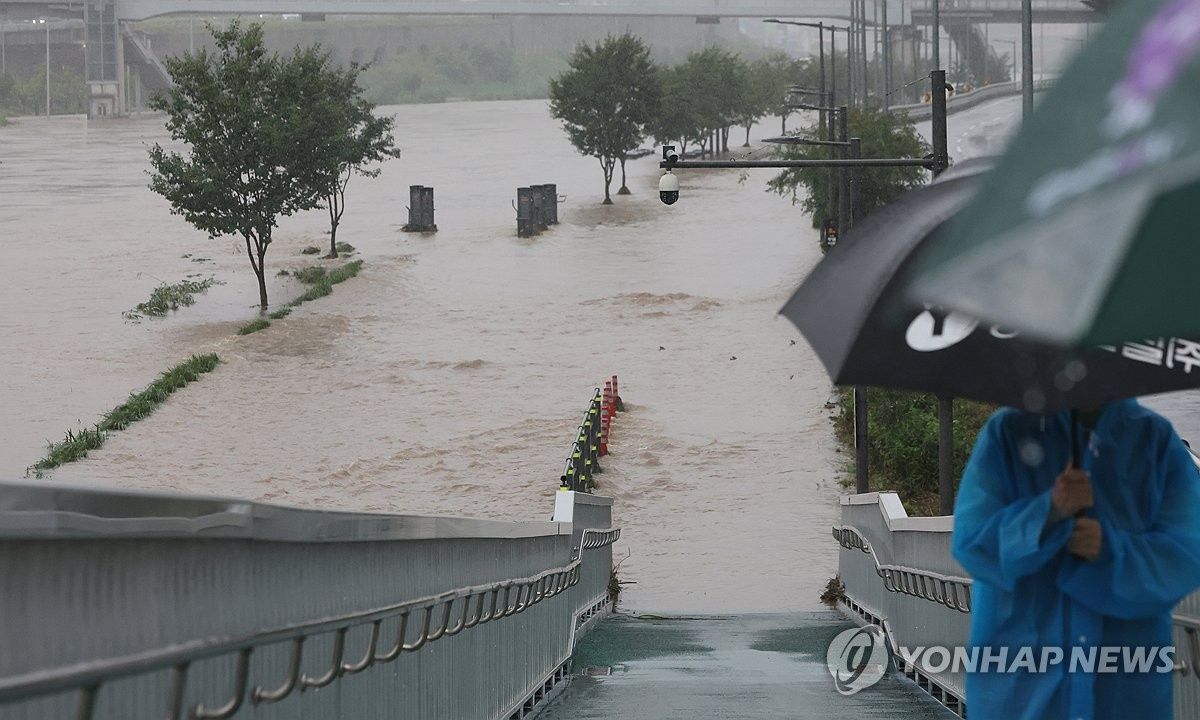
South Korea's Seoul metropolitan region and eastern Gangwon province experienced a severe overnight downpour on Saturday that inundated homes, inundated roadways, and caused widespread property destruction affecting roughly 540 locations, according to officials cited by Yonhap News Agency. The deluge, which struck between midnight and 10 am local time, delivered nearly 200 millimetres of rain across both regions in just ten hours, demonstrating the intensity and concentrated nature of the weather system. Rainfall measurements recorded across key affected areas illustrated the precipitation's uneven distribution: Paju accumulated 192.5 mm, Dongducheon received 189.5 mm, Pocheon gathered 179 mm, Gimpo collected 166.5 mm, and Cheorwon recorded 159.5 mm, with each reading substantially exceeding typical weekend rainfall for the season.
The Central Disaster and Safety Countermeasure Headquarters maintained heightened alerts throughout Saturday morning as conditions remained unstable. By 11 am, heavy rain warnings persisted across ten distinct regions within Gangwon Province, whilst Pocheon—having absorbed significant precipitation—faced particular vulnerability to mudslides, prompting authorities to issue a specific mudslide warning for that locality. The combination of saturated soil conditions from the preceding rainfall and forecast for continued downpours created compounding hazard scenarios that demanded sustained emergency preparedness across both the Seoul metropolitan zone and surrounding provinces.
Damage assessments revealed the breadth of the precipitation event's impact on civilian infrastructure and property. Authorities documented 148 separate reports of flooded residential structures and inundated roadways, whilst an additional 392 cases involved uprooted trees and accumulated debris scattered across affected communities. Despite the scale of material damage, emergency response protocols proved effective in preventing loss of life. Ninety-five individuals representing 44 separate households across six cities were relocated temporarily as a precautionary measure, though this evacuation reflected prudent disaster management rather than immediate peril. The absence of fatalities, whilst fortunate, underscored the effectiveness of South Korea's established emergency warning and evacuation infrastructure, which has evolved substantially following previous severe weather events.
Recreational and transportation infrastructure sustained considerable disruption as authorities prioritized public safety. Access restrictions affected ten national parks entirely, including the heavily visited Mount Bukhan, alongside 275 designated hiking paths across the region. These closures eliminated outdoor recreation opportunities during what would typically be a weekend period of significant tourist and leisure activity. Simultaneously, maritime transport networks experienced significant disruption, with authorities suspending seven ferry routes operating along South Korea's western coastal waters. Such comprehensive service suspensions reflected the heightened risks posed by deteriorating weather conditions over both terrestrial and marine environments.
Weather forecasting models indicated that the deluge represented merely the initial phase of a broader atmospheric disturbance. Meteorologists anticipated heavy rainfall would persist throughout Sunday, with some zones potentially experiencing precipitation intensity reaching 300 mm per hour—a rate that could overwhelm drainage infrastructure and create dangerous flash flood scenarios. This extended forecast window necessitated sustained alertness from emergency management agencies and preparation for potential secondary impacts including additional flooding, landslide incidents, and infrastructure strain across multiple provinces.
Government leadership mobilized in response to the unfolding crisis. Prime Minister Han Seong-sook convened an emergency response meeting during which she issued directives for authorities to rapidly deploy equipment and personnel to affected communities. Her remarks acknowledged both the fortunate absence of immediate casualties and the tangible suffering experienced by residents confronting flooded residences, compromised roadways, and substantial material losses. The prime minister's expressed condolences recognised the psychological and financial toll exacted upon households grappling with property damage whilst simultaneously emphasising governmental commitment to mitigation efforts.
Prime Minister Han specifically highlighted the elevated vulnerability of Chungcheong Province in the country's central region and Gangwon Province in the northeast, both facing heavy precipitation forecasts during late Saturday and early Sunday hours. Her directive instructed emergency officials to implement heightened vigilance regarding potential landslide development within these geographic zones, recognising that consecutive rainfall events could destabilize slopes previously saturated from the overnight deluge. This forward-looking disaster management approach reflected lessons absorbed from previous years' severe weather episodes that had demonstrated the compounding dangers of sustained precipitation across terrain susceptible to mass movement.
For Malaysian and broader Southeast Asian observers, the South Korean experience illuminates how even developed nations with advanced weather monitoring and emergency infrastructure confront significant challenges when extraordinary precipitation events occur. The overnight flooding in Seoul and Gangwon demonstrates that rainfall exceeding 190 mm within a twelve-hour window generates consequences regardless of national development status or technological sophistication. Malaysia's own monsoon seasons routinely produce comparable or greater precipitation volumes across various regions, suggesting that South Korean authorities' emergency protocols and civilian evacuation procedures may offer relevant insights for Malaysian emergency management agencies.
The episode also underscores how climate variability increasingly produces weather events that challenge existing infrastructure design standards. Precipitation intensities reaching 300 mm per hour represent genuinely extreme meteorological phenomena that can overwhelm drainage systems engineered according to historical rainfall patterns. As both East Asia and Southeast Asia experience increasingly erratic weather patterns potentially linked to broader climatic shifts, the question emerges whether existing flood management infrastructure across the region requires recalibration based on updated precipitation datasets and more aggressive intensity scenarios. South Korea's response to this particular event, including park closures and ferry suspensions, reflects a precautionary approach that prioritizes prevention of casualties even when statistical probability of damage remains uncertain.

