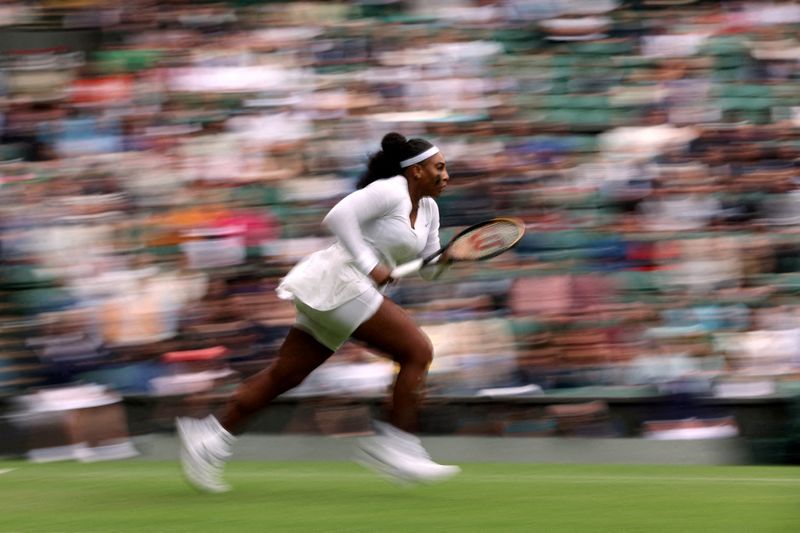
Serena Williams will stride back into the spotlight at Wimbledon next week, nearly a decade after claiming her seventh title at the All England Club. The American legend's comeback, announced via wildcard selection, fundamentally reshapes the narrative of an already fractious women's tournament, adding a compelling emotional and competitive dimension to what had promised to be a wide-open championship.
The world's top-ranked player, Aryna Sabalenka, enters as favourite but carries troubling vulnerabilities. The Belarusian powerhouse crashed from Roland Garros quarter-finals in dramatic fashion, surrendering the final 10 games of her match against Angelique Kerber. Her Wimbledon preparation proved equally concerning when she surrendered a deciding set 6-0 to Jessica Pegula in Berlin, exposing the mental fragility that periodically undermines her otherwise formidable game. Sabalenka's emotional intensity, whilst a source of fierce competitive energy, becomes a liability on grass where consistency and composure prove paramount.
Poland's Iga Swiatek pursues an unlikely achievement: becoming the first player since Williams herself in 2016 to capture back-to-back Wimbledon crowns. This bid assumes particular significance given the modern era's remarkable parity at the sport's highest level. In the decade since Williams' seventh title, eight different champions have claimed Wimbledon, a striking statistic that underscores how power has dispersed across the women's game. No single player has dominated as comprehensively as Williams once did, making the tournament genuinely unpredictable.
The field boasts several compelling challengers with genuine credentials. Mirra Andreeva, the Russian teenager who recently became the youngest French Open champion in 34 years at just 19 years old, arrives brimming with audacious talent and the fearlessness characteristic of youth. Her aggressive baseline game represents the modern template, yet grass demands different technical and tactical approaches. American Coco Gauff continues her intermittent quest to solve the grasscourt puzzle that has eluded her throughout her career, despite success on other surfaces. Elena Rybakina, who captured the 2022 title, possesses a deceptively simple yet brutally effective power game that can overwhelm opponents when functioning optimally. British hope Emma Raducanu carries the weight of home expectations, seeking to become the first British woman to claim a Wimbledon singles title since 1977—a drought spanning nearly five decades.
Yet Williams' presence overshadows all other storylines entirely. The 44-year-old legend and 23-time Grand Slam singles champion returns after a four-year absence from competitive singles play, her last professional match occurring at the 2022 U.S. Open. Having secured the eighth and final wildcard from Wimbledon organisers, she will step onto Centre Court as an undisputed drawing force, guaranteed to elevate television ratings and dominate social media discourse. Her comeback was hardly secret—Williams rejoined the anti-doping testing pool last December and reportedly shed around 20 pounds through weight-loss medication whilst training intensively with coach Rennae Stubbs.
Recent displays suggest competitive readiness despite the four-year hiatus. During her doubles return alongside Victoria Mboko at Queen's Club, Williams demonstrated that her legendary 120mph serve—among the most destructive weapons in women's tennis history—remains formidable. Her baseline power appeared undiminished, suggesting physical conditioning has achieved reasonable standards. Singles competition presents an entirely different proposition, however, requiring sustained concentration, tactical flexibility, and the precise court positioning that grass demands. Nonetheless, establishment figures believe her realistic objective involves simply competing effectively. She would become the oldest woman to win a singles match at Wimbledon since Martina Navratilova, aged 47, managed the feat in 2004.
Former world number one Andy Roddick articulated the extraordinary confidence Williams displays by selecting Wimbledon as her singles comeback venue after years away. Rather than scheduling seven warm-up tournaments, she committed directly to grass at sport's most prestigious lawn competition. This audacity reflects unshakeable self-belief that Roddick described as surpassing anything he experienced during his entire professional career. Fellow American Grand Slam champion Lindsay Davenport noted that Williams would only return if convinced she could deliver immediate impact. Speaking to the BBC, Davenport acknowledged that grass represents particularly unforgiving terrain—the ball travels quickly, bounces low, and demands extraordinary physical commitment—yet suggested that if anyone possessed the capability for success, it would be Williams.
The potential matchup between Williams and Sabalenka presents a strategic paradox for the world number one. Should Sabalenka face Williams early, any victory provides minimal advantage given the challenger's four-year absence from singles competition. Conversely, losing to a comeback player lacks political appeal, delivering no positive narrative regardless of circumstances. Sabalenka confronts a situation where victory carries no meaningful upside, a psychological burden that could undermine her composure on a surface where emotional control proves essential.
The broader context involves transformation of women's professional tennis into a genuinely competitive ecosystem lacking any single dominant force. Since Williams captured her seventh Wimbledon crown in 2016, players including Naomi Osaka, Sabalenka, Swiatek, Gauff, Rybakina, and Ash Barty have accumulated multiple Grand Slam titles, yet none has established the systematic dominance that defined Williams' career. The last six Grand Slam tournaments produced six different champions, an extraordinary statistic reflecting both depth and volatility throughout the women's field.
For Malaysian and Southeast Asian audiences, Williams' return offers profound significance beyond sporting entertainment. Her comeback challenges contemporary assumptions about athletic aging and female achievement, demonstrating that excellence need not follow conventional progression curves. Younger players like Andreeva and the established contenders face not merely another competitor but an iconic figure whose legacy fundamentally shaped modern women's tennis. The tournament thus becomes not simply about determining a champion but about testing whether a legend can reclaim relevance in a sport that has evolved substantially during her absence.

