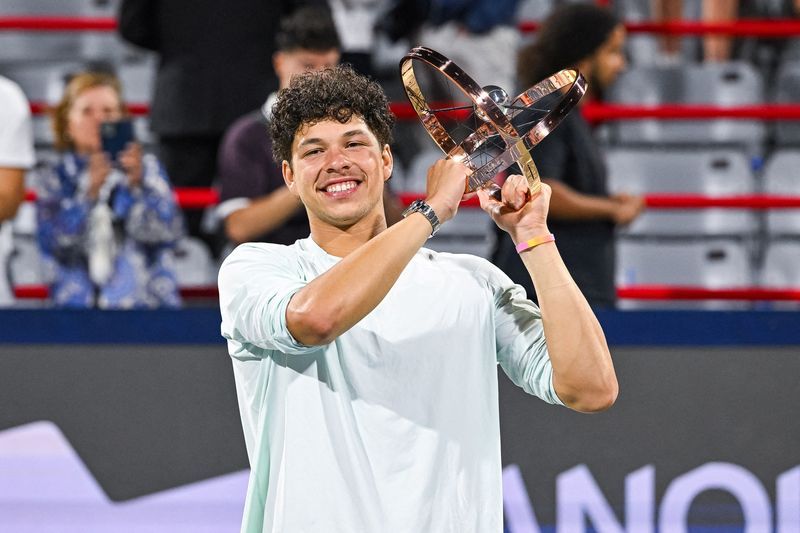
Ben Shelton arrives at the US Open determined to transform a frustratingly inconsistent season into a breakthrough performance at one of tennis's most prestigious stages. The world number nine's campaign has resembled a volatile stock market, fluctuating wildly between triumph and disappointment as he navigates the demanding international circuit. Yet his dominant performance at the Canadian Open, where he successfully defended his title without dropping a single set, has rekindled optimism that the 23-year-old American possesses the mental fortitude and technical prowess required to compete at the sport's highest level when it matters most.
The volatility of Shelton's 2024 season reflects the unpredictability that often defines a young athlete's development. While he captured four titles across various tournaments, his Grand Slam record tells a more sobering story. A quarter-final appearance at the Australian Open suggested genuine promise in early 2024, yet subsequent performances deteriorated markedly. His campaign at Roland Garros ended prematurely in the second round, while Wimbledon proved even more humbling, with an opening-round exit that underscored significant gaps between his performances on hard courts and grass. These setbacks would ordinarily derail confidence, but Shelton's Canadian breakthrough demonstrates his capacity for rapid recalibration.
Following his victory over Brandon Nakashima in Montreal, Shelton articulated a notably self-aware assessment of his game, identifying concrete improvements that extended beyond mere platitudes. He emphasised his enhanced "clinical" approach and sharpened focus, coupled with a dramatically elevated return-of-serve game that occasionally reached elite levels. His observations about his serve-breaking capabilities and defensive flexibility suggest genuine technical refinement rather than superficial confidence. Crucially, Shelton recognised that his hard-court performance trajectory showed consistent month-on-month improvement, providing a logical foundation for optimism heading into the US Open's hard-court environment where his game naturally flourishes.
The psychological dimensions of Shelton's challenge carry particular significance for the American tennis establishment. No American man has claimed the US Open singles championship since Andy Roddick's 2003 triumph over Juan Carlos Ferrero, marking a two-decade drought for the nation at one of sport's most prestigious tournaments. This historical context transforms Shelton's campaign from an individual athletic endeavour into a national narrative, with expectations and media scrutiny invariably intensifying alongside genuine competitive ambition. The younger generation of American males has struggled to consistently produce world-class challengers at Grand Slams, making Shelton's emergence as a serious contender particularly noteworthy.
Former US Open champion Roddick, speaking on his "Served with Andy Roddick" podcast ahead of the tournament, offered cautious yet substantive endorsement of Shelton's title prospects. Roddick's assessment carries particular weight given his intimate familiarity with the pressures and technical demands of chasing major championships. He acknowledged that Shelton represents a genuine contender, though his conditional framing—noting the importance of top rivals failing to perform optimally—reflects tennis's competitive reality. Prior to Jannik Sinner's withdrawal from the tournament, Roddick observed that Shelton could realistically challenge if the Italian world number one and Spain's Carlos Alcaraz fell short of their customary standards. This pragmatic evaluation neither inflates expectations nor dismisses Shelton's legitimate capabilities.
Shelton's 2023 semi-final run at the US Open established a tangible reference point for current ambitions. That campaign demonstrated his capacity to sustain excellence across multiple matches under significant pressure, suggesting his current trajectory represents genuine progression rather than random fluctuation. The hard-court surface at Flushing Meadows has traditionally suited aggressive baseline players who combine powerful striking with returning acuity—precisely the skillset Shelton has recently highlighted as improving substantially. His technical attributes align naturally with successful US Open tennis, creating a favourable alignment between personal capability and environmental factors.
Tennis's unique calendar structure presents both opportunity and challenge for athletes seeking consistent excellence. The sport's extended season spanning nearly the entire calendar year offers perpetual opportunities for redemption and resurgence, yet simultaneously demands extraordinary physical and mental durability. Shelton's philosophical perspective on this reality—characterising it as "a blessing and a curse"—demonstrates mature recognition that individual matches carry disproportionate significance in determining seasonal trajectories. His acknowledgement that one exceptional performance can fundamentally alter perceptions of an entire campaign reflects the sport's high-leverage structure, where Grand Slam victories carry exponentially greater weight than regular tour results.
The convergence of Shelton's improved form, his proven capacity for major-tournament success, and the apparent vulnerability of top-ranked competitors creates a historically significant moment for American tennis. Whether Shelton can transform Canadian success into a Grand Slam breakthrough remains uncertain, yet the conditions appear more favourable than at any point during his previous professional career. His self-awareness regarding technical improvements, combined with the psychological boost from defending a prestigious title, suggests he arrives at Flushing Meadows in substantially different mental space than when he encountered disappointment at Roland Garros and Wimbledon.
For Southeast Asian tennis enthusiasts and observers of global sports dynamics, Shelton's trajectory offers broader insights into generational transitions within tennis hierarchies. The emergence of North American male talent capable of challenging European and international dominance reflects evolving competitive landscapes. Shelton's development also underscores how seemingly dramatic inconsistency during developmental stages can mask genuine progress, with breakthrough performances often arriving suddenly once technical and psychological elements align harmoniously. His Canadian triumph and current momentum heading into the US Open demonstrate that tennis careers rarely follow linear trajectories; instead, volatility often precedes breakthrough success.

