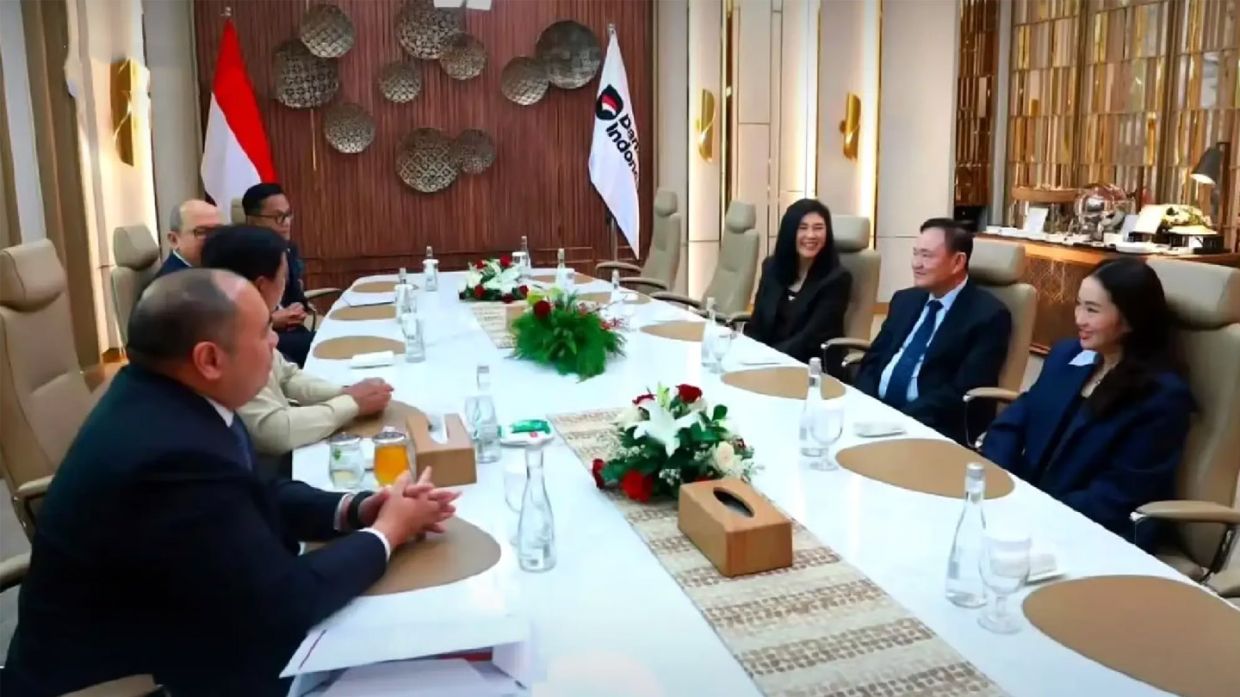
Three members of Thailand's politically influential Shinawatra family travelled to Jakarta this week for high-level discussions with Indonesian President Prabowo Subianto, signalling deepening economic engagement between two of Southeast Asia's largest economies. The July 9 meeting brought together Thaksin Shinawatra, his daughter Yingluck Shinawatra, and his granddaughter Paetongtarn Shinawatra—each of whom has served as Thailand's prime minister—with Prabowo and senior executives at the Danantara investment agency. The gathering underscores Indonesia's strategic approach to fostering ties with influential foreign figures and Thailand's continued economic diplomacy in the region.
Thaksin, who led Thailand from 2001 to 2006, holds an advisory position at Danantara Indonesia, a state-controlled entity tasked with managing and optimising Indonesia's strategic national assets. His involvement in the agency's governance circles has made him a recurring participant in conversations about Indonesia's economic transformation agenda. The presence of Yingluck, who served as prime minister between 2011 and 2014, and Paetongtarn, who currently holds the office after assuming power in 2024, created an unusual convergence of three generations of Thai executive leadership within a single diplomatic encounter.
The substance of the discussions centred on identifying investment opportunities that could benefit both nations while exploring asset management approaches and devising development strategies geared toward sustainable economic growth. Given Indonesia's status as the region's economic heavyweight and Thailand's expertise in certain sectors, such dialogue carries implications for cross-border capital flows and collaborative projects. The Indonesian government framed the meeting as part of its broader initiative to strengthen international partnerships and consolidate its position amid volatile global market conditions and shifting geopolitical dynamics.
Danantara Indonesia occupies a crucial position in Indonesia's economic machinery, functioning as the institutional mechanism through which the government acquires, develops, and monetises state-owned assets to fuel long-term national transformation. The agency's leadership, including group chief executive officer Rosan Roeslani, chief operating officer Dony Oskaria, and chief investment officer Pandu Sjahrir, participated directly in the conversation. This high-level participation reflects Prabowo's government's seriousness about the engagement and the calibre of the Thai delegation.
The meeting at the Danantara building represented the formal component of a broader diplomatic visit. Indonesian Cabinet Secretary Teddy Indra Wijaya confirmed the gathering, and photographs circulated by the Cabinet Secretariat's official social media channels documented the participants together. These images served to publicise the interaction, suggesting that both sides welcomed the transparency and informal atmosphere characterising the encounter.
Thaksin's appointment to Danantara's advisory council positioned him as a conduit between Thai interests and Indonesia's investment priorities. His previous experience managing Thailand's economy, despite the controversial circumstances of his exit from power, grants him credibility in discussing complex financial strategies with Indonesian counterparts. The advisory arrangement reflects a pattern whereby Southeast Asian economic figures maintain cross-border influence through such institutional placements.
Beyond the formal business engagement, the Indonesian government hosted the Shinawatra family at Prabowo's private residence, where they engaged in what officials characterised as warm and cordial discussions. These private interactions often yield more substantial understandings than public meetings, allowing participants to explore sensitive topics and build personal rapport that facilitates future cooperation. The dual-track format—combining formal institutional engagement with informal social connection—reflects diplomatic best practice in emerging-market relationships.
The convergence of three Thai prime ministers in a single negotiation carries symbolic weight in Southeast Asia's political economy. Thailand's domestic political volatility over the past two decades has left its institutional capacity somewhat fragmented, yet the Shinawatra family's commercial acumen and international networks remain formidable assets. Prabowo's willingness to engage all three simultaneously signals confidence in their collective influence and commercial value to Indonesia's development agenda.
For Malaysian observers, the meeting illustrates how Thailand and Indonesia are actively cultivating economic partnerships that could reshape regional investment patterns. As ASEAN's two largest economies by GDP, their alignment on development priorities carries downstream implications for the entire bloc. Should the discussions yield concrete joint ventures or coordinated investment strategies, Malaysia may face competitive pressures in attracting foreign capital and managing its own strategic asset portfolios. The sophistication with which both nations are deploying their institutional frameworks—Indonesia through Danantara, Thailand through its former executive talent—suggests a level of strategic economic thinking that other regional players must monitor closely.
The timing of the engagement also merits consideration. Prabowo's administration has prioritised rebuilding Indonesia's international economic relationships and positioning the country as an attractive destination for both domestic and foreign investment. Thailand's political stability under Paetongtarn's leadership, coupled with the accumulated expertise of her predecessors, creates a favourable environment for bilateral economic cooperation. Both nations face common challenges in managing national assets efficiently and positioning themselves competitively as global capital markets shift in response to technological change and geopolitical restructuring. These discussions likely addressed those shared concerns within a framework of mutual benefit.

