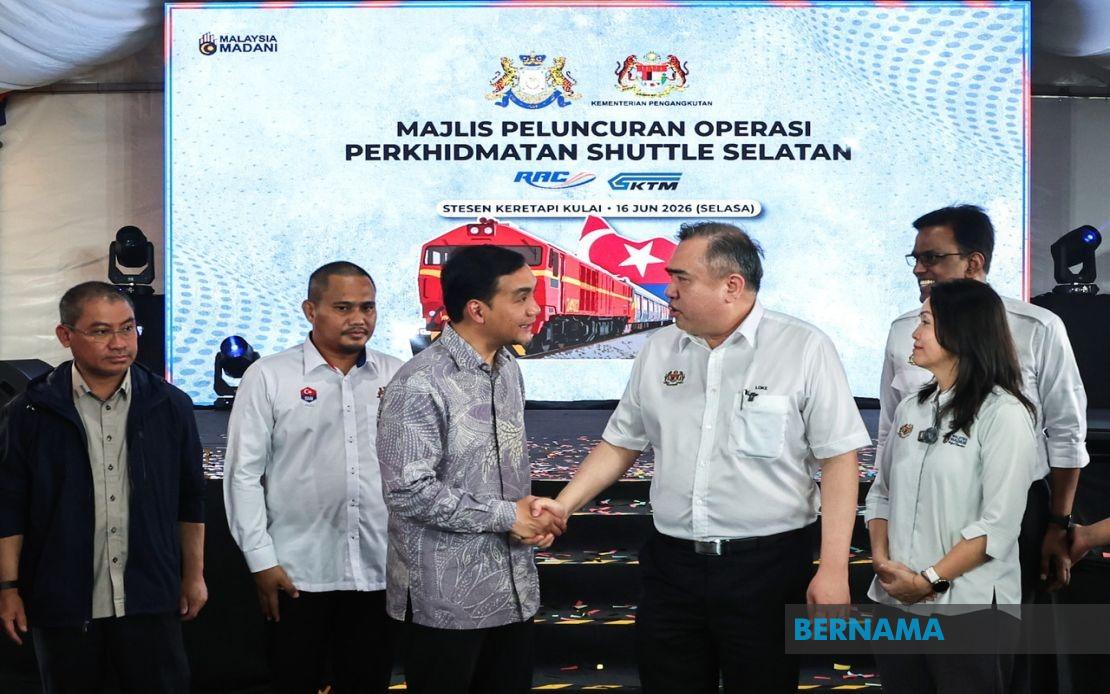
Transport Minister Anthony Loke officially inaugurated the Shuttle Selatan service at Kulai KTM station on June 16, marking a significant expansion of rail-based connectivity in southern Johor. The new service is designed to address growing transport demands across three major population centres—Kulai, JB Sentral and Pasir Gudang—and is anticipated to benefit more than two million people in the region.
The launch comes as Johor experiences rapid economic growth across multiple sectors including manufacturing, logistics, port operations, education and trade. Local officials, including Johor Menteri Besar Datuk Onn Hafiz Ghazi and the state's transport committee chairman, attended the ceremony, signalling strong state-level support for the initiative. The service represents a collaborative effort by the Ministry of Transport, Keretapi Tanah Melayu Berhad and the Railway Assets Corporation to strengthen public transport infrastructure in this strategically important region.
Operationally, Shuttle Selatan will begin with two primary routes: one connecting Kulai and JB Sentral in both directions, and another serving Kempas Baru and Pasir Gudang. The Kulai-JB Sentral journey is expected to take approximately 40 minutes, while the Kempas Baru-Pasir Gudang route will require 40 to 45 minutes. These travel times represent a meaningful improvement over existing alternatives, providing commuters with a faster and more comfortable travel experience compared to road-based options that often face congestion challenges during peak hours.
The government has outlined an ambitious expansion roadmap that will substantially increase the service's reach. Future phases will extend coverage from Paloh to Kulai, passing through Kluang, Renggam and Layang-Layang stations, creating a more comprehensive network across southern Johor. Additionally, three new stations are planned at Taman Daya, Bandar Baru Sri Alam and Pasir Putih, allowing more communities to access rail-based transport. These expansions reflect a long-term commitment to developing integrated public transport infrastructure that can support the region's continued economic expansion.
To facilitate seamless journey experiences, the government has introduced complementary mobility solutions addressing first- and last-mile connectivity challenges. These measures include coordinated feeder bus services, integration with Bas.My routes, a dedicated shuttle service operating from Kempas Baru, and park-and-ride facilities established at AEON Bandar Dato' Onn. This multi-modal approach recognises that effective public transport systems require more than just core rail services—they need supporting infrastructure that makes accessing the main service convenient from residential areas and allows drivers to combine personal vehicle use with public transport.
To accelerate public adoption, the Transport Ministry has introduced the Commuter MADANI Shuttle Selatan Card, offering substantial incentives for early adopters. The RM50 travel card provides unlimited rides for a specified period, and the government distributed 3,000 cards free to Johor residents. Through the Railway Assets Corporation, more than RM150,000 has been allocated as an incentive programme specifically designed to encourage modal shift from private vehicles to public transport. This financial incentive addresses a common barrier to public transport adoption in Malaysia—the upfront cost perception—by essentially subsidising early users to build ridership momentum.
The Shuttle Selatan initiative reflects broader national transport policy priorities under the current government administration. By improving connectivity between residential areas, commercial districts and industrial zones, the service aims to reduce private vehicle dependency, ease traffic congestion and lower overall transport costs for commuters across southern Johor. For the region's business community, reliable public transport reduces employee absenteeism and transport-related expenditure while expanding labour pool accessibility to major employment centres. For residents, the service offers affordable alternatives to car ownership and fuel costs—an increasingly important consideration as vehicle running costs continue rising.
For Malaysian readers monitoring transport developments, the Shuttle Selatan launch demonstrates the government's commitment to prioritising public transport infrastructure in high-growth regions beyond the Klang Valley. Johor's rapid development creates both opportunities and challenges; while economic growth attracts investment and employment, it also generates traffic congestion and urban sprawl if not supported by adequate public transport. The shuttle service addresses these challenges by providing capacity for commuters before road infrastructure becomes critically congested, a preventive approach that generally proves more cost-effective than retrofitting transport solutions to already-saturated road networks.
The service also carries implications for broader Southeast Asian transport integration. As a major economic hub with significant port operations and trade corridors, improved transport efficiency in Johor benefits not only local commuters but also supports regional commerce by facilitating smoother movement of goods and people through this strategically positioned state. Enhanced public transport in Johor potentially reduces logistical bottlenecks that affect cross-border trade and regional supply chains.