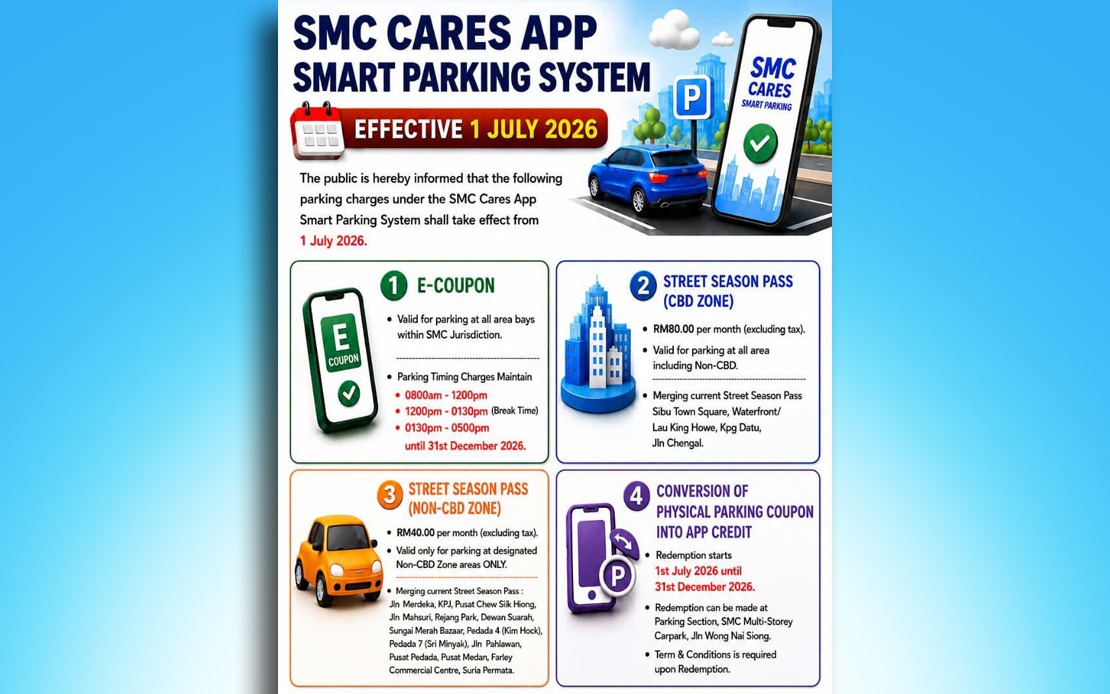
Sibu Municipal Council has responded to mounting public complaints by announcing significant modifications to its SMC Cares Smart Parking system, including a grace period and concessions for elderly motorists. The grace period, set between five and 10 minutes, will allow drivers adequate time to exit their vehicles and activate the parking application before an Over Parking Notice is triggered, addressing concerns that penalties were being issued with insufficient warning.
Chairman Clarence Ting Ing Horh outlined the changes at a press conference, emphasising that the council's intention is to create a user-friendly system rather than generate revenue through rapid fines. The modification comes after the system was fully deployed earlier this month and sparked considerable backlash on social media platforms where motorists shared frustrations about the enforcement mechanism. The council has instructed system provider Primal Solution Sdn Bhd to implement the grace period to give users realistic opportunities to complete their parking transactions through the mobile application.
Beyond the grace period adjustment, the council will introduce a Senior Citizen Parking Pass for drivers aged 60 and above starting in August. While specific details about the concession remain pending, the move directly acknowledges complaints that elderly residents faced particular difficulties navigating the mobile application registration process and using the platform's interface. This demographic-specific intervention suggests the council recognises that technology adoption cannot be uniform across all age groups and that accessibility must be built into parking enforcement systems.
The council has also implemented procedural reforms designed to address public concerns about appeal mechanisms. Motorists who believe an Over Parking Notice was incorrectly issued can now submit appeals for council review, particularly in cases involving registration number errors or other legitimate circumstances. Each penalty notice is now explicitly tied to photographic evidence maintained within the system, creating an audit trail that should theoretically make wrongful charges easier to identify and contest.
Clarifying the roles of enforcement personnel, Ting emphasised that parking wardens employed by the contractor are strictly limited to enforcing parking-related offences such as unpaid charges, expired time limits, and overstaying. Illegal parking enforcement, including traffic obstruction cases, remains the exclusive domain of SMC's enforcement division and state police. This distinction addresses social media claims that private contractors were overstepping their authority in issuing compounds for violations beyond their jurisdiction.
Personal interaction improvements form another component of the response strategy. The council has instructed the contractor to ensure parking wardens are more approachable when assisting members of the public unfamiliar with the application system. Wardens have been specifically directed not to wear face coverings except for legitimate medical reasons, a visibility measure intended to build public trust and facilitate easier identification. These changes reflect acknowledgement that the system's acceptance depends partly on positive interpersonal encounters at the point of enforcement.
For users requiring direct assistance, the council has established a dedicated SMC Cares counter at Sibu Public Library where staff provide guidance on application registration and usage. This physical support infrastructure addresses complaints that technical difficulties went unresolved when users had no avenue for real-time help. The counter represents a hybrid approach combining digital systems with traditional customer service, recognising that not all users are comfortable resolving technological issues independently.
Ting addressed comparisons alleging that Sibu maintains the state's highest parking charges by presenting data suggesting rates remain competitive with other Sarawak local authorities. The council also clarified its financial relationship with the contractor, noting that all parking revenue flows directly to SMC while the service provider receives separate compensation under a fixed service contract. This transparency appears designed to counter suggestions that profit-driven incentives were driving overly aggressive penalty issuance.
The system has accumulated over 93,000 registered users since introduction, with the council projecting registrations will exceed its initial 100,000-user target by year-end. However, this uptake occurred despite widespread complaints regarding operational functionality. Users reported complications with registration, particularly among senior citizens, unintuitive interface design, sluggish system performance, unexpected automatic logouts, payment processing delays, and compounds being issued before motorists could complete parking transactions. These technical deficiencies clearly contributed to the public relations crisis that prompted the council's recent announcement.
The council is actively soliciting public feedback to drive continuous system improvement, encouraging users to channel complaints directly to SMC rather than relying on unverified social media claims. This invites discussion about information verification and the speed at which digital platform complaints spread through social networks, outpacing official institutional responses. The situation illustrates how contemporary local governance must navigate rapid communication cycles where system failures become highly visible before correction mechanisms can be implemented.
For Malaysian cities considering similar smart parking implementations, the Sibu experience provides instructive lessons about the necessity of phased deployment, robust testing with diverse user demographics, and appeal mechanisms built in from launch rather than added reactively. The modifications announced represent course corrections, though their effectiveness depends on proper execution and consistent contractor compliance with new directives. As digital municipal services expand throughout Malaysia, balancing enforcement efficiency with user experience will determine public acceptance of technology-driven governance.

