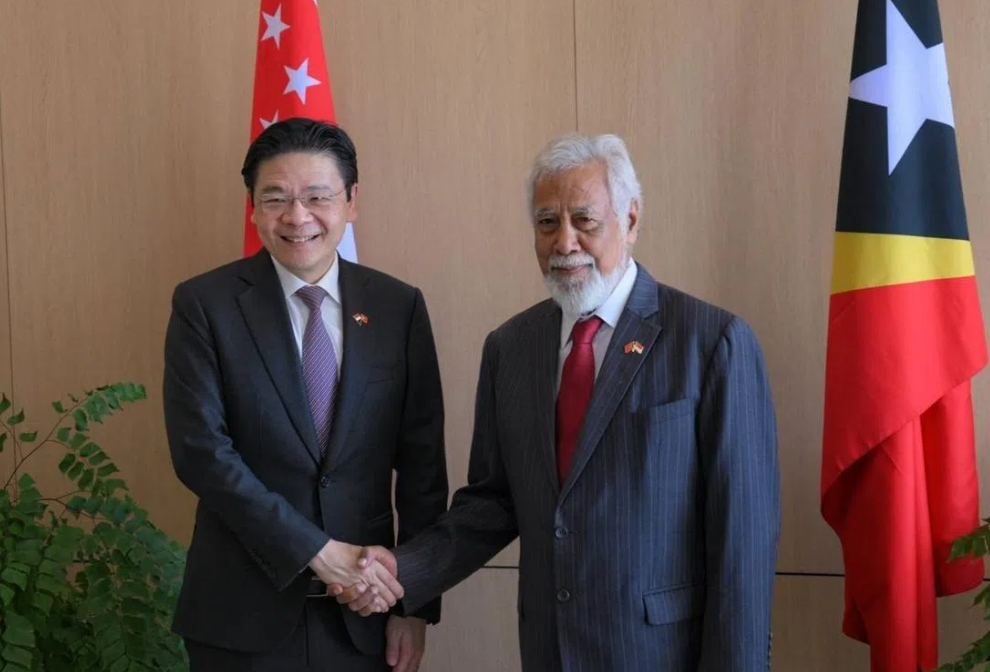
Prime Minister Lawrence Wong's historic visit to Timor-Leste this week signals a significant recalibration of Singapore's regional strategy toward its newest Southeast Asian neighbour. The signing of a comprehensive bilateral cooperation framework on July 3 at the Government Palace in Dili represents more than ceremonial diplomacy—it establishes formal mechanisms for two small nations to pursue shared interests in an increasingly complex geopolitical environment.
The centrepiece of the agreement is a regular consultation mechanism between the two foreign ministries, designed to move beyond traditional bilateral matters into regional, international and strategic discussions. This architecture allows both governments to coordinate positions on larger issues affecting Southeast Asia while maintaining focus on direct country-to-country concerns. For Malaysia and other regional observers, this arrangement demonstrates how smaller economies can leverage structured dialogue to amplify their voices in regional forums, particularly within Asean where consensus-building remains paramount.
Timor-Leste's position in Southeast Asia has fundamentally shifted since formally joining Asean on October 26, 2025. As the 11th member state of a bloc it has long sought to join, the nation now occupies a critical position in regional architecture spanning the Indian and Pacific Oceans. Singapore's proactive engagement reflects recognition that Timor-Leste's successful integration serves broader Asean cohesion. The nation's scheduled assumption of the Asean chairmanship in 2029 makes this moment particularly significant, with PM Wong announcing that Singapore will expand its Stars (Singapore-Timor-Leste Asean Readiness Support) package to include specialised training on chairmanship protocols and responsibilities.
On the economic front, Singapore's existing role as one of Timor-Leste's largest investors underscores the pragmatic foundations of this partnership. Singaporean companies are already diversifying across wholesale trade, renewable energy and other sectors, positioning the city-state as a development partner rather than merely a neighbour. This investment pattern matters for Malaysian enterprises tracking opportunities in Southeast Asia's emerging economies—Singapore's presence suggests viable business corridors exist despite Timor-Leste's relative remoteness and limited infrastructure. The commitment to expand commercial cooperation indicates confidence in the nation's long-term stability and growth trajectory.
A particularly significant announcement concerns labour mobility. From the second half of 2027, Singapore will open selected occupations in construction and marine shipyard operations to Timorese workers on employment passes. This decision reflects both practical manpower needs in Singapore's tight labour market and strategic intent to deepen people-to-people connections with Timor-Leste. For regional analysts, the move demonstrates how labour migration can serve broader diplomatic objectives beyond simple wage arbitrage. Malaysian policymakers have similarly grappled with balancing labour import needs against social concerns, making Singapore's structured approach to worker integration potentially instructive.
Healthcare cooperation represents another dimension of bilateral deepening. The National University Hospital and Timor-Leste's Ministry of Health plan to sign a five-year agreement focusing on workforce development, training systems and health infrastructure strengthening. This collaboration targets priority areas including emergency care, paediatrics, and obstetrics—sectors where Timor-Leste requires institutional capacity building. Such technical cooperation, often overlooked in media coverage, may prove as strategically valuable as trade arrangements, establishing networks of medical professionals and embedding Singapore's standards and practices into Timor-Leste's health system. This soft power dimension extends Singapore's influence while genuinely improving services for Timorese citizens.
Education forms the third pillar of cooperation. Singapore is supporting development of Timor-Leste's teacher training institutes and educational leadership programmes, targeting the creation of capable school administrators who will shape the nation's future generations. In Southeast Asia's development hierarchy, where human capital remains a critical constraint, this focus on institutional capacity in education carries outsized importance. Malaysian institutions similarly recognise that developing administrative and pedagogical expertise in neighbouring countries creates lasting partnerships and generates future leaders sympathetic to Singapore and Malaysian approaches.
The bilateral framework also acknowledges the symbolic importance of Asean membership for Timor-Leste. PM Xanana Gusmao characterised the nation's accession as realising a national aspiration, while PM Wong positioned Singapore's support as foundational to this achievement. The Stars package enhancement, including tailored workshops and attachments to Singapore's Asean chairmanship team in 2027, provides practical mentoring for officials navigating Asean's complex consensus-based decision-making structures. For Timor-Leste preparing to chair Asean two years after Singapore's tenure, this knowledge transfer proves invaluable.
Wong's receipt of the Order of Timor-Leste's highest honour reflects Timor-Leste's gratitude for Singapore's sustained support to nation-building efforts. His acceptance speech, emphasising individual Singaporeans' contributions across training, knowledge-sharing and daily cooperation, highlighted the human dimensions often absent from official communiqués. This personalization matters psychologically—it frames Singapore's engagement not as great-power benevolence but as the accumulated effort of professionals and public servants committed to genuine partnership. Such framing builds the social capital necessary for sustained cooperation beyond any single leader's tenure.
For Malaysia and other regional states, Singapore's approach to Timor-Leste integration offers instructive lessons. The comprehensive framework spanning economics, labour, healthcare, education and political capacity-building addresses multiple dimensions of national development simultaneously. Rather than pursuing narrowly transactional relationships, Singapore has invested in institutional development and human capital creation that will benefit Timor-Leste for decades. This long-term orientation, backed by concrete commitment of resources and expertise, contrasts with episodic engagement many countries offer developing neighbours.
The timing of Wong's visit—the first by a Singapore prime minister—also signals Timor-Leste's emergence from geopolitical margins toward mainstream Asean concerns. Singapore's historical focus on its immediate region around the Straits of Malacca and bilateral relationships with developed economies meant Timor-Leste largely received attention through its Asean accession process rather than as an independent priority. This change reflects the nation's strategic maturation and the opportunities Singapore perceives in its development trajectory. For Malaysian observers, the message is clear: newly integrated Asean members warrant comparable strategic attention and investment in capacity building.
Moving forward, the real test of this partnership lies in implementation. Bilateral frameworks remain aspirational unless complemented by sustained funding, personnel deployment and political will. Singapore's expansion of the Stars package and commitment to healthcare-education cooperation suggest serious intent, yet these initiatives require consistent resourcing beyond election cycles and leadership transitions. The labour mobility programme, launching in 2027, provides a measurable commitment point where outcome can be assessed. Should Singapore follow through comprehensively on announced initiatives while Timor-Leste demonstrates capacity to absorb support and utilise training effectively, this partnership could become a model for how larger nations can facilitate smaller neighbours' development without creating dependency relationships.

