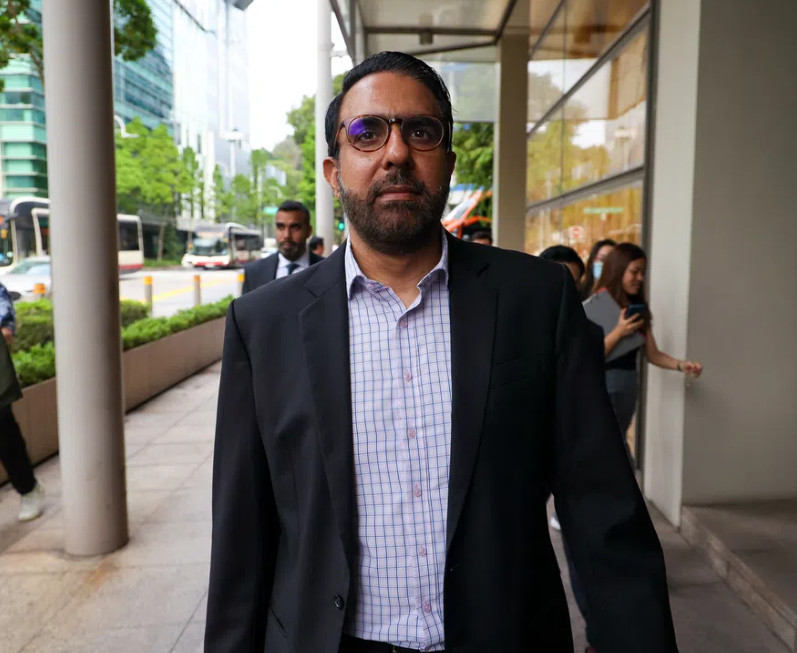
Singapore's Law Society is moving to permanently disbar Workers' Party chief Pritam Singh from legal practice, marking a significant escalation in consequences for the opposition politician following his February 2025 conviction on perjury charges. The disciplinary case will be heard by the Court of Three Judges on August 13, with the society explicitly requesting that Singh be struck off the rolls—the most severe sanction available under Singapore's legal profession framework.
Singh, who represents Aljunied GRC in Parliament, holds a law degree but has maintained a non-practising status for some time. His legal troubles stem from testimony he provided to Parliament's Committee of Privileges regarding a 2021 incident involving former Workers' Party MP Raeesah Khan. Khan had falsely claimed in Parliament that police had mishandled a sexual assault case, a statement she subsequently retracted. When called before the privileges committee to explain his knowledge of the lie, Singh was convicted of providing false statements under oath on two separate counts.
The mandatory nature of the Law Society's disciplinary application underscores how Singapore's regulatory framework treats dishonesty allegations within the profession. A spokesperson confirmed that the society is required by law to initiate proceedings whenever the Attorney-General's Chambers notifies it of a conviction involving "fraud or dishonesty." This obligation exists independent of prosecutorial discretion or mitigating circumstances—once such a conviction is recorded, the disciplinary process becomes automatic.
Singh's appeals have been exhausted. In December 2025, the High Court rejected his challenge to the original conviction, and he subsequently paid a $14,000 fine. This legal defeat removed what some observers had hoped might be an avenue to challenge the underlying finding of dishonesty, which would have complicated the Law Society's case.
The Court of Three Judges hearing the case comprises Chief Justice Sundaresh Menon, Justice Kannan Ramesh, and Justice See Kee Oon. This tribunal represents the apex of Singapore's legal disciplinary system and possesses discretionary authority to impose suspension periods of up to five years, financial penalties reaching $100,000, or complete removal from the profession. However, legal precedent has established that striking off the rolls represents the presumptive sanction for misconduct rooted in dishonesty, with only exceptional circumstances warranting departure from this standard.
Recent judicial practice reinforces this presumption. In July 2026, another lawyer convicted of lying to police about a drink-driving matter was struck off despite potential arguments for leniency. The court determined that no extraordinary circumstances existed to justify suspending rather than permanently removing the lawyer. Legal analysts suggest Singh faces similar headwinds, particularly given that his dishonesty involved false statements made to a parliamentary institution rather than a routine police matter.
For Malaysian observers, the case carries particular significance as both Singapore and Malaysia share common-law heritage and similar professional regulation frameworks. Dishonesty findings within legal professions tend to be treated with exceptional severity across Commonwealth jurisdictions, reflecting the understanding that lawyers occupy positions of public trust requiring unimpeachable integrity. The progression from criminal conviction to automatic disciplinary proceedings to likely disbarment follows a well-established pattern in this region.
The Workers' Party internally moved swiftly following Singh's conviction. On April 30, the party's central executive committee issued a formal letter of reprimand after its own disciplinary panel found that Singh had violated two constitutional articles. This internal action, while less severe than potential legal consequences, signalled the party's acknowledgment that standards of conduct had been breached.
Singh's trajectory illustrates the particular vulnerabilities of opposition figures navigating parliamentary privilege procedures. As the Workers' Party chief, his role involves defending party members and coordinating parliamentary strategy, responsibilities that placed him at the centre of managing the fallout from Khan's false statement. His testimony to the privileges committee, which ultimately led to perjury convictions, occurred within this high-stakes political context, though legal proceedings treat such circumstances as aggravating rather than mitigating factors.
The August 13 hearing will likely attract significant attention both in Singapore's legal community and among political observers across Southeast Asia. A striking-off order would effectively end Singh's capacity to practise law, though his parliamentary seat would remain unaffected under current constitutional arrangements. The case represents a rare intersection of parliamentary politics and professional regulation, highlighting how institutional mechanisms designed to protect parliamentary integrity can carry profound consequences for individual careers.
For the broader legal profession in Singapore and the region, the case reinforces that dishonesty findings trigger mandatory consequences that operate independently of an individual's political importance or professional stature. This consistency in applying disciplinary rules regardless of a lawyer's prominence serves the profession's stated interest in maintaining public confidence in the integrity of legal practitioners—a principle that transcends the particular controversy surrounding Singh's conduct.

