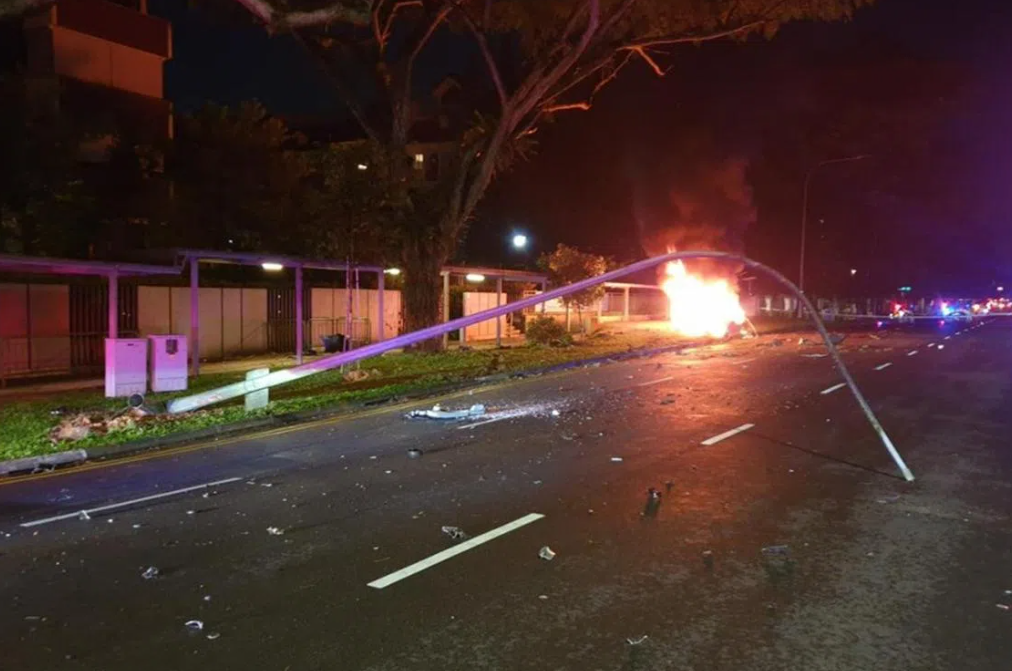
A Singapore man faces serious criminal charges after a reckless early-morning drive that endangered multiple road users and left two young children requiring hospital treatment. Aaron Tan Yao Cong, 29, was charged in court on Thursday with five offences stemming from the March 6, 2024 incident, which saw him drive against traffic at dangerous speeds before ploughing into a private bus carrying school-age passengers.
Court documents reveal a troubling sequence of events beginning at 5.50am when Tan ignored a traffic sign directing vehicles straight ahead along Cavenagh Road. Instead of proceeding as instructed, he steered left and drove directly into oncoming traffic on the two-lane road leading towards Buyong Road. The erratic manoeuvre caused him to halt on the wrong side of the roadway—a positioning that itself posed significant hazard to other motorists in the pre-dawn darkness.
Within minutes, Tan accelerated away as police arrived at the scene. By 6.16am, officers spotted his vehicle racing along Bukit Timah Road towards Upper Bukit Timah Road, where he was recorded hitting an average speed of 114 kilometres per hour while weaving dangerously between other vehicles. This high-speed chase through early morning traffic continued across multiple road sections, including between Coronation Road and Anamalai Avenue, as Tan appeared to evade police apprehension.
The situation escalated dramatically at the junction of Sixth Avenue when Tan failed to respect a red traffic light. His vehicle collided with a private bus that was executing a U-turn at the intersection. The impact was severe enough to cause Tan's car to strike a nearby lamp post, which ignited the vehicle. Despite the fire engulfing his car, Tan and three passengers travelling with him managed to escape the burning wreckage without critical injuries.
Hospital records show that the collision affected multiple parties. The bus driver and two child passengers aged nine and ten both required medical attention following the crash. While initial reports indicated two children from the bus needed hospital treatment, the full scope of injuries across all vehicles involved underscores the potential for tragedy inherent in such reckless driving.
Alcohol impairment appears central to the charge sheet. When arrested, Tan refused to comply with a breathalyser test—itself a separate criminal offence. However, subsequent blood testing at the hospital revealed his alcohol content at 148 milligrams per 100 millilitres of blood, substantially exceeding Singapore's legal driving limit of 80 milligrams per 100 millilitres. This 85 per cent excess over the permitted threshold indicates significant intoxication at the time of the incident.
Tan's history compounds the seriousness of current charges. Court records show a previous conviction in 2019 for drink-driving and driving without due care and attention. His reoffending following that earlier sanction suggests a pattern of disregarding both traffic laws and public safety. The repeat nature of the drink-driving allegation triggers enhanced penalties under Singapore law.
The five charges laid against Tan span the entire scope of his dangerous conduct: drink-driving, dangerous driving causing hurt, leaving a vehicle in a position likely to cause danger to others, refusing to provide a breath specimen when lawfully required, and driving against traffic flow. Each charge carries distinct sentencing guidelines that can compound significantly when imposed cumulatively.
Legal consequences for drink-driving as a repeat offence carry maximum jail time of two years and fines reaching S$20,000. The dangerous driving causing hurt charge allows courts to impose up to two years imprisonment and S$10,000 in fines, with repeat offenders facing doubled penalties. Refusing the breathalyser test can result in six months imprisonment and fines up to S$5,000, or S$10,000 for repeat offenders. Driving against traffic flow on first conviction permits three months jail or S$1,000 fine, while repeat offenders face six months imprisonment and S$2,000 fines. The vehicle position charge carries a separate three-month jail term or S$1,000 fine possibility.
Tan indicated no plea on any of the five charges when appearing before the court. His next scheduled court date is July 16, when prosecutors will presumably present evidence from police investigations, traffic camera footage, medical records, and toxicology results. The case raises critical questions about enforcement of drink-driving laws and whether existing penalties sufficiently deter repeat offenders.
For Malaysian readers, the incident serves as a sobering reminder of risks posed by impaired drivers on regional roads. While Singapore maintains strict drink-drive enforcement and penalties, drink-driving remains a significant contributor to road fatalities across Southeast Asia. The case illustrates how a single individual's decision to drive while intoxicated can endanger dozens of people, particularly vulnerable populations like school-age children using public transport.
The incident also highlights critical distinctions between first-time and repeat offenders in sentencing frameworks. Singapore's escalating penalty structure aims to ensure that drivers who ignore initial convictions face substantially harsher consequences. Whether this deterrent proves effective in Tan's case will depend on judicial discretion exercised at sentencing. Road safety advocates typically argue that custodial sentences for repeat drink-drivers remain essential components of public protection strategies, particularly when victims include children.