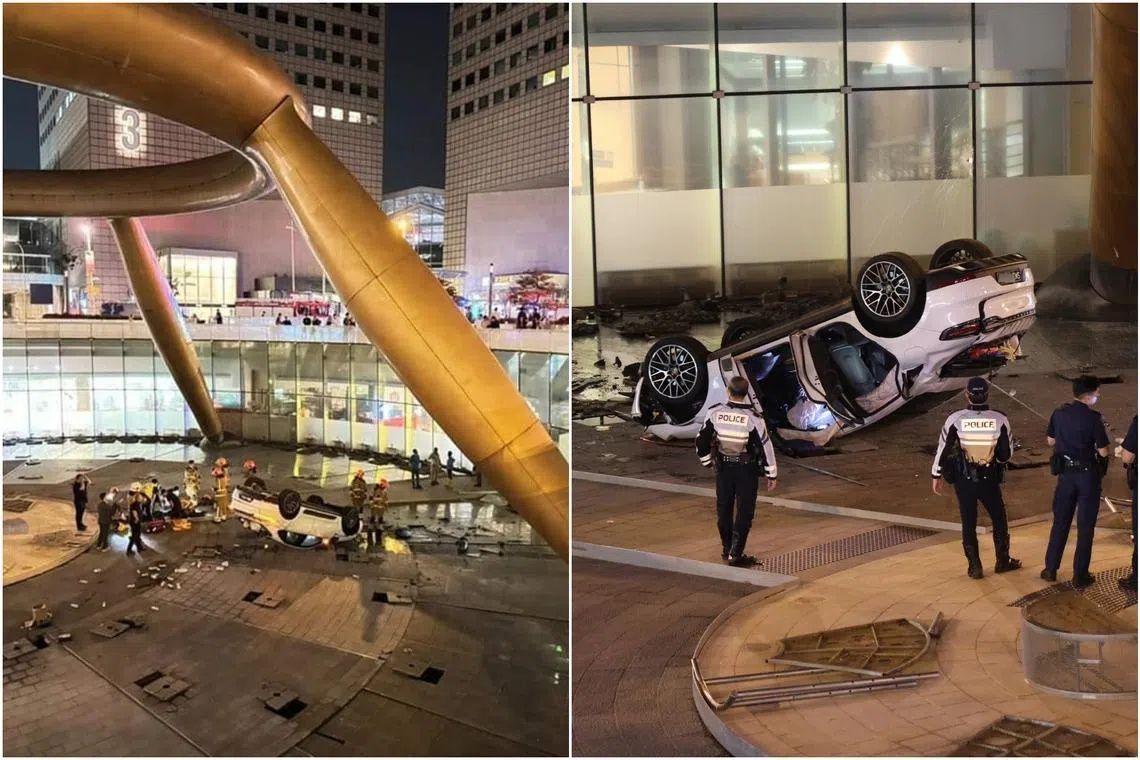
A court in Singapore has handed down a five-week jail sentence to a 58-year-old man who drove his car into the iconic Fountain of Wealth at Suntec City shopping mall on July 13, 2024, after consuming approximately one litre of beer. The incident, which caused nearly S$64,600 in property damage, highlights the severe consequences of drink-driving and the judicial system's approach to deterring such dangerous behaviour on public roads in the island nation.
According to court proceedings, the offender, identified as Then Shing Chong, had left his residence around 5pm on July 12 to visit Suntec City for a social drinking session with a friend. He arrived at the shopping mall approximately an hour later, parked his vehicle in the basement carpark, and proceeded to a bar where he remained until midnight, consuming roughly a litre of beer over a period of approximately six hours. During this time, he also informed medical professionals at the Institute of Mental Health that he had taken either an antihistamine or a sleeping pill prior to drinking, a factor that may have compounded the effects of alcohol on his cognitive and motor functions.
The sequence of events leading to the collision demonstrates the cascade of poor decisions that culminated in the dangerous incident. After exiting the carpark at midnight, Shing Chong's vehicle stopped momentarily for approximately ten seconds as a gantry barrier lifted to permit his passage. He then drove onto Temasek Boulevard, a major thoroughfare in the business district, where his ability to concentrate began to deteriorate significantly. Despite directional signage clearly indicating that traffic should turn left into a roundabout ahead, Shing Chong continued driving straight, crossing three lanes of traffic without correction or awareness of the hazard he was creating for other road users.
Having breached the roundabout instructions, the vehicle continued its trajectory directly toward the Fountain of Wealth, striking and demolishing a protective barricade before plunging into the basement structure of the iconic fountain. The impact was forceful enough to require a lorry crane for recovery operations. Shing Chong sustained injuries in the collision, including a lacerated scalp, and was transported to the emergency department of Tan Tock Seng Hospital for treatment. Notably, blood and breath alcohol tests were not conducted following the accident, as immediate medical attention took priority, though the circumstances and his own admissions to authorities established the alcohol-related nature of the incident beyond reasonable doubt.
The accident occurred in a context of active construction work at the fountain's basement level. Three construction workers were present at the site during the collision and managed to evacuate the area without sustaining injuries. The Deputy Public Prosecutor, Gladys Lim, emphasised to the court the potentially catastrophic consequences had the workers been positioned directly in the path of the descending vehicle, arguing that lives could easily have been lost. This factor significantly influenced the judicial decision to prioritise deterrence over rehabilitation considerations.
Shing Chong's legal team, comprising Josephus Tan, Cory Wong, and Devlin Mohyong of Invictus Law Corporation, mounted a defence centred on mental health mitigation. They sought a mandatory treatment order rather than custodial sentencing, presenting an Institute of Mental Health report indicating that their client had been suffering from major depressive disorder at the time of the offence. The defence argument rested on establishing a causal link between his psychiatric condition and his dangerous driving behaviour, suggesting that treatment addressing his underlying mental health issues would be more appropriate than imprisonment.
The prosecution and the court, however, rejected this approach. Deputy Public Prosecutor Lim argued that the severity of drink-driving as a public safety concern necessitated a punitive response and that deterrence—both specific to the offender and general to the broader public—was essential. District Judge Koo Zhi Xuan concurred, emphasising that drinking alcohol and then operating a motor vehicle represents highly irresponsible conduct that jeopardises lives and property. The judge noted that Shing Chong's actions had inflicted significant property damage and risked injury or death to multiple individuals, warranting a custodial sentence.
Beyond the five-week jail term imposed on July 14, Shing Chong has been disqualified from holding or obtaining any class of driving licence for two and a half years from the date of his release from custody. This extended driving ban underscores the judicial system's determination to prevent repeat offending and to protect public safety by removing dangerous drivers from the roads for an extended period. The disqualification period is calculated from release rather than from sentencing, meaning the total period during which the offender cannot legally drive extends beyond the imprisonment term itself.
The matter is particularly significant for Southeast Asian observers given Singapore's reputation for strict enforcement of traffic laws and its zero-tolerance approach toward drink-driving. The jurisdiction has consistently handed down substantial penalties for alcohol-related driving offences, and this case reinforces that trajectory. The fact that Shing Chong made full restitution for the nearly S$64,600 in damages caused to the Fountain of Wealth did not substantially mitigate his custodial sentence, suggesting that financial compensation alone is insufficient to offset the seriousness of endangering public safety through impaired driving.
For Malaysian readers, this case serves as a cautionary reminder of how drink-driving incidents can escalate from poor personal decisions into serious criminal matters with lasting consequences. The Fountain of Wealth, one of Singapore's most recognisable landmarks, suffered substantial damage in the incident, and the restoration process would have required significant time and expense. The case also illustrates how mental health considerations, while important in sentencing frameworks, do not automatically preclude custodial sentences when public safety concerns are paramount.
The incident underscores broader regional concerns about road safety and impaired driving across Southeast Asia. While Singapore maintains some of the strictest enforcement mechanisms in the region, neighbouring jurisdictions including Malaysia continue to grapple with reducing drink-driving incidents and improving public awareness about the dangers of operating vehicles while intoxicated. The Suntec fountain case demonstrates that no amount of wealth or social status protects an individual from serious legal consequences when they prioritise alcohol consumption over public safety, a principle that transcends national boundaries.

