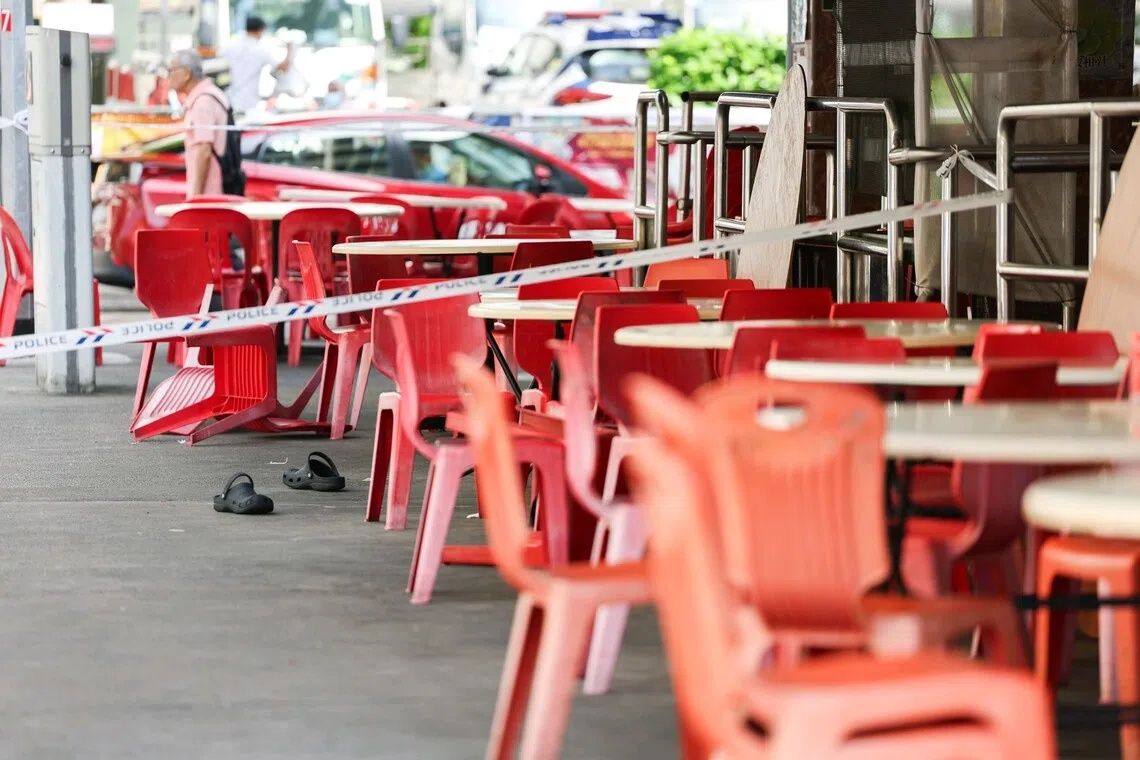
A Singapore court has handed down a 17-month jail sentence to Pradave Shashi Kumar, 22, for his role in a violent incident that claimed the life of a young man in the early hours of September 22, 2024. The court found Kumar guilty of voluntarily causing hurt using a dangerous weapon after he pleaded guilty on Tuesday. His case represents the first of four accused individuals to face adjudication in connection with the fatal Kitchener Road altercation that has brought fresh scrutiny to late-night violence in Singapore's entertainment districts.
The victim, Dhinessh Vasie, a 25-year-old man, died from injuries sustained when he was stabbed in the heart during the chaotic brawl. The incident unfolded in the early morning hours when a group of revellers, including Kumar and three companions, departed from a club at Golden Mile Tower around 4am to continue celebrating at a pub located on Sam Leong Road. As they made their way through a back alley adjacent to their destination, they encountered a larger group of eight men engaged in a heated dispute with three women. This chance encounter would trigger a sequence of events leading to Vasie's death and multiple prosecutions.
According to Deputy Public Prosecutor Jonathan Tan's account presented to the court, the violence escalated when one member of Kumar's group exchanged words with a man from the larger gathering before initiating physical contact. This initial confrontation quickly snowballed into a broader altercation involving multiple participants. As the fighting intensified, Vasie's group attempted to retreat towards the back alley in the direction of Verdun Road, creating a chaotic scene witnessed by multiple bystanders. Throughout this phase, several observers reported seeing one of Kumar's companions, Muhammad Sajid Saleem, 24, wielding a small knife with a 7.5-centimetre blade held in a downward position.
The escalation from fistfight to life-threatening violence occurred rapidly once the knife became visible. Vasie and his companions initially fled the scene, prompting Kumar's group to pursue them. As the chase progressed toward a coffee shop situated at the intersection of Verdun Road and Sam Leong Road, Vasie began to slow his pace before coming to a complete stop. This moment of exhaustion proved fatal, as it allowed Sajid to catch up and inflict a devastating stab wound to Vasie's upper back. The prosecutor's narrative reveals that while Vasie was already severely injured and slumped over the scene, the assault continued unabated.
At this critical juncture, the incident transformed from a stabbing into a coordinated beating. Another member of the group, Kirrthik Roshan Prem Ananth, 23, seized a chair from the coffee shop and used it to repeatedly strike the incapacitated victim. Kumar, witnessing this and the severity of Vasie's condition, proceeded to pick up a second chair and delivered two forceful blows targeting Vasie's head and chest. The prosecutor emphasised during sentencing that Vasie, already severely wounded and rendered immobile, offered no resistance whatsoever to this brutal secondary assault. This detail appears to have weighed significantly on the judicial assessment of culpability, distinguishing Kumar's actions from a genuine mutual combat scenario.
The chain of events following the attack proceeded swiftly as the accused group departed the coffee shop vicinity and made their way towards City Square Mall, seemingly unconcerned about the victim left bloodied at the scene. Emergency responders arrived shortly thereafter, though their intervention came too late to prevent Vasie's death. Police apprehended Kumar at approximately 5.15am on the same morning, within ninety minutes of the incident. The rapid response reflected the seriousness with which law enforcement treated the incident, though the gravity of what had occurred—a fatal outcome—would emerge only later through medical examination.
The case structure reveals the differing levels of involvement and responsibility among the four accused persons now navigating Singapore's criminal justice system. Sajid faces the most serious charge of murder, presumably reflecting his role in inflicting the fatal knife wounds. Satish Jason Prabhas, 23, and Kirrthik Roshan Prem Ananth, 23, face rioting charges, acknowledging their participation in the broader violent disorder. Kumar's conviction specifically targets his deployment of the chair as an instrument of assault, classifying his conduct within the framework of voluntarily causing hurt with a dangerous weapon. This differentiated charging approach demonstrates prosecutorial assessment of relative culpability while maintaining accountability across all participants.
The legal framework governing Kumar's conviction permits substantial penalties. Under Singapore law, individuals convicted of voluntarily causing hurt while using a dangerous weapon face potential incarceration of up to seven years, alongside or instead of significant fines and corporal punishment through caning. The 17-month sentence handed to Kumar, while representing a serious custodial term, falls substantially below the statutory maximum, potentially reflecting judicial recognition of mitigating factors or the graduated nature of his participation compared to the knife wielder. The sentencing represents the court's calibration of punishment against the specific circumstances of his actions and his position within the broader altercation.
This incident carries sobering implications for Singapore's approach to late-night entertainment district safety and crowd control. The circumstances reveal how innocent chance encounters and minor interpersonal friction in venues catering to intoxicated individuals can rapidly escalate into lethal violence. The involvement of multiple assailants attacking a vulnerable, wounded victim highlights the organisational chaos that can emerge from what might initially appear to be isolated disputes. For the Malaysian context and regional observers, the case underscores persistent challenges in managing alcohol-fuelled violence across Southeast Asian cities, where similar demographic patterns and night-life economies create comparable risks.
The prosecution and conviction of Kumar alongside ongoing proceedings against the other three accused individuals represent Singapore's determined response to serious violence. The phased adjudication allows the courts to evaluate each participant's culpability individually while maintaining comprehensive accountability for the collective outcome. For regional observers and policymakers, the case demonstrates both the severity with which Singapore's courts treat violent crime and the complex evidentiary and legal challenges that arise when multiple assailants contribute to a single fatal outcome. The death of Dhinessh Vasie serves as a stark reminder of how quickly recreational activities can transform into tragedy when violence intersects with intoxication and numerical advantage.

