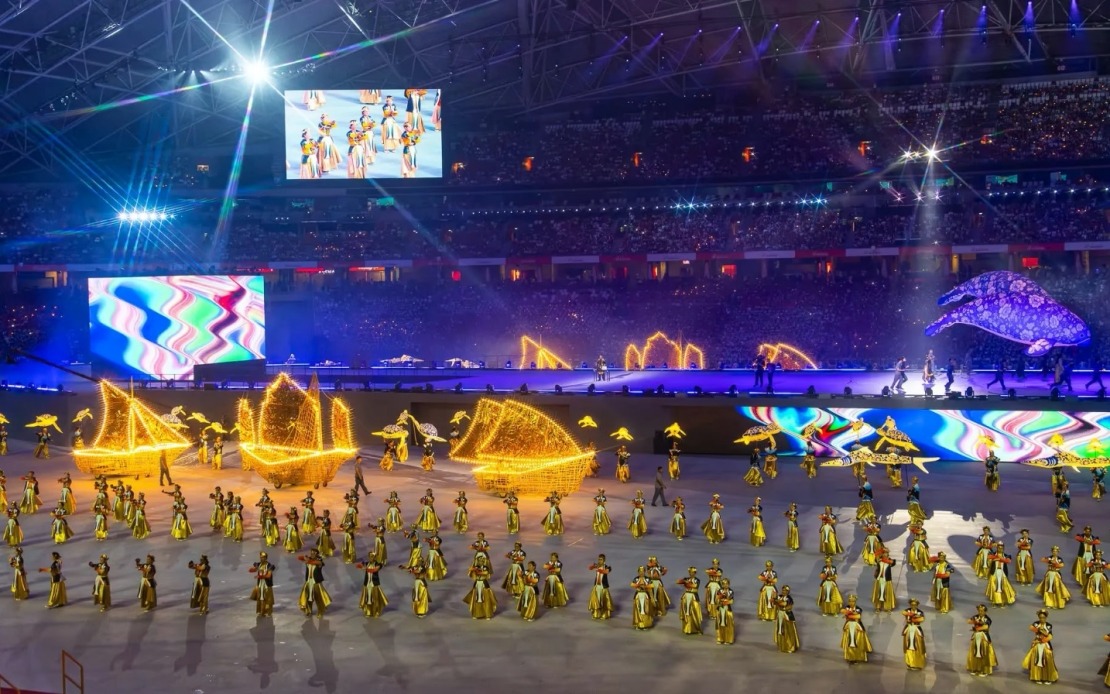
Singapore's 61st National Day celebrations on Sunday marked a significant milestone with the return of the National Day Parade to the National Stadium after an absence of ten years, reviving a centrepiece of the republic's annual civic observance. The event, conducted under the theme "Majulah Singapura, Go Beyond!", brought together President Tharman Shanmugaratnam, Prime Minister Lawrence Wong, Cabinet ministers, and Members of Parliament alongside approximately 42,000 members of the public who filled the stadium dressed in the national colours of red and white. The return to the National Stadium represents not merely a logistical decision but a symbolic recommitment to conducting the parade in its traditional venue, reflecting continuity in Singapore's national identity celebrations during a period of leadership transition.
A particularly noteworthy innovation this year was the decision to conduct both the Presidential Gun Salute and State Flag Flypast at Kallang Basin, marking the first instance in Singapore's sixty-year history that these ceremonial elements extended beyond the National Stadium's confines. This geographical expansion of the traditional parade format enabled the maritime venue to accommodate substantially more spectators across the wider Kallang precinct, democratising access to these important state ceremonies. Four 25-pounder Howitzer guns, each mounted on Mobility 3rd Generation (M3G) rafts, navigated around the basin in a demonstration that blended military precision with innovative use of the urban landscape, allowing thousands of additional citizens to participate directly in the festivities rather than observing through media coverage alone.
The 21-gun salute itself involved 151 personnel drawn from the 23rd Battalion of the Singapore Artillery and 35th Battalion of Singapore Combat Engineers, underscoring the depth of military participation required to execute these ceremonial protocols. Such involvement reflects the historical intertwining of Singapore's armed forces with national identity formation, particularly given the city-state's geopolitical circumstances and the mandatory military service requirement for male citizens. The scale of military participation in civilian celebrations provides a window into how Singapore integrates its defence apparatus into the national consciousness, distinguishing it from many other developed nations where civil-military ceremonies operate more distinctly.
The main parade and ceremony commenced at approximately 6 pm and operated under the sub-theme "Go Beyond Self", drawing together 32 contingents encompassing over 2,000 participants in total. The composition reflected Singapore's institutional diversity, with six Guard of Honour contingents totalling 72 personnel from the Singapore Army, Republic of Singapore Navy, Republic of Singapore Air Force, Digital and Intelligence Service, Singapore Police Force, and Singapore Civil Defence Force. Beyond these uniformed elements, the parade featured ten contingents from youth organisations and sixteen supporting contingents, each contributing to a choreographed demonstration of national unity and institutional cohesion that characterises Singapore's organised approach to public gatherings.
Complementing the formal parade segment was an elaborate performance showcase featuring 36 artistes and more than 2,600 performers who brought the overarching "Majulah Singapura, Go Beyond!" theme to life through music, dance, and theatrical production. This segment strove to narrate contemporary Singapore through "authentic stories, innovative technology and a moving soundtrack", attempting to ground abstract national ideals in lived experience and contemporary artistic expression. The scale of performance participation—involving thousands of individuals rehearsed and coordinated for a single evening—demonstrates the logistical capacity Singapore has developed for producing large-scale civic spectacles that balance military precision with creative spontaneity.
A particularly significant inclusion this year was the participation of seven dancers from diverse backgrounds, notably including an autistic dancer and a performer with Down syndrome. This deliberate casting choice functioned as both symbolic gesture and practical statement: acknowledging that national contribution and civic participation transcend conventional ability categories, and that Singapore's shared future depends upon including marginalised groups historically excluded from mainstream celebrations. For Malaysian audiences, this developmental approach to inclusive national symbolism offers relevant comparison points, particularly given ongoing discussions in Malaysia regarding disability representation and accessibility in public ceremonies.
The thematic emphasis on "going beyond" operates simultaneously on multiple registers. At the institutional level, it justifies the innovative expansion of ceremonial elements to Kallang Basin. At the social level, the inclusion of performers with disabilities literalises the concept by extending participation beyond traditional boundaries. At the temporal level, it situates the immediate celebrations within Singapore's broader development narrative, positioning the nation as perpetually exceeding prior limitations. This multilayered thematic construction enables the parade to function as what scholars might term a "total social fact"—a civic event that simultaneously conveys information about institutional capabilities, social values, political priorities, and national aspirations.
From a Southeast Asian perspective, Singapore's continued investment in large-scale National Day ceremonies, particularly the deliberate choice to return the parade to the National Stadium after a decade's absence, signals commitment to traditional civic ritual during an era when digital platforms increasingly fragment collective experience. While many developed nations have witnessed declining attendance at traditional public ceremonies, Singapore's 42,000-person stadium capacity and the expansion to accommodate thousands more at Kallang Basin suggests sustained public appetite for direct, in-person participation in national celebrations. This phenomenon warrants analysis alongside competing trends toward virtual commemoration and privatised celebration.
The leadership transition context adds interpretive depth to this National Day iteration. President Tharman Shanmugaratnam, who assumed office in September 2023, and Prime Minister Lawrence Wong, who took over in May 2024, are both relatively recently elevated to their respective offices. Their joint presiding over a National Day celebration notable for returning traditional formats to their original venues may signal reassurance of continuity and stability during a period of governmental transition. For Malaysian observers watching Singapore's managed succession and ceremonial reinforcement of institutional continuity, the parallels to Malaysia's own transitions between administrations provide instructive comparison points regarding how nations use civic ceremony to reinforce legitimacy during leadership changes.
The participation of Cabinet ministers and Members of Parliament in ceremonial roles reflects Singapore's formal constitutional framework where legislative and executive branches participate visibly in national celebrations. This public institutional presence distinguishes Singapore's approach from nations where political figures maintain greater ceremonial distance from defence force participation. The integration of political, military, youth, and civilian elements within a single coordinated ceremony embodies Singapore's model of national consensus-building and collective mobilisation around state-defined objectives.
Looking forward, the successful execution of the 2024 National Day Parade—styled as NDP 2026 despite occurring in 2024, presumably anticipating the 2026 national elections—establishes a template for future celebrations. The decision to maintain the National Stadium as primary venue while expanding ceremonial reach through the Kallang Basin precedent suggests that Singapore's civic ritual planning will increasingly seek to balance traditional formats with expanded accessibility. For other Southeast Asian nations considering their own ceremonial formats, Singapore's model demonstrates how institutional innovation need not entail abandoning traditional sites, but rather extending their reach and relevance to broader populations.
The thematic emphasis on inclusion and diversity, particularly visible in the deliberate casting of performers with disabilities, reflects evolving international norms around representation and accessibility in public institutions. Singapore's choice to prominently feature such performers in a state ceremony suggests that national symbolism increasingly encompasses recognition of diverse abilities and experiences. This development merits attention from Malaysian policymakers and cultural institutions currently navigating similar conversations regarding representation and inclusion in national symbolic practices, particularly as Malaysia seeks to project itself as a progressive, inclusive Southeast Asian society.

