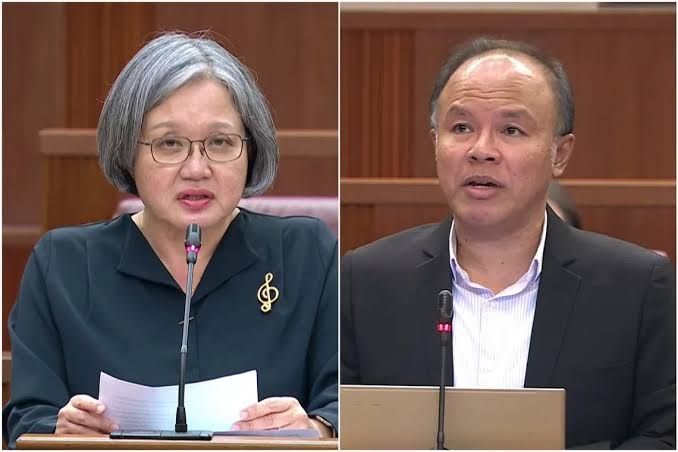
Singapore's Parliament has formally concluded a protracted constitutional matter involving two senior opposition figures, determining that no further disciplinary action can be taken against Workers' Party leaders Sylvia Lim and Faisal Manap despite findings that they misled a parliamentary committee. Leader of the House Indranee Rajah announced on July 7 that the legislature is statutorily barred from imposing sanctions under the Parliament (Privileges, Immunities and Powers) Act, effectively ending a dispute that has preoccupied Singapore's political establishment for several years.
The underlying controversy traces to 2021, when former Sengkang GRC Member of Parliament Raeesah Khan fabricated an anecdote about police conduct during a parliamentary speech. A subsequent Committee of Privileges investigation determined that Khan, along with Lim, Faisal, and party leader Pritam Singh, had provided false testimony while being questioned by the parliamentary body. Khan's initial deception concerning an alleged encounter with law enforcement created a cascading series of complications that ensnared multiple senior opposition figures in questions about their credibility and candour before Parliament.
The Committee of Privileges identified a critical distinction in culpability among the three accused. Pritam Singh bore primary responsibility after the committee concluded he had instructed Khan to "take her lie to the grave" during an August 2021 meeting, thereby actively obstructing the subsequent inquiry. Lim and Faisal, who were present at that encounter, subsequently denied to investigators that such a directive had been issued. While both were found to have deceived the committee, their roles were characterised as subsidiary and considerably less grave than Pritam's orchestration of the cover-up. Nevertheless, both provided evidence of limited utility during the committee's examination, a circumstance that partially mitigated their overall culpability.
Parliament's response to these findings reflected considerable procedural deliberation. Rather than immediately prosecuting both cases simultaneously, the legislature opted to refer Pritam alone to the public prosecutor, enabling him to mount a full legal defence with counsel while awaiting the conclusion of criminal proceedings before addressing Lim and Faisal's conduct. This sequencing strategy was justified on grounds of fundamental fairness, allowing the House to observe how courts would ultimately characterise the factual matrix before imposing its own parliamentary sanctions on the secondary figures. Indranee acknowledged the strategic dimension of this deferral, noting that had timelines unfolded differently, she would have pursued a more robust disciplinary course.
The legal architecture governing parliamentary misconduct proved decisive. Section 22 of the PPIPA constrains Parliament's authority to punish breaches of privilege, limiting the House's reach to offences committed either during the current parliamentary session or the immediately preceding session. This temporal restriction exists deliberately to provide finality and prevent indefinite retrospective investigation of historical parliamentary conduct. The 15th Parliament, which commenced in September 2025 following general elections, thus retained jurisdiction only over violations occurring in its current session or the 14th Parliament's second session. Since Lim and Faisal's misstatements occurred during the 14th Parliament's opening session, the new Parliament fundamentally lacks legal authority to impose penalties, rendering their transgressions temporarily immune from legislative punishment.
Pritam Singh's subsequent criminal conviction in February 2025, upheld by the High Court in December 2025, vindicated the Committee of Privileges' original findings regarding factual accuracy. The courts' confirmation that Pritam had indeed lied to Parliament proved that Lim and Faisal's denials to the committee were themselves fabrications, since the underlying facts the committee investigated were factually accurate. However, this judicial validation came too late within the electoral cycle to permit parliamentary action. The timing dynamics illustrate a constitutional tension between ensuring comprehensive accountability and observing statutory safeguards designed to prevent perpetual reopening of historical grievances.
Indranee emphasized that Parliament retains non-punitive mechanisms for expressing institutional disapproval of dishonest conduct. The legislature previously demonstrated this capacity in January when it adopted a motion declaring Pritam Singh unsuitable to serve as Leader of the Opposition, a declaratory step that broadcasts Parliament's institutional judgment about fitness for senior roles without invoking formal disciplinary mechanisms. This censorious action represented the House's clearest available expression of collective disapprobation regarding the mendacity at issue. Indranee's argument implicitly presented this January motion as providing sufficient institutional remedy despite the unavailability of formal penalties under the PPIPA framework.
For Malaysian observers monitoring Singapore's parliamentary governance, this outcome illuminates both the strengths and potential vulnerabilities of time-bound disciplinary regimes. The PPIPA's temporal constraints serve legitimate constitutional purposes, preventing indefinite harassment of opposition figures through perpetually resurrected historical misconduct allegations. Yet the same provisions can also create perverse incentives where coordinated delay strategies allow legislative sessions to lapse, thereby extinguishing Parliament's enforcement capacity. Singapore's experience suggests that opposition parties contemplating obstructive conduct might calculate that patient procedural navigation could outlast legislative memory and jurisdictional windows.
The Workers' Party responded to the closure by emphasizing that the matter had already been internally settled during its June party elections, when members voted overwhelmingly to retain Pritam Singh as leader despite his criminal conviction. This internal vindication reflected the party's assessment that members desired continuity of leadership and preferred to move forward rather than undergo extended transitional instability. The party's posture suggested that it viewed the parliamentary investigation and criminal prosecution as exhausted remedies, with the immediate political risk substantially mitigated through electoral renewal at the party level.
Lim herself responded to Indranee's ministerial statement by declining to object to its substance, though she reiterated that during the January motion debate she had clarified her position comprehensively. Lim maintained that references to her conduct in Pritam's appellate judgment relied solely on prosecution evidence presented in court, circumstances in which she had no opportunity to cross-examine witnesses or present counter-evidence, since she was not called as a witness in criminal proceedings. Her response suggested tactical resignation to the parliamentary outcome while preserving the record of her claimed procedural disadvantage.
This episode holds several instructive implications for Southeast Asian legislatures grappling with opposition misconduct and parliamentary discipline. The primacy of formal legal timelines over substantive justice concerns reflects Singapore's constitutional ordering, whereby statutory constraints trump ad hoc equitable considerations. Indranee's explicit acknowledgment that "the law, in this case the time bar provisions of PPIPA, must be observed" prioritizes institutional regularity over achieving particular outcomes in individual cases. For Malaysian parliamentary observers, this underscores how jurisdictional and temporal boundaries can unexpectedly truncate accountability processes regardless of factual culpability or institutional desires for enforcement.
The broader significance extends to questions about opposition party discipline and parliamentary credibility within competitive democracies. When senior opposition figures misrepresent facts to parliamentary bodies, the resulting institutional damage transcends partisan calculation. Confidence in legislative proceedings depends on presumptions that members furnish candid testimony when questioned by oversight mechanisms. The failure of multiple Workers' Party principals to meet this baseline standard created broader corrosive effects on parliamentary reputation that Parliament's ultimate inability to impose sanctions cannot fully remediate. The case thus illustrates how institutional accountability gaps, even when created by legal constraints rather than political choice, can impose broader constitutional costs.
Singapore's handling of this matter ultimately reflects the operation of rule-of-law principles even when those principles produce outcomes that frustrate substantive accountability. Indranee's ministerial statement essentially conceded that Parliament's hands are bound by statute, however unsatisfying that constraint might appear given the High Court's confirmation of the underlying dishonesty. This represents a particular constitutional choice—that temporal finality and jurisdictional clarity ultimately supersede retrospective justice—that reflects mature acceptance of legal constraints even when they impede addressing serious misconduct. For regional observers, the episode demonstrates both the necessity and the potential costs of anchoring parliamentary discipline to explicit statutory frameworks rather than relying on discretionary institutional authority.

