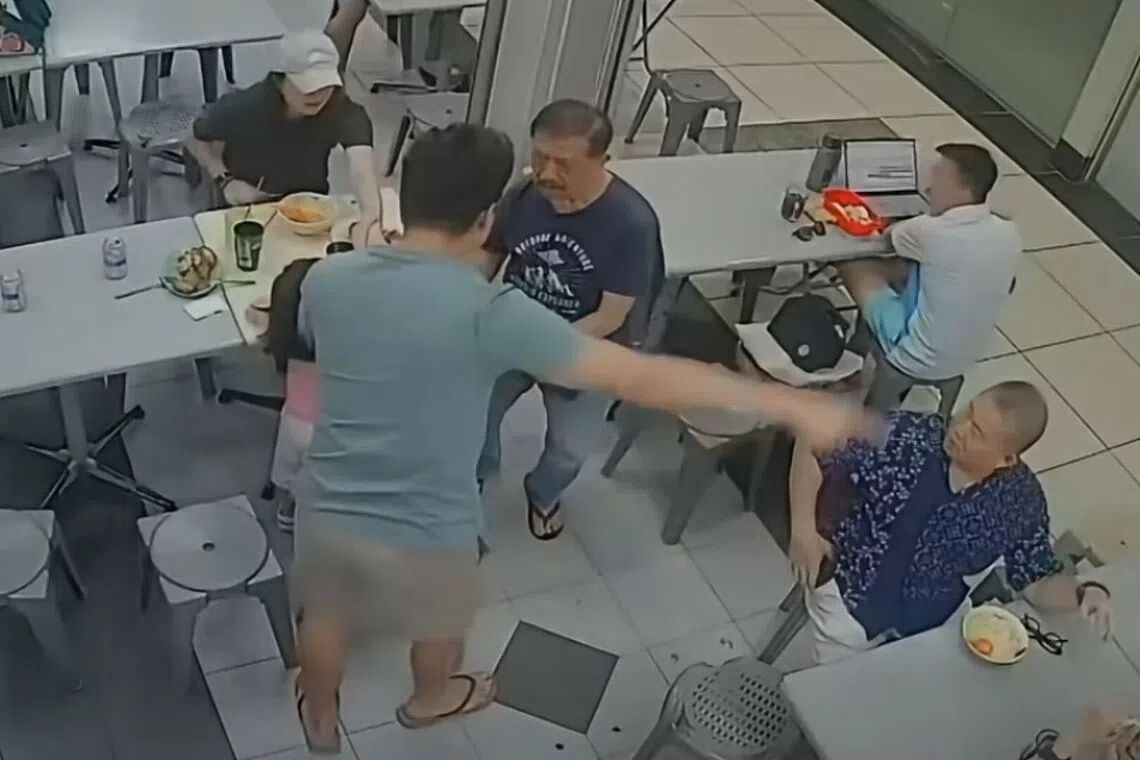
Singapore authorities have launched an investigation into a confrontation at a coffee shop in the East Coast area that resulted in an elderly man being forcibly pushed to the ground. The incident, which was captured on security camera footage and subsequently shared on social media, has drawn public attention to the circumstances surrounding the altercation and raised questions about what prompted such a forceful physical response.
The police confirmed on Sunday, August 16, that a formal report had been filed and that investigations into the matter are proceeding. The incident occurred at a local coffee shop, where the elderly man, described as being in his 70s and experiencing mobility difficulties, was present at the time. According to accounts of what transpired, the man approached a table where a young girl was seated and made physical contact by patting her on the head—an action that appears to have triggered an immediate and aggressive response from an accompanying adult.
The sequence of events that unfolded was documented in security camera footage later shared on Facebook. In the video, the elderly man can be observed moving carefully through the coffee shop, relying on the tables on either side for stability as he navigates the narrow space. His gait reflects the physical limitations that affect his ability to move independently, a detail that becomes significant when considering the context of what followed.
When the elderly man reached the table occupied by the girl, he extended his hand and patted her head in what appears to have been a casual, friendly gesture. However, a woman seated at the same table immediately moved to block this contact, pushing his hand away. Her intervention seemed to signal disapproval of the physical gesture. Nevertheless, before the situation could be de-escalated, a man who had apparently been sitting at the table stood up quickly and approached the elderly man.
What occurred next was captured on the security footage. The man verbally confronted the elderly man, and moments later, he delivered a forceful shove that caused the elderly man to fall to the ground. The sudden nature of the physical assault, combined with the elderly man's already compromised balance and mobility, made him particularly vulnerable to injury from such an impact.
The son of the injured man posted an account of the incident on Facebook on August 15 at 7.14 p.m., seeking to identify the individual responsible for pushing his father. In his post, the son explained that his father was in his 70s and, despite his mobility challenges, regularly helped out at a food stall in the coffee shop. The family's public appeal for information was driven by concern over the man's condition following the incident and a desire to understand what had motivated such an aggressive response to a seemingly innocuous gesture.
According to the son's account, the aftermath of the confrontation included an apology from the man who had shoved his father. The man reportedly expressed regret for his actions and even offered the elderly man a beverage in a gesture of reconciliation. However, this apparent remorse did not address the more serious consequence of his actions: the elderly man subsequently developed severe back pain as a result of the fall. For a person already managing mobility issues, such an injury could significantly impact quality of life and independence.
The incident highlights a broader tension that can arise from generational differences in personal space norms and the interpretation of seemingly benign physical contact. What the elderly man may have intended as a friendly, avuncular gesture toward a child was perceived differently by the adults present, particularly the man who felt compelled to intervene so aggressively. The gap between intention and interpretation, combined with the swift escalation to violence, underscores how misunderstandings can quickly spiral in confined public spaces.
On August 16 at 9.55 a.m., the son posted again on Facebook, thanking members of the public for their concern and for any information they had provided. However, he noted that despite these efforts, the identity of the man who pushed his father remained unknown to the family at that time. This detail is significant for understanding the wider implications of the incident: while the man had apologized at the scene, the family's inability to conclusively identify him complicated any potential further resolution of the matter.
The case draws attention to how quickly situations involving physical contact, even minor ones, can escalate in urban public spaces where strangers interact in close proximity. For Malaysia and other Southeast Asian countries with similarly densely populated public venues, the incident serves as a reminder of the importance of restraint, de-escalation, and consideration for vulnerable members of the community, particularly elderly individuals whose physical vulnerabilities may not always be immediately apparent.

