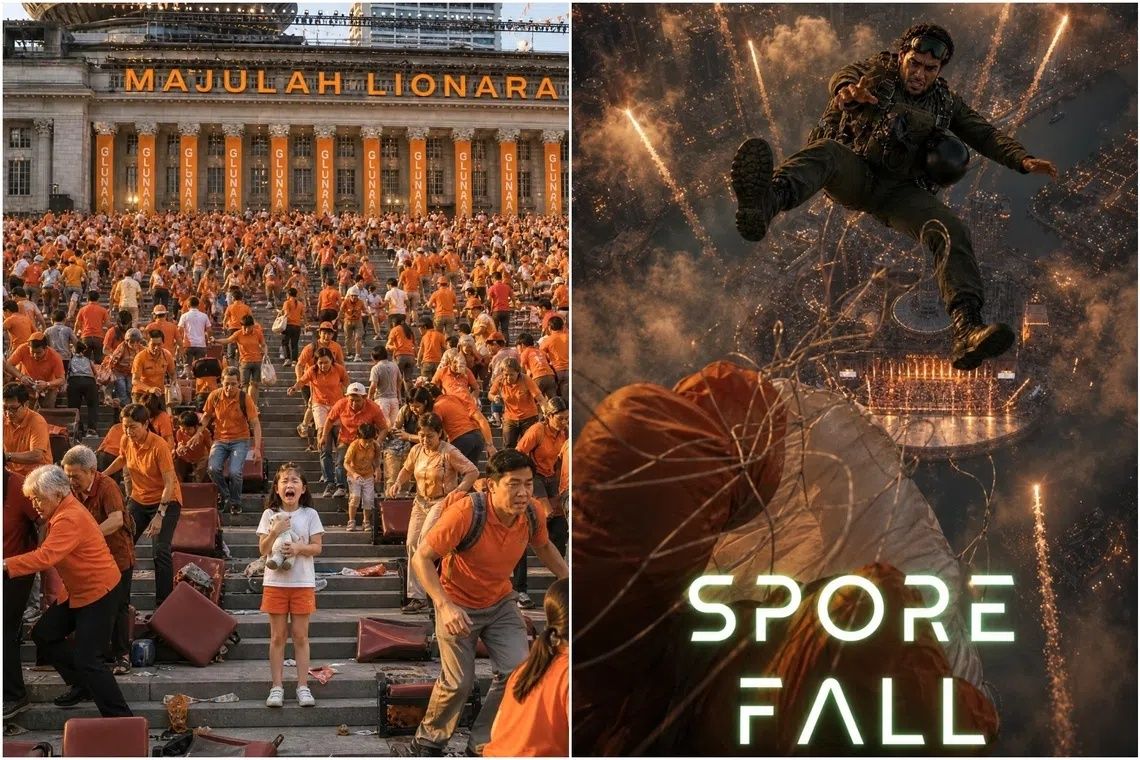
Singapore-based production studio Edenstone is preparing for significant public pushback over its latest creative venture, an artificial intelligence-assisted short film that reimagines the country's most celebrated civic occasion as a dystopian nightmare. The four-minute work, titled Bersama Majulah, depicts a National Day Parade engulfed by a catastrophic outbreak of a lethal spore pathogen that transforms people into zombie-like creatures. Though set in the fictional nation of Lionara, the film employs unmistakably Singaporean visuals, prominently featuring the Marina Bay skyline and the iconic Merlion, making its commentary pointedly local rather than abstract. The project will premiere on August 9, deliberately chosen to coincide with Singapore's National Day, ensuring maximum visibility and controversy.
The film emerges as a spinoff from Edenstone's broader AI animation series Spore Fall, which debuted in March on sporefall.com and established the narrative universe exploring humanity's struggle against existential biological threat. The series follows characters including a soldier and a medic navigating survival within a collapsing social order. Bersama Majulah extends this apocalyptic framework specifically into the symbolic heart of Singaporean national identity, transforming an occasion meant to celebrate civic unity into a stage for examining how that unity might fracture under extraordinary pressure. The creative vision comes from Singaporean showrunner Joel Boh, while executive producer Chan Gin Kai brings credentials as a recent Golden Horse Award winner for Best Animated Feature for the 2025 film Another World. The official theme composition by local musician Dharma Sadasivan ensures the project maintains cultural rootedness despite its technological innovation.
Boh's public statement directly addresses the provocative nature of depicting a dystopian Singapore during National Day celebrations, framing the choice as fundamentally optimistic rather than critical. He contends that imagining the nation under extreme duress represents an act of profound faith in Singapore's structural resilience and identity strength. This interpretation reframes what might initially appear as iconoclasm into something closer to affirmation, suggesting that a society confident in its foundations can withstand imaginative reimagining, even in darkly speculative scenarios. Boh emphasises that the core message centres on Singapore's capacity to choose collective cohesion over individual fear when confronted with existential challenges, using the hypothetical breakdown of normal civic institutions to paradoxically reinforce their importance. This philosophical positioning attempts to preempt accusations that the project undermines national pride by arguing instead that true confidence permits such creative risk-taking.
The production arrives amid intensifying international scrutiny regarding artificial intelligence's role in entertainment creation and its potential for misuse. Recent incidents in China highlighted these anxieties when the AI-generated microdrama The Peach Blossom Hairpin faced removal from platforms following allegations that creators deployed performers' facial characteristics and fashion choices without authorisation. This incident prompted Chinese regulatory authorities to mandate explicit labelling and digital watermarks on all AI-generated content beginning September 1, establishing what may become a template for other jurisdictions. Similarly, major American entertainment unions including the Writers Guild of America and SAG-AFTRA have negotiated detailed contractual protections designed to safeguard human creators' employment prospects and prevent unauthorised replication of their likenesses through digital technology.
Edenstone has positioned Bersama Majulah deliberately within these evolving ethical frameworks, adopting the descriptor "human-written, AI-realised" to clarify the production's creative hierarchy. The studio contends that human authors retain complete authorship over narrative architecture, scriptwriting, character development, emotional trajectory and world-building components, while artificial intelligence functions strictly as an accelerant for visual asset production operating under explicit human creative supervision. This distinction attempts to navigate between technological capability and artistic responsibility, arguing that AI serves the story rather than driving its conception. Boh reinforces this position by emphasising that technology exists to scale the team's visual output capacity rather than substitute for human creative decision-making, effectively positioning AI as a tool that enhances rather than replaces the fundamental work of artistic authorship.
For Southeast Asian audiences and creators, this project carries particular significance as a case study in how regional productions can leverage advanced technology to compete with larger entertainment markets while maintaining ethical accountability. Singapore's position as a technology hub and creative incubator gives this experiment outsized attention across the region, potentially establishing precedents for how other countries approach AI-assisted filmmaking. The film demonstrates that resource-constrained production environments can achieve visual sophistication previously requiring significantly larger budgets and teams, potentially democratising access to advanced visual storytelling tools. However, the project's reception will partly determine whether Southeast Asian audiences accept AI-assisted content as legitimate artistic expression or whether they perceive it as ethically compromised regardless of creative intentions.
Boh's claim that his studio mission involves proving Singapore's global creative competitiveness directly engages with ongoing conversations about whether the region can produce entertainment that resonates internationally beyond tourism marketing and cultural documentation. By targeting the most symbolically significant national occasion as creative material, Edenstone signals ambitious creative confidence and willingness to take substantive risks. The choice suggests a belief that mature democracies and stable societies can engage with speculative narratives about their potential fragility without experiencing actual destabilisation. This contrasts with more cautious approaches that treat national symbols as inherently fragile and requiring protective quarantine from critical or imaginative reinterpretation.
The technological and ethical considerations embedded in Bersama Majulah reflect broader questions animating creative industries across Asia as artificial intelligence capabilities expand. How should societies balance technological innovation's productivity gains against concerns about artistic authenticity, creator protection and consent? Can AI-assisted production become accepted as a legitimate creative methodology if accompanied by transparent disclosure and human authorial responsibility? These questions lack simple answers, particularly in contexts where regulatory frameworks remain nascent and cultural attitudes toward technology vary significantly. Edenstone's willingness to generate these conversations through provocative content rather than avoid them entirely may ultimately prove its most valuable contribution, regardless of critical or public reception.

