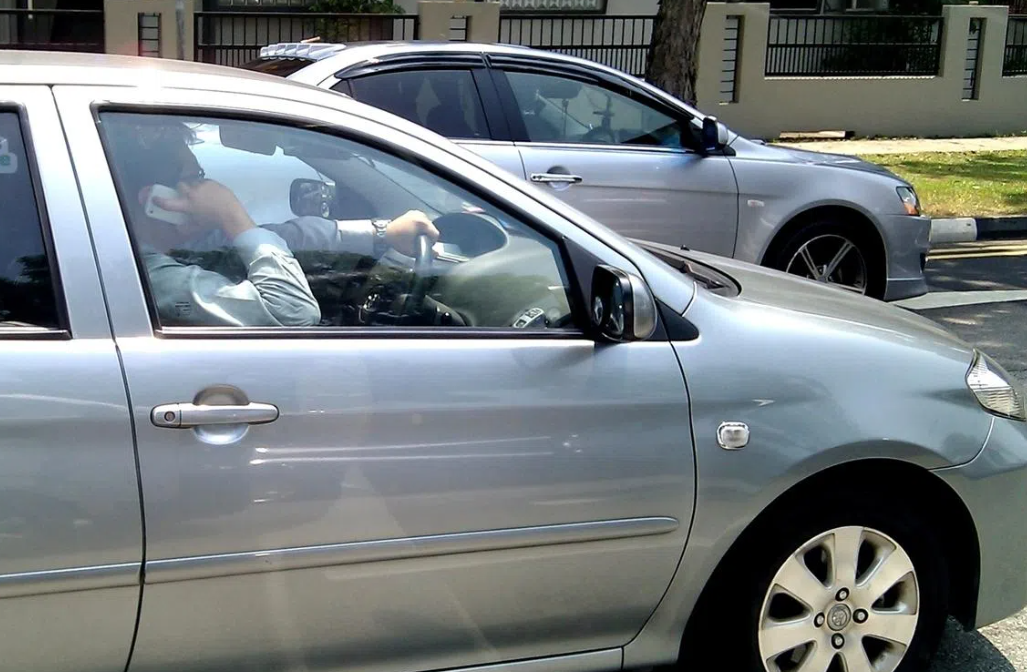
Singapore is moving to criminalize the simple act of holding a smartphone while driving, even if the device is not being actively used, under sweeping amendments to its road traffic legislation tabled this week. The Ministry of Home Affairs justified the crackdown by pointing to deteriorating road safety, with traffic deaths reaching a decade-high of 149 last year compared to 141 in 2016, and injuries surging from 9,342 in 2024 to 9,955 in 2025. Over the past five years, fatality rates have climbed approximately 24 per cent while traffic violations have jumped roughly 38 per cent, prompting authorities to describe the situation as a public safety emergency requiring legislative intervention.
The proposed Road Traffic (Miscellaneous Amendments) Bill represents a fundamental shift in enforcement philosophy by removing the requirement that authorities prove a driver was actively using a phone. Under existing law, officers must demonstrate that a motorist was texting, calling, or otherwise engaging with their device to secure a conviction—a burden that has complicated enforcement efforts. The new approach classifies merely possessing a phone while the vehicle is in motion as a standalone offence, based on the reasoning that the presence of such a device inherently distracts from road focus and increases accident risk.
This change will have immediate practical consequences for law enforcement. The Traffic Police will gain the ability to leverage photographic and video evidence captured through fixed cameras or submitted by members of the public, substantially broadening their capacity to detect and prosecute offenders compared with the previous requirement for manual observation. The measure carves out an exception for mounted devices attached to dashboards or other fixtures, allowing drivers to retain their phones in such secured positions while ensuring genuine hands-free navigation and communication remain permissible.
Under the current legislative framework, drivers caught holding a phone while driving typically receive 12 demerit points and a financial penalty ranging from $400 to $500 through summary conviction procedures. In more serious circumstances, cases proceed to court prosecution, where first-time offenders face a maximum of six months' imprisonment and $1,000 in fines, with repeat offenders subject to up to one year in jail and $2,000 in penalties. The new legislation does not appear to specify what sanctions will accompany the expanded phone-holding offence, though the trajectory of Singapore's road traffic law suggests penalties will align with or exceed these existing thresholds.
Beyond distracted driving, the Bill introduces a novel offence addressing what authorities characterize as purposeful endangerment through vehicles—situations where drivers deliberately weaponize their cars to harm others. This category addresses a persistent gap in Singapore's criminal law, where perpetrators of such acts fall outside the scope of traditional homicide charges because the legal standard for murder or culpable homicide requires proof of intent to kill or knowledge that death was probable. A high-profile case illustrating this gap involved Jarrett Tee Lee Kiat, who raced on an expressway and killed an 18-year-old teenager; despite causing death, the most serious charge available was dangerous driving, for which he received five years and eight months imprisonment.
The new purposeful endangerment offence creates a middle ground allowing courts to impose sentences proportionate to culpability in cases where drivers clearly abuse vehicles to injure others but where the strict legal requirements for murder cannot be satisfied. Conviction under this provision carries a maximum sentence of 15 years imprisonment, corporal punishment through caning, substantial fines, and mandatory driving disqualification for life or a minimum of 10 years if extenuating circumstances warrant shorter duration. This framework represents a significant escalation in available penalties and signals the judiciary's authority to punish reckless endangerment more severely.
The amendments also substantially increase penalties for conventional dangerous and careless driving resulting in grievous injury. For dangerous driving causing grievous hurt, maximum prison terms will rise from five to seven years for first-time offenders and from 10 to 13 years for those with prior convictions. Cases involving aggravating circumstances—particularly alcohol consumption—will face additional jail exposure of up to 18 months, elevated from the previous one-year cap. These enhancements reflect judicial concerns articulated during recent sentencing decisions, notably a case in which a High Court judge expressed doubt that existing maximum penalties adequately addressed the most egregious traffic offences.
The legislative impetus for these changes partly stems from the sentencing of Yoong Kok Kai, who struck an auxiliary police officer after driving home while intoxicated following multiple consecutive drinking episodes, leaving the victim in a vegetative state. When his original three-and-a-half year sentence was appealed, the High Court increased it to five years, with the presiding judge pointedly observing that there could be no justification for combining heavy alcohol consumption with vehicle operation. That same judge noted uncertainty about whether statutory maximums sufficiently reflected the severity of the worst-case scenarios, diplomatically suggesting that Parliament consider revisiting penalty structures.
For Malaysian and Southeast Asian readers, Singapore's approach merits attention as the city-state routinely serves as a bellwether for regional traffic safety policy. The shift toward using camera evidence and public submissions to prosecute phone-holding offences represents an enforcement innovation that neighbouring countries including Malaysia may eventually adopt, particularly given similar urban congestion and road fatality trends across the region. Malaysia's own road death statistics have periodically rivaled or exceeded Singapore's in absolute terms, and mechanically holding a phone whilst driving is demonstrably common across Southeast Asia.
The legislative package also reflects broader international trends toward specialized offences targeting vehicle-based violence, a category of harm that traditional homicide and assault statutes struggle to address adequately. This distinction between violence using vehicles and violence via conventional means exists in other Commonwealth jurisdictions and reflects recognition that a multi-tonne object in motion requires its own penal framework. For Malaysia and other nations in the region grappling with rising road trauma, Singapore's experience suggests that incremental penalties within existing categories have proven insufficient and that legislators must periodically recalibrate the severity of sanctions available.
Implementation of these amendments will likely present challenges around public acceptance and consistency in enforcement. Public submission of video evidence through cameras risks inconsistent prosecution and raises questions about evidentiary standards and judicial discretion in assessing footage quality. Similarly, the psychology of driver compliance will test whether enhanced penalties genuinely deter behaviour or merely shift enforcement intensity without fundamentally altering risk perception. Singapore's heavy-handed approach contrasts with some Southeast Asian jurisdictions that have emphasized education and infrastructure improvements alongside enforcement.

