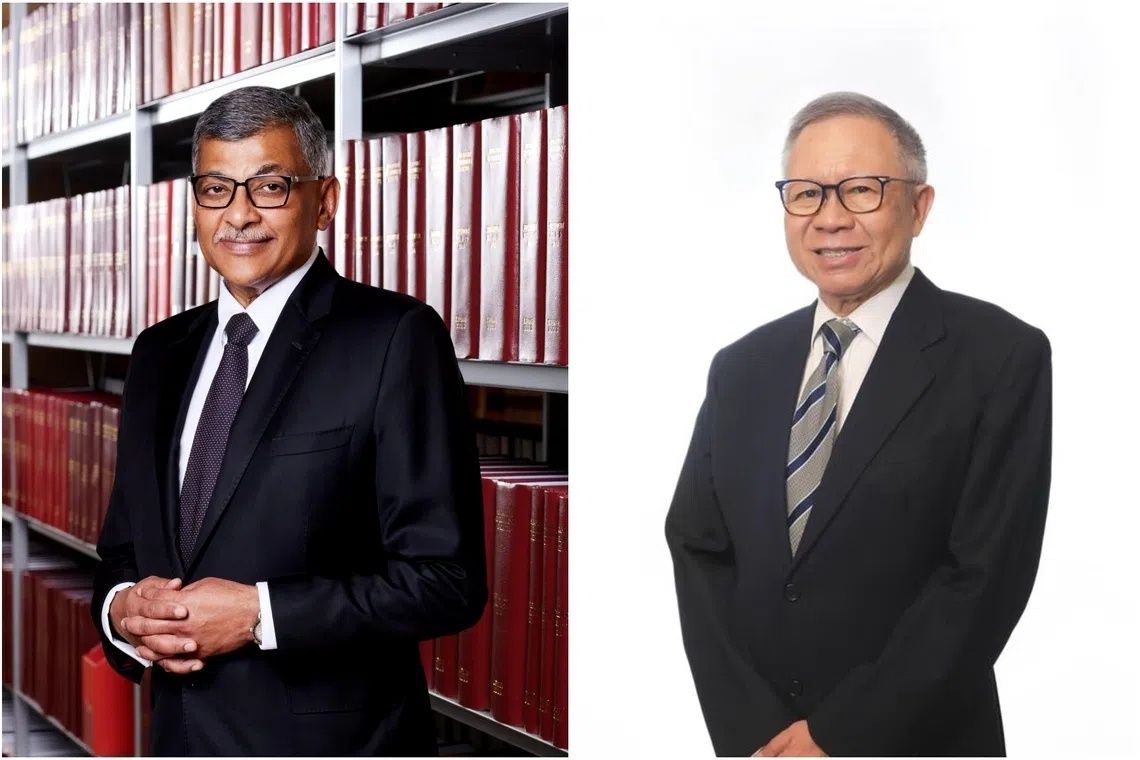
Singapore has recognised two towering figures in public administration with its highest civilian honour, bestowing the Order of Temasek (With Distinction) on Chief Justice Sundaresh Menon and Eddie Teo, the former chairman of the Council of Presidential Advisers, at the 2026 National Day Awards. The accolades underscore the city-state's tradition of celebrating institutional leadership, with both men representing nearly seven decades of combined service to the republic across the judiciary, defence, intelligence and governance sectors.
Menon, aged 62, has shaped Singapore's justice system over the past 14 years since assuming the role in November 2012. His impending departure from the bench on February 26, 2027, marks the end of a transformational era in the administration of justice. The Chief Justice has been instrumental in steering the judiciary through a comprehensive modernisation programme that extended far beyond routine administrative improvements, fundamentally redefining how Singapore's courts operate and serve the public.
The technological overhaul of Singapore's judiciary under Menon's stewardship represents one of the most significant institutional shifts in recent years. The judiciary underwent extensive digitalisation to improve case management and accessibility, while new structures were simultaneously introduced to enhance specialisation. The establishment of the Appellate Division of the High Court streamlined appellate processes, whilst the creation of the Singapore International Commercial Court positioned the nation as a premier venue for resolving international commercial disputes. These developments collectively strengthened Singapore's competitive advantage in the region's legal services landscape, attracting multinational corporations and international law firms seeking trusted dispute resolution mechanisms.
Beyond infrastructure, Menon championed a shift in judicial philosophy through the adoption of therapeutic justice approaches in the Family Justice Courts and Youth Courts. This paradigm prioritises rehabilitation and restoration over purely punitive outcomes, particularly for vulnerable populations. The establishment of the Singapore Judicial College represented a parallel commitment to continuous judicial education, ensuring that judges remained apprised of evolving jurisprudence and best practices. In a statement reflecting on his tenure, Menon emphasised that the judiciary's strength rests upon the collective efforts of judges, court officers, legal professionals and support staff, and that the award recognises their shared dedication to upholding the rule of law that has defined Singapore's governance since independence.
The recognition carries particular symbolic weight as it coincides with the bicentennial of Singapore's legal and judicial system, allowing the nation to commemorate both historical achievement and contemporary institutional excellence. Menon's characterisation of his role as "the greatest privilege and honour" of his professional career underscores the reverence accorded to the position of Chief Justice in Singapore's institutional hierarchy, whilst simultaneously placing the award in the broader context of Singapore's foundational commitment to legal certainty and judicial independence.
Eddie Teo's path to this honour reflects an even more extensive tenure in public service spanning 56 years. The 79-year-old began his career in 1970 within the Ministry of Defence's Security and Intelligence Division, eventually rising to its directorship at the remarkably young age of 31, a position he held through 1994. His subsequent movements through progressively senior positions—permanent secretary for defence from 1994 to 2000, and permanent secretary in the Prime Minister's Office from 1998 to 2005—positioned him as a key architect of Singapore's governance structures during a period of rapid economic expansion and geopolitical complexity.
Teo's chairmanship of the Public Service Commission from 2008 to 2018 exemplified his commitment to institutional reform and diversity. During a decade of significant change, he deliberately broadened the PSC's composition by recruiting members from varied professional backgrounds spanning academia, law and social work, a strategic diversification that enriched the commission's perspective on public sector recruitment and development. Following his retirement from the PSC in 2018, Teo transitioned to the Council of Presidential Advisers, serving as chairman until June 2026, an advisory body charged with reviewing government expenditure of Singapore's accumulated reserves—a role of considerable constitutional and economic significance.
Teo's tenure at the helm of the CPA earned particular distinction during the Covid-19 pandemic, when Singapore's government accessed approximately S$40 billion (US$31.3 billion) from the nation's reserves, representing the largest withdrawal since the fund's establishment. This substantial deployment of accumulated resources required thorough scrutiny and approval from the council and then-President Halimah Yacob, underscoring the checks and balances embedded within Singapore's fiscal governance framework. The judicious deployment of these reserves enabled Singapore to stabilise its economy during unprecedented disruption while maintaining employment and supporting businesses without accumulating excessive public debt—an outcome that vindicated both the policy design and the council's stewardship.
Teo's career reflects a particular generation of Singapore's leadership that had direct exposure to the nation's founding figures. He specifically highlighted his first two decades of service as foundational, acknowledging the mentorship he received from Lee Kuan Yew, Goh Keng Swee and former President S. R. Nathan. These relationships positioned Teo within a lineage of institutional knowledge and leadership philosophy that shaped Singapore's post-independence trajectory. His reflection on his career emphasises the intellectual and moral satisfaction derived from public service, and implicitly serves as an endorsement of such careers for potential entrants to the civil service considering their professional futures against alternative private sector opportunities.
The two recipients represent a significant transnational lesson for Southeast Asian governance, particularly regarding institutional continuity and the cultivation of long-serving, professionally dedicated leadership. Unlike systems where political transitions frequently displace senior officials, Singapore's approach emphasises meritocratic advancement and institutional stability as determinative factors in governance quality. Both Menon and Teo built their careers through demonstrated competence, rising through hierarchical systems that prioritised performance and eventually reached positions from which they could shape institutional values and practices.
For Malaysian observers, the recognition accorded to these figures warrants particular reflection on the architecture of institutional independence and professional accountability in the region. Singapore's emphasis on judicial modernisation, the rule of law as a foundational governance principle, and the professionalisation of the civil service through merit-based advancement offers a comparative model worth examining. The bicentennial recognition of Singapore's legal system signals a society's self-conscious investment in narratives of institutional excellence, whilst Teo's career trajectory demonstrates how sustained public service can yield high-level positions of constitutional importance.
The 2026 National Day Honours recognised 7,491 individuals across various categories, reflecting Singapore's practise of honouring service across sectors. Beyond the two Order of Temasek recipients, five individuals received the Distinguished Service Order, including Land Transport Authority chairman Alan Chan, whose leadership in public transport modernisation resulted in dramatic reliability improvements—rail mean kilometres between failures increased from 393,000 in 2017 to two million in 2026—and delivered major infrastructure projects including the Thomson-East Coast Line. Former Civil Aviation Authority of Singapore chairman Edmund Cheng was similarly recognised for his diverse contributions spanning aviation sector development and social rehabilitation work.
These awards collectively reflect Singapore's institutional culture of public recognition for senior officials, a practise that serves multiple functions: it reinforces meritocratic values by celebrating achievement, provides continuity narratives spanning decades of institutional development, and implicitly establishes exemplary standards for aspiring public servants. The honours awarded to Menon and Teo, in particular, suggest that Singapore's political leadership views sustained institutional reform and professionalised governance as achievements worthy of the state's highest civilian recognition, a message resonating throughout the region's administrative communities.

