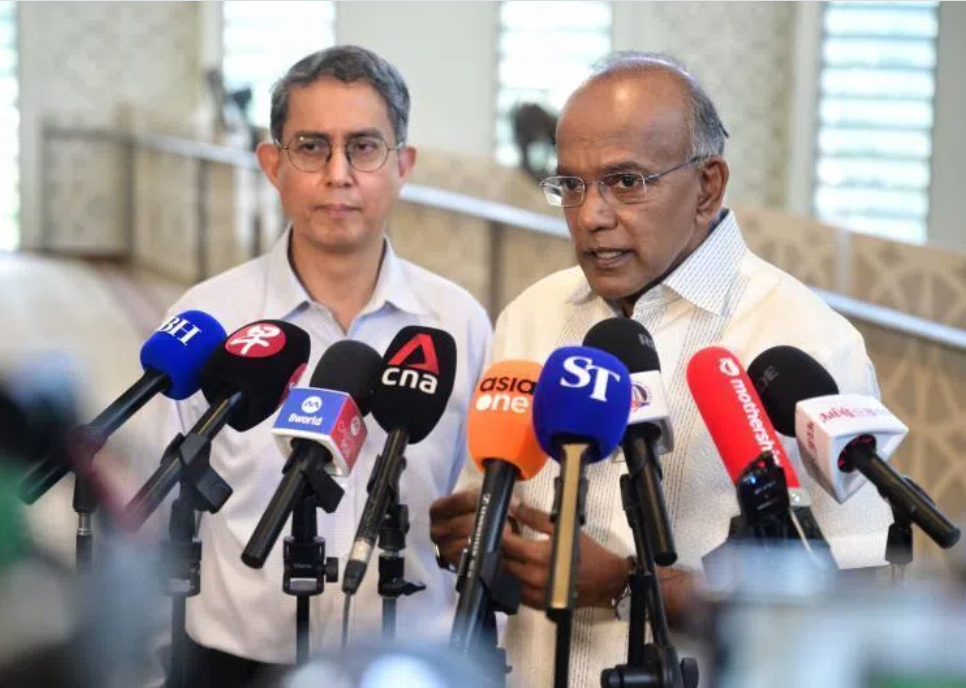
Singapore's Home Affairs Minister K Shanmugam has publicly defended the treatment of former Minister-in-charge of Muslim Affairs Faishal Ibrahim following his resignation over a controversy involving online communications with a member of the public. In a statement released on Wednesday, Shanmugam characterised the interactions between Faishal and an unnamed woman as objectively inappropriate, whilst maintaining that the former minister had received equitable treatment throughout the process and had himself recognised the necessity of stepping down from his parliamentary and ministerial roles.
The sequence of events began when Faishal transmitted his resignation letter to Prime Minister Lawrence Wong on July 20, explicitly stating that no physical relationship had developed between himself and the woman involved, and that he had never deliberately intended for their exchanges to evolve into something inappropriate. Shanmugam's subsequent commentary, however, focused on the nature of the online interactions themselves rather than the substance of Faishal's explanations. According to the Home Affairs Minister, a series of digital exchanges occurred between the two parties, during which Faishal expressed concern that abruptly severing contact with the woman might provoke an adverse reaction from her.
Where Shanmugam's analysis proved particularly significant was his assessment of how Faishal's continued engagement with the woman was perceived and interpreted. Rather than viewing the former minister's responses as merely friendly or professional, the woman understood them as encouragement to persist in the correspondence. This misalignment between intention and perception represents a critical element in understanding why the interactions ultimately crossed professional boundaries. When Faishal eventually attempted to disengage from the online exchanges, the situation escalated, with the woman subsequently expressing anger at his withdrawal and eventually taking her grievance directly to the Prime Minister's Office by submitting electronic correspondence that included selected messages and photographs from their interactions.
The escalation from private communication to governmental complaint fundamentally altered the nature of the controversy. Shanmugam emphasised that once the woman approached Prime Minister Wong with allegations of harassment, the matter transformed from what might have remained a confidential interpersonal dispute into something carrying public significance. Both parties levelled accusations against one another—Faishal claimed the woman had harassed him, prompting authorities to refer the matter to police for investigation. This dual complaint mechanism underscored the complexity of the situation and justified the government's decision to scrutinise Faishal's conduct as a public office holder.
The ministerial statement outlined the governing principles that have shaped Singapore's approach to personal conduct standards among its political leadership. These benchmarks, established by founding Prime Minister Lee Kuan Yew and reinforced more recently by Senior Minister Lee Hsien Loong, distinguish between matters that remain entirely private and those that enter the public sphere. According to this framework, behaviour that qualifies as inappropriate but remains confidential and ceases after counselling may theoretically remain a private affair. However, once such conduct becomes known through formal complaint or public disclosure, the government deems examination and potential disciplinary action as necessary responses to maintain the integrity of public service.
Faishal's political career, spanning nearly two decades, presented a notable arc of advancement within Singapore's governing People's Action Party structure. Beginning in 2006 as part of the Marine Parade Group Representation Constituency team, he secured reelection across three subsequent parliamentary terms before returning to Marine Parade ahead of the 2025 General Election, where his team achieved an uncontested victory. His pre-political background as a real estate professor at the National University of Singapore brought academic credentials to his legislative work. His rise through ministerial ranks occurred incrementally: parliamentary secretary for transport in 2012, senior parliamentary secretary holding education and social-family development portfolios by 2017, minister of state by 2020, and finally senior minister of state and acting minister following Prime Minister Wong's cabinet reorganisation in May 2025.
Shanmugam's personal assessment of Faishal provided a counterbalance to the necessary acknowledgment of procedural impropriety. The Home Affairs Minister characterised his former colleague as conscientious, deeply committed to constituency service in Nee Soon GRC, and genuinely motivated by service-oriented principles. Shanmugam's declaration that he had rarely encountered individuals—whether within government or beyond—of comparable calibre to Faishal suggested that the resignation, whilst procedurally sound, represented a loss for Singapore's political leadership. This nuanced position avoided either whitewashing the conduct that necessitated Faishal's departure or diminishing recognition of his broader contributions to public service.
The circumstances surrounding Faishal's case carry particular relevance for Southeast Asian political contexts where government accountability and standards of ministerial conduct remain subjects of ongoing debate and development. Singapore's approach—balancing individual privacy with public interest considerations—reflects a specific institutional maturity in separating personal from professional spheres whilst maintaining that public office holders operate under elevated scrutiny. The fact that Faishal himself arrived at the conclusion that his positions had become untenable, rather than requiring forcible removal, suggests that the government's process allowed for reflection and personal agency within its investigative framework.
For Malaysian observers, the Singapore precedent illustrates how a political system approaches the intersection of personal conduct and public office in contemporary contexts. The importance placed on fairness in proceedings, the distinction between private misstep and public complaint, and the capacity for a political figure to maintain reputation for broader service even whilst being held accountable for specific conduct represent elements that resonate across the region. Faishal's resignation also occurred within the context of an uncontested election victory mere weeks prior, demonstrating that political success and personal conduct vulnerabilities can operate as parallel rather than mutually exclusive phenomena in electoral systems.

