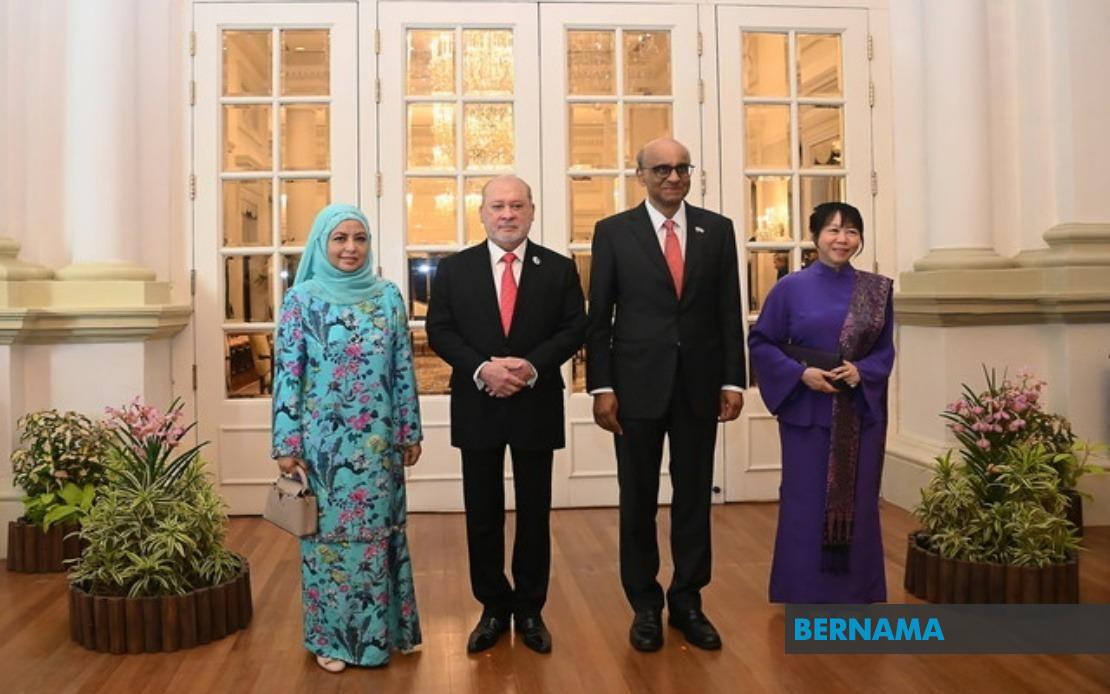
Singapore President Tharman Shanmugaratnam arrives in Malaysia this month for a three-day state visit, bringing with him a carefully articulated message about the future of bilateral relations that extends far beyond the infrastructure projects and trade agreements typically dominating the two nations' interactions. In an exclusive interview, the president has framed the Singapore-Malaysia relationship as fundamentally rooted in accumulated trust built over six decades, a foundation he argues must be actively renewed and deepened rather than taken for granted in an increasingly fractious global environment.
The timing of President Tharman's visit, at the invitation of His Majesty Sultan Ibrahim, King of Malaysia, carries symbolic weight given the shifting geopolitical landscape in Southeast Asia. The president's language deliberately moves away from transactional framing, instead emphasizing the need for both nations to view their partnership as essential to navigating global turbulence. This rhetorical shift reflects a recognition that the Malaysia-Singapore relationship, despite its historical intimacy, requires conscious reinforcement to remain resilient through periods of strain.
Central to the president's vision is the notion that shared heritage—encompassing languages, customs, and cultural traditions refined over centuries—provides an essential counterweight to occasional disagreements. The recent joint UNESCO recognition of the kebaya alongside Brunei, Indonesia, and Thailand, along with ongoing efforts to secure recognition for Chingay, represents more than cultural celebration. These initiatives function as deliberate mechanisms for sustaining traditions and transmitting them to younger generations, creating continuity in identity even as both societies modernize.
President Tharman explicitly acknowledges that disputes between close neighbours are inevitable, yet he frames the management of such differences as the true test of partnership maturity. This candid recognition of tensions—past and potential future—distinguishes his approach from earlier diplomatic rhetoric that sometimes minimized disagreements. By affirming that successive governments have chosen not to be constrained by sensitive bilateral issues, the president validates both nations' track records of pragmatic dispute resolution while signalling that dialogue and mutual understanding remain non-negotiable principles.
The economic dimension of bilateral cooperation receives substantial attention, particularly regarding emerging sectors where integration could yield transformative benefits. The Johor-Singapore Special Economic Zone represents an attempt to model win-win collaboration through complementary strengths, while the Rapid Transit System Link addresses the practical daily reality of hundreds of thousands of commuters crossing the Causeway—the world's busiest land border crossing. These projects demonstrate how bilateral cooperation translates into tangible improvements for ordinary citizens, grounding abstract partnership commitments in lived experience.
Climate and energy cooperation emerge as crucial frontiers for deepened integration. As tropical nations facing similar environmental challenges and having committed to sustainability targets, Singapore and Malaysia possess obvious incentives to collaborate in renewable energy and carbon credit markets. The president's emphasis on this dimension reflects recognition that addressing climate transition requires regional coordination rather than isolated national approaches, a reality with particular resonance for Southeast Asian countries vulnerable to environmental disruption.
The digital economy represents another frontier where President Tharman envisions transformative potential. The recently concluded ASEAN Digital Economy Framework Agreement, scheduled for signature at November's 49th ASEAN Summit in Manila, could theoretically double Southeast Asia's digital economy from a projected US$1 trillion to US$2 trillion by 2030. For Malaysia and Singapore, positioning themselves as champions of this framework carries implications beyond their bilateral relationship, extending to their roles as ASEAN anchors influencing the entire region's economic trajectory.
People-to-people connectivity receives particular emphasis, with the president acknowledging that what previous generations experienced naturally now requires deliberate facilitation. This observation carries implications for Malaysian readers concerned with sustaining the Malaysia-Singapore relationship beyond current leadership. The prescription—expanded bilateral exchange programmes, joint internships, youth leadership forums, and collaborative community projects—targets younger cohorts who lack the historical memory of pre-independence intimacy and must therefore construct connection through intentional engagement.
Within the broader ASEAN context, President Tharman positions Singapore and Malaysia as custodians of the organization's relevance and coherence. His acknowledgment of Malaysia's successful 2025 ASEAN Chairmanship—highlighted by welcoming Timor-Leste as the eleventh member and advancing digital economy frameworks—reinforces the notion that both nations share interest in maintaining ASEAN's centrality amid great-power competition. The reference to Singapore's upcoming 2027 Chairmanship suggests an implicit partnership whereby both nations will work to preserve ASEAN's institutional strength and utility during a critical period.
The president's framing of regional stability deserves particular attention. Rather than characterizing stability as resulting from the absence of disputes, he argues it depends on the discipline to manage disagreements responsibly. This conceptual reframing carries implications beyond Singapore-Malaysia relations; it implicitly challenges competing regional narratives suggesting that escalating tensions render multilateral frameworks obsolete. For Malaysian and Southeast Asian readers, this argument provides intellectual scaffolding for defending ASEAN's relevance and the Malaysia-Singapore partnership against skepticism from those advocating alignment with competing power blocs.
The emphasis on rules-based order and adherence to international law connects bilateral relations to the broader regional architecture Singapore and Malaysia have helped construct. As founding ASEAN members, both nations have vested interests in preserving institutional frameworks that privilege dialogue over coercion. This positioning becomes especially significant given current regional tensions, where alternative approaches emphasizing unilateral assertion or power politics gain occasional traction.
President Tharman's references to his personal experiences—travels throughout Malaysia, appreciation of its cultural evolution, and enjoyment of Malaysian cuisine—serve rhetorical functions beyond sentiment. These touches humanize the relationship, demonstrating that bilateral ties involve genuine affection and personal investment rather than abstract government interest. For Malaysian audiences, such expressions validate that Singapore's leadership values Malaysia beyond its utility as a strategic partner or economic collaborator.
Ultimately, President Tharman's message frames the Singapore-Malaysia relationship as requiring active renewal precisely because it cannot be sustained on historical momentum alone. The metaphorical language of hearts shaking hands suggests intimacy and equality—a partnership between distinct entities choosing to connect—rather than hierarchical or subordinate relationships. For a region navigating great-power competition and institutional uncertainty, the Singapore-Malaysia relationship's demonstrated capacity for managing complexity through dialogue offers an instructive model, one the president seeks to strengthen and expand during his visit.

