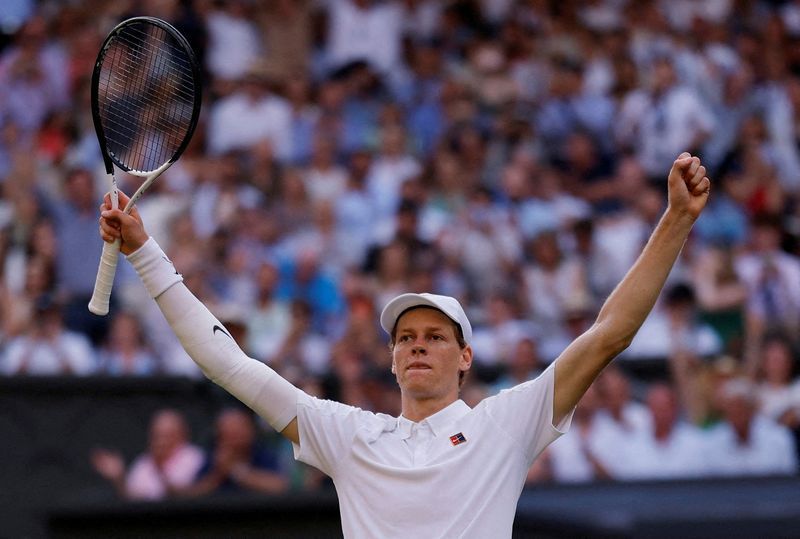
Jannik Sinner's return to Wimbledon as defending champion carries an unfamiliar weight of vulnerability. The Italian world number one will attempt to reassert his dominance on the All England Club's grass courts starting Monday, but his previously unshakeable aura has fractured following a physically-taxing campaign that culminated in a shocking second-round departure from the French Open. The 24-year-old's collapse in Paris, where a 30-match winning streak dating to February was abruptly terminated, has emboldened his rivals and raised legitimate questions about his ability to maintain elite performance across consecutive Grand Slams and varying surfaces.
Sinner's trajectory through the early part of 2024 appeared destined for historical significance. His devastating form on clay—the surface that should have suited him best—suggested he was constructing a legacy season comparable to the great champions. Yet the human cost of that relentless push became evident in Paris when his body simply could not sustain the intensity required. The accumulated fatigue from playing numerous tournaments with insufficient recovery time between events left him depleted precisely when Grand Slam pressure demanded his highest level. This vulnerability transforms Wimbledon from a celebration of retained dominance into a crucial test of resilience and adaptability.
Mats Wilander, the seven-times Grand Slam champion who has observed elite tennis across generations, believes Sinner remains the player to beat despite his recent stumble, particularly with Carlos Alcaraz sidelined by injury. However, Wilander's assessment carries an important caveat: grass courts possess unique challenges that even the most complete players cannot entirely predict or control. Wilander suggested that Sinner's well-deserved rest period following Paris should restore him to full strength, but acknowledged that the Frenchman's tournament posed different, perhaps more manageable, demands than what awaits on London's faster, less predictable surface. The Italian's decision to skip tune-up tournaments before Wimbledon reflects either cautious preparation or concerning uncertainty about his readiness—interpretations that will shape market expectations and opponent psychology.
Novak Djokovic emerges as the narrative's most compelling counterpoint to Sinner's continued dominance. The 39-year-old Serbian champion cannot be dismissed despite his own early French Open exit, particularly given his unmatched credentials on grass where movement and return-of-serve capabilities translate into genuine competitive advantages. Djokovic pursues his eighth Wimbledon title, which would match Roger Federer's record, but more significantly, he remains locked in his pursuit of an elusive 25th Grand Slam championship—a milestone that grows more distant as his career enters its final chapter. Andy Roddick, himself a Wimbledon finalist, articulated Djokovic's current mindset with precision: the Serb views this tournament as genuinely his best remaining opportunity to achieve both objectives before time inevitably runs out. Such motivation can transform even a 39-year-old's performance, particularly on a surface where tactical intelligence and experience compound technical excellence.
Alexander Zverev's emergence as a serious Wimbledon contender represents perhaps the most significant shift in the tournament's competitive landscape. The German's long-awaited Grand Slam breakthrough at Roland Garros fundamentally altered perceptions of his capacity to sustain excellence under the sport's heaviest pressure. Boris Becker, himself a six-times major champion and fellow German, has elevated Zverev into outright favourite status, an assessment that reflects both the vacancy created by Alcaraz's absence and Zverev's established credentials as a formidable grasscourt competitor. Becker's observation that Zverev's powerful serve essentially guarantees advancement to the semi-finals demonstrates how the German's weaponry aligns perfectly with grass's particular demands. The transition from clay success to grass contention requires adaptation, yet Zverev possesses the technical foundation to execute that shift more seamlessly than most players.
Alcaraz's injury, while reducing the tournament's star power, paradoxically enhances competitive opportunities for the secondary tier of contenders. The Spanish phenomenon's dominance across Wimbledon's 2023 and 2024 editions established him as grass's preeminent player, and his absence eliminates perhaps the only current player capable of imposing sustained superiority across the tournament. This removal fundamentally restructures the draw's probability distribution, shifting advantage away from the narrowly concentrated apex players toward a broader constellation of capable challengers. American talents including Ben Shelton, Taylor Fritz, and Frances Tiafoe possess the baseline power and serve speed to trouble even the most accomplished opponents on this surface.
Flavio Cobolli, the French Open runner-up representing the next generation's emerging force, will seek to capitalize on Wimbledon's expanded opportunities. The Italian's Roland Garros performance demonstrated that young players can navigate the sport's most demanding events successfully, and grass's different demands may suit his developing game. The departure of Alcaraz creates a vacuum not merely at the title level but throughout the tournament's depth, allowing unseeded and lower-ranked players realistic pathways to significant runs that would seem impossible in a fully-constituted field.
Sinner's positioning as defending champion fundamentally complicates his psychological landscape. Retaining a Grand Slam title requires not merely reproducing previous success but exceeding it, since opponents arrive with accumulated tactical information and heightened preparation specifically calibrated to neutralize his dominant patterns. The grass surface, while offering Sinner a reset opportunity in terms of physical recovery, simultaneously presents challenges distinct from clay. Grass rewards aggressive baseline construction and serve-based directness more consistently than the defensive counterattacking that can prevail on Roland Garros' clay. Whether Sinner can adjust his gameplan while simultaneously managing the residual physical concerns that manifested in Paris remains the central question animating expert commentary.
The tournament's competitive texture has shifted fundamentally from recent years when Alcaraz and Sinner dominated headlines through mutual excellence. This edition features a more unsettled hierarchy where multiple credible pathways to the final exist simultaneously. Djokovic's return to serious contention, Zverev's momentum, and Sinner's demonstrated fragility combine to create genuine uncertainty regarding outcomes. The All England Club's 2024 edition promises to test not merely technical proficiency but mental fortitude, strategic adaptation, and the capacity to maintain elite consistency across surfaces and circumstances.

