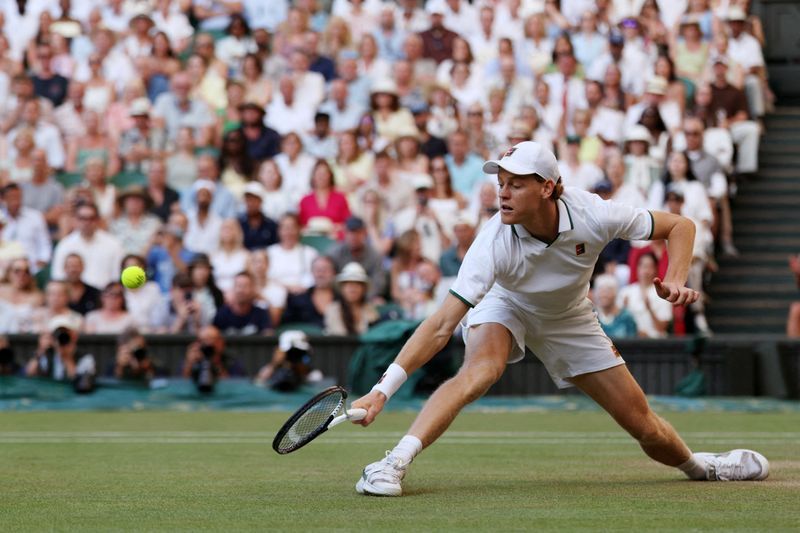
World number one Jannik Sinner will not compete at the US Open later this month following a persistent right knee injury that has sidelined him for the past several weeks. The Italian announced his withdrawal on Friday, dealing a significant blow to the field's competitive depth at the season's final Grand Slam tournament scheduled for New York from August 23 to September 13.
At just 24 years old, Sinner had been among the tournament's most formidable contenders heading into the competition. His recent form had been exceptional, including a fifth major title victory at Wimbledon last month that underscored his standing as the sport's top-ranked player. However, the injury sustained earlier this month has proven more troublesome than initially anticipated, forcing a cautious approach to his recovery timeline.
The South Tyrolean's medical team and coaching staff determined that pushing forward would compromise his long-term health and competitive future. In a statement posted on social media, Sinner explained that despite intensive rehabilitation efforts at the Monte Carlo training facility over recent days, he remains unable to resume competitive play at the required intensity. "Even though I have been working hard with my team and my medical staff, we have now had to make the difficult decision that I will not be able to compete at the U.S. Open this year," he said, acknowledging the frustration of missing a major championship at his peak.
The injury cost Sinner participation in two crucial hard-court tune-up events that typically prepare players for the US Open's demanding surface and conditions. He withdrew from both the Cincinnati Open and the Canadian Open, tournaments that serve as vital preparation for a major championship. These absences illustrated the severity of the knee issue, as missing such prestigious warm-up competitions is unusual for a player of his calibre unless injury concerns are substantial.
Sinner's absence fundamentally reshapes the tournament landscape, particularly benefiting his primary rival on the men's circuit. Spain's Carlos Alcaraz, ranked number two globally, confirmed his participation at Flushing Meadows just one day before Sinner's announcement, representing his return to competitive tennis following a four-month layoff caused by his own injury difficulties. Though Alcaraz's recent form remains uncertain given the extended break, he now arrives in New York as the tournament's highest-ranked competitor and among the strongest favourites for the title.
Alcaraz's positioning as the clear frontrunner carries additional significance given the historical context between these rivals. The Spaniard defeated Sinner in last year's US Open final, demonstrating his ability to perform under pressure at this particular venue. With Sinner absent, Alcaraz's path to an eighth Grand Slam crown appears considerably less obstructed, as he no longer faces his most consistently competitive opponent in the tournament draw.
The dynamics of professional tennis at its highest level frequently hinge upon the fitness of top-ranked players. Sinner's withdrawal exemplifies the precarious nature of competing at elite levels, where the difference between peak performance and injury management can determine major championship outcomes. The timing also highlights the compressed scheduling that characterises the modern tennis calendar, particularly during the summer Grand Slam season when back-to-back tournaments provide limited recovery periods.
From a regional perspective, Sinner's injury and subsequent withdrawal carries implications for how elite athletes manage their careers during demanding tournament schedules. Southeast Asian tennis enthusiasts and aspiring professionals observe these decisions as instructive case studies in career longevity. The willingness of top players to prioritise long-term health over short-term tournament participation represents a shifting paradigm in professional sports management, contrasting with earlier generations' approaches.
The US Open will proceed with an altered competitive landscape, featuring a reduced contingent of established champions and potentially creating opportunities for emerging players. While Sinner's absence disappoints from a quality-of-field perspective, it underscores the unpredictability that makes tennis compelling. Tournament organisers and broadcasters face the reality that even scheduling the year's final major championship cannot guarantee the participation of the world's finest talent when injuries intervene.
Alcaraz's readiness to compete after four months away from official matches introduces its own uncertainty into predictions. While he carries the favourite's designation given his ranking and pedigree, extended absences from competitive play often produce unexpected outcomes as players reacclimate to match conditions and intensity. The Spaniard will attempt to navigate the tournament while managing his own physical conditioning concerns, creating a narrative thread that will likely define the championship's opening rounds.

