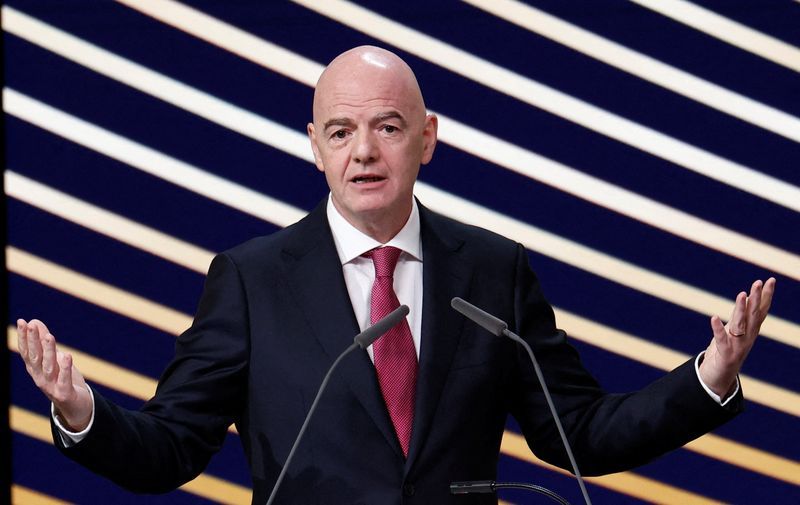
Gianni Infantino's strategy for surviving the gravest threat to his FIFA presidency may ultimately hinge not on reconciling with Europe's football giants but on leveraging the substantial financial commitments his administration has made to soccer's poorest and smallest nations. The Swiss administrator confirmed his intention to seek a fourth term at next year's Congress in April, but the political turbulence shows no sign of abating as regional heavyweights abandon ship following his ill-fated proposal to monetise World Cup matches through private equity investment.
The speed of Infantino's political deterioration has been striking. Wales became the first federation to formally withdraw its support on Monday, while UEFA—representing 55 European nations—signalled it was considering legal action against the FIFA president over the private equity initiative. More significantly, UEFA had previously voted unanimously to boycott all FIFA tournaments should the stake sale proceed, a nuclear option that highlights the depth of displeasure among traditional football powers. CONCACAF, the governing body for North and Central American football, has also declared no confidence in his leadership, creating a formidable coalition of opposition from regions that have historically wielded considerable influence within world football's structures.
Yet the constitutional mechanics of FIFA's governance create significant friction against any effort to dislodge Infantino before his term naturally concludes in 2026. An Extraordinary Congress could theoretically be triggered if 20 percent of FIFA's 211 member associations submit a written request for a vote of no confidence. UEFA alone, with its 55 nations, possesses sufficient numbers to unilaterally demand such a session, which would need to convene within three months of the petition. However, actually assembling a majority coalition to remove an incumbent president represents an altogether different proposition than simply calling for a vote. The arithmetic of FIFA's democratic structure presents Infantino with an unexpected advantage despite his current isolation among football's establishment.
FIFA's voting system grants each of its 211 member associations precisely equal standing regardless of economic capacity, sporting history, or global influence. This egalitarian structure fundamentally alters the political landscape when compared to conventional international organisations weighted by wealth or population. A nation like Bhutan, which has never qualified for a World Cup and operates a modest domestic football programme, carries exactly the same voting power as France, Spain, or England. This democratic levelling-of-the-playing-field works decisively in Infantino's favour given the distribution of his political patronage and the asymmetrical dependence it has created.
The financial architecture supporting this political dynamic became even more favourable to the FIFA president during his tenure. Member associations have been able to claim up to $3 million for football development initiatives during the 2023-2026 World Cup cycle, representing a $1 million increase compared to the previous quadrennial period. For wealthy federations operating professional leagues with substantial commercial revenue, these grants constitute marginal supplements to existing budgets. However, for emerging nations across Asia, Africa, the Caribbean, and the Pacific, FIFA's development funding frequently represents the difference between maintaining competitive national teams and complete stagnation. The asymmetry in how these resources translate into political leverage cannot be overstated.
Vanuatu exemplifies this dynamic with particular clarity. The island nation of approximately 340,000 people ranks 160th globally in FIFA's official standings, yet its football association leadership has secured representation on FIFA's Executive Council through one of eight vice-presidential positions. Beyond this ceremonial elevation, FIFA's backing enabled Vanuatu to construct a 6,500-capacity stadium in Port Vila completed in 2022, funded through a $4.15 million development grant that the nation's modest economy could never have provided independently. Brian Kaltak, Vanuatu's pioneering professional footballer now playing for Perth Glory in Australia, credited Infantino's administration with transforming opportunities for emerging nations, emphasising how development projects have created pathways for players from the footballing periphery to participate in international competition.
This pattern of strategic investment replicates across the global south with remarkable consistency. FIFA's development financing has constructed training facilities, equipped gymnasiums, and funded coaching programmes across regions where national football associations operate with skeletal budgets and minimal commercial revenue. These investments possess undeniable genuine value—they genuinely advance football development in communities where such infrastructure would otherwise remain inaccessible—yet simultaneously construct a patronage network creating powerful disincentives for beneficiary nations to vote against the architect of their good fortune. The relationship between financial dependency and political compliance represents perhaps FIFA's most enduring institutional dynamic, regardless of the occupant of the presidency.
Infantino's political miscalculation regarding the private equity proposal has fractured his relationship with precisely those football confederations exercising maximum influence over global governance. UEFA's unanimous boycott position demonstrates that even the threat of disrupting international competition fails to intimidate Europe's federations when confronting what they regard as institutional corruption. CONCACAF's withdrawal of confidence signals that the Americas' traditional alignment with European perspectives on governance norms remains intact. Yet beneath this elite consensus operates a parallel universe of smaller nations with fundamentally different political calculations and economic realities.
The prospective removal campaign therefore confronts a mathematical puzzle with daunting complexity. Even assuming every UEFA member votes for Infantino's removal—itself an optimistic scenario given individual nations' varied relationships with FIFA—European votes represent approximately 26 percent of FIFA's total membership. Assembling the additional 25 percent required for a majority removal vote from the remaining 156 member associations distributed across Africa, Asia, Oceania, and the Americas presents exponentially greater organisational difficulty, particularly when many such associations receive no comparable alternative funding sources for their football programmes.
Critics of FIFA's governance structures contend that Infantino's funding model has deliberately reinforced institutional dynamics permitting political manipulation through financial dependency. The accusation holds considerable analytical weight—the concentration of discretionary development resources within the presidency's control creates asymmetrical leverage fundamentally incompatible with democratic governance principles. Yet this critique arrives at a moment when precisely these structural advantages provide Infantino his most credible political lifeline as traditional power structures simultaneously abandon him.
The approaching April Congress will reveal whether the damage inflicted by the private equity debacle extends sufficiently deep to overcome the structural advantages Infantino has cultivated through a decade of strategic investment in emerging nations. The outcome may ultimately depend on whether smaller footballing nations—having benefited substantially from FIFA's patronage during his tenure—view his removal as sufficient priority to forfeit the development partnership they value. For now, the developing world's football associations hold cards that European confederations can only envy, even as Infantino's political future teeters precariously.

