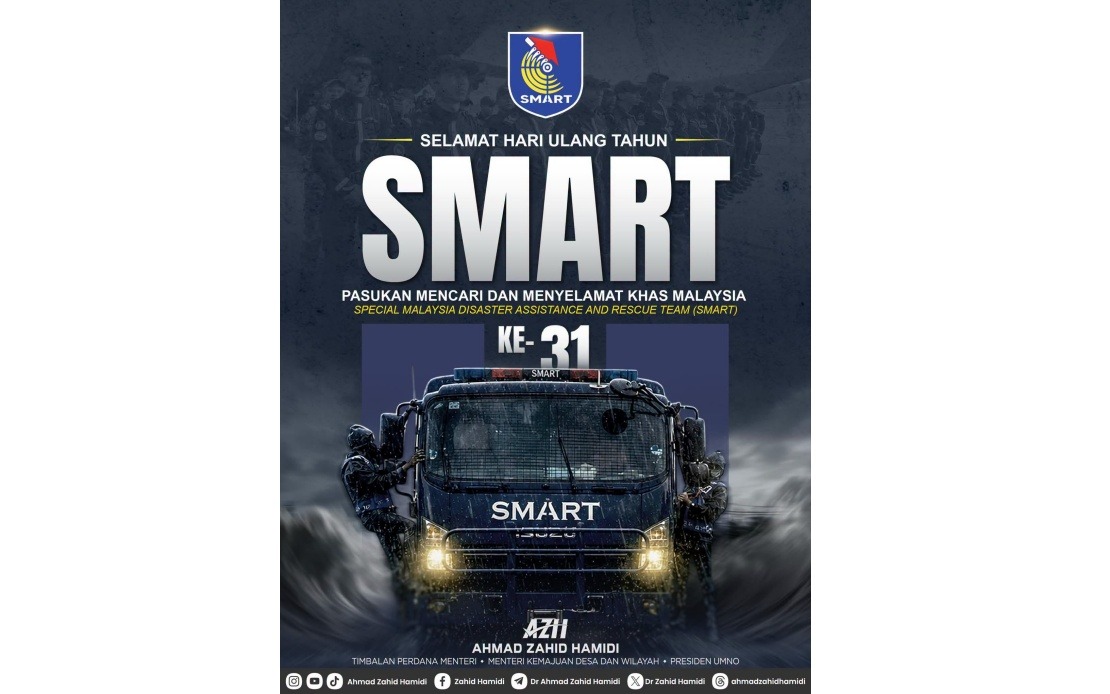
Malaysia's Special Malaysia Disaster Assistance and Rescue Team (SMART) is positioned to secure recertification as a Heavy Urban Search and Rescue (Heavy USAR) team, underscoring the nation's sustained commitment to maintaining elite disaster response capabilities. The recertification process through the International Search and Rescue Advisory Group (INSARAG) External Reclassification represents a critical milestone for a team that has become synonymous with professional emergency management across Southeast Asia and beyond. Deputy Prime Minister Datuk Seri Dr Ahmad Zahid Hamidi, speaking in his capacity as Chairman of the National Disaster Management Committee, highlighted the significance of this pursuit, framing it not merely as a technical achievement but as a demonstration of Malaysia's dedication to humanitarian excellence and international responsibility.
The implications of SMART's potential recertification extend well beyond the team's operational scope. Successful validation would reinforce Malaysia's standing within the global disaster management community, particularly relevant as climate change intensifies weather-related catastrophes throughout the region. The INSARAG classification system serves as the international standard for evaluating search and rescue capabilities, with Heavy USAR designation reserved for teams demonstrating exceptional technical proficiency, logistical sophistication, and proven real-world performance. For a nation positioned at the intersection of multiple geological and meteorological hazard zones, maintaining such certification signals institutional preparedness and operational maturity to both regional partners and the international community.
SMART's trajectory offers instructive lessons for understanding how national institutions evolve in response to tragedy and institutional learning. The team's establishment on August 1, 1995 emerged directly from the catastrophic collapse of Highland Towers condominium in December 1993, a disaster that exposed critical gaps in Malaysia's emergency response infrastructure. Rather than treating the tragedy as an isolated incident, Malaysian policymakers recognized the need for a fundamentally different approach to disaster management—one grounded in specialized training, advanced equipment, and professional discipline. This institutional response transformed a moment of vulnerability into a foundation for sustained excellence, creating a rescue capability that would eventually earn international recognition and respect.
When SMART achieved its initial Heavy USAR classification in 2016, the team secured a position of considerable distinction within Asia-Pacific disaster response architecture. As the second ASEAN nation to achieve this status, eighth in the Asia-Pacific region, and forty-sixth globally, SMART joined an extraordinarily selective cohort of teams meeting the most stringent international standards. This ranking reflects not casual competence but rather demonstrated mastery across multiple dimensions—technical rescue expertise, medical capability, logistics coordination, and command structure sophistication. The call sign MAS-1 has become recognized in international disaster response circles as synonymous with Malaysian professionalism and operational effectiveness.
Deputy Prime Minister Zahid emphasized the human dimensions underlying SMART's technical achievements, articulating a vision of rescue work that transcends mechanical procedure. His characterization of SMART personnel as individuals who "consistently place the safety of victims above their own interests" acknowledges the moral and psychological dimensions of emergency response that formal training protocols alone cannot instill. This framing resonates particularly within Malaysian and Southeast Asian contexts, where collective values and communal responsibility carry substantial cultural weight. The values Zahid identified—courage, determination, and sacrifice—function both as operational principles guiding individual decision-making and as cultural narratives that reinforce institutional identity and public legitimacy.
The recertification process represents an ongoing commitment to quality maintenance rather than a mere ceremonial renewal. International standards for Heavy USAR teams require continuous demonstration of capability through exercises, updated training, maintenance of equipment sophistication, and documented operational performance. For SMART, this means systematic investment in personnel development, technology acquisition, and operational readiness across more than two decades since initial establishment. Each recertification cycle demands institutional evidence that performance standards have not diminished—a requirement that compels constant internal scrutiny and improvement rather than permitting institutional complacency.
Regional disaster response architecture increasingly depends on networks of certified teams capable of rapid mutual support. Malaysia's maintenance of Heavy USAR status positions SMART as a reliable node within Southeast Asian emergency management infrastructure, capable of deploying expertise across international boundaries when catastrophic events overwhelm local response capacity. This mutual reinforcement mechanism strengthens the entire region's disaster resilience, particularly for smaller economies lacking resources to independently develop such specialized capabilities. SMART's international certification essentially validates Malaysia's capacity to serve as a regional resource, enhancing both national influence and humanitarian contributions.
The economic dimensions of maintaining Heavy USAR status merit consideration alongside humanitarian benefits. Disaster response and recovery represent significant economic factors for developing economies in hazard-prone regions. Rapid, effective rescue operations minimize casualty counts and facilitate faster economic recovery by reducing disruption duration and associated losses. SMART's international credibility enhances Malaysia's ability to attract international support during major disasters, as recognized certified teams typically benefit from coordinated international assistance mobilization. Furthermore, the existence of world-class domestic rescue capacity supports insurance markets, risk assessment frameworks, and business continuity planning by demonstrating genuine preparedness rather than mere aspiration.
Deputy Prime Minister Zahid's invocation of time pressure—"every second of search and rescue counts in saving lives"—encapsulates the operational reality driving SMART's institutional culture. This temporal dimension distinguishes disaster rescue from many other emergency services, creating psychological and operational pressures that demand exceptional training, equipment, and team cohesion. SMART's international recognition reflects successful navigation of these pressures across numerous actual deployment scenarios, from domestic incidents to overseas humanitarian missions. The team's track record demonstrates that institutional excellence achieved through systematic investment, rigorous training, and value-driven personnel selection produces measurable operational outcomes.
Looking forward, SMART's recertification pursuit must address evolving disaster typologies and emerging challenges within the Southeast Asian context. Rapid urbanization, climate change impacts, aging infrastructure, and increased population density in hazard zones create novel rescue scenarios requiring adaptive expertise. Successful recertification processes typically incorporate provisions for capability evolution, ensuring that teams update methodologies and equipment in response to changing threat landscapes. SMART's continued international engagement through recertification cycles positions the team to incorporate global best practices while contributing Malaysian operational knowledge to international disaster management discourse.
The institution's thirty-one year history demonstrates how specialized excellence emerges from institutional commitment, sustained investment, and principled personnel management. SMART's pursuit of recertification, while presented through administrative and technical frameworks, ultimately reflects Malaysia's determination to maintain the highest standards of public service delivery within a critical national security function. For Malaysian policymakers and citizens alike, SMART's potential recertification validation reaffirms that investment in institutional capacity, driven by clear national values and professional discipline, produces tangible benefits extending far beyond technical certification documents.

