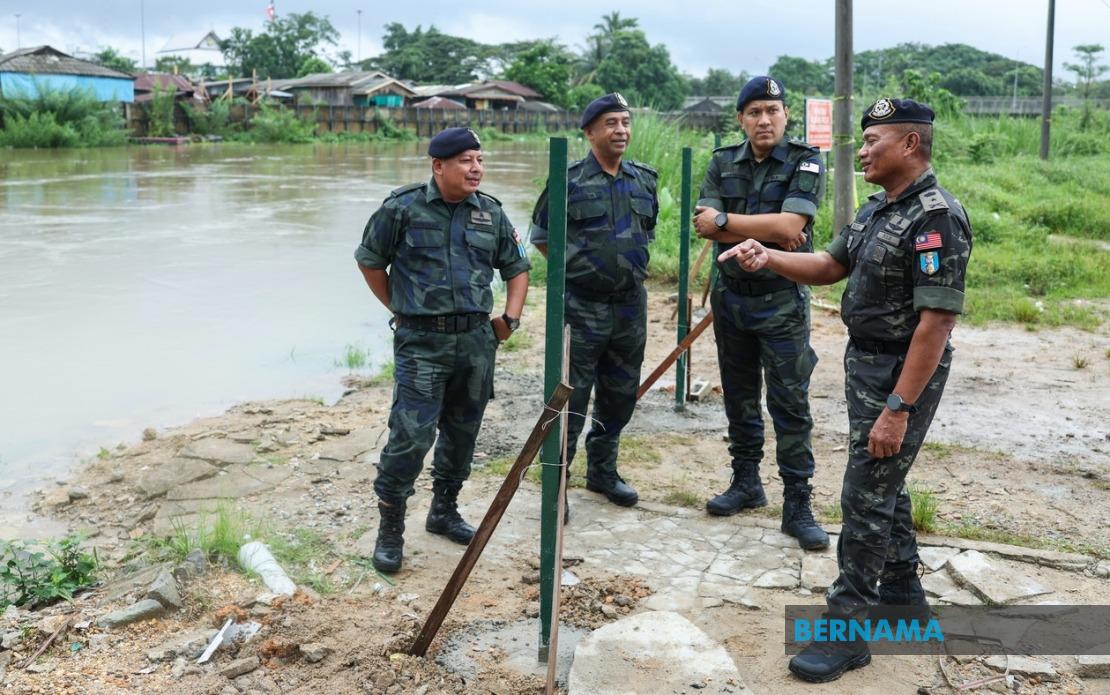
Operasi Taring Wawasan Kelantan, a targeted security operation by the General Operations Force (GOF), has exposed an evolving strategy employed by human trafficking rings operating across Southeast Asia's porous borders. During raids conducted in Pasir Mas, Kelantan, law enforcement arrested 13 Myanmar nationals—including five women—in what authorities characterise as a deliberate shift in smuggling tactics designed to circumvent the heightened vigilance of Malaysian security agencies. The operation underscores the cat-and-mouse dynamic between enforcement authorities and transnational criminal networks that continue to exploit migration pressures and labour demand across the region.
According to Southeast Brigade GOF commander SAC Ahmad Radzi Hussain, the syndicate's revised approach represents a calculated response to intensified border security measures. Rather than transporting large batches of migrants in conspicuous convoys, traffickers now disperse their cargo across multiple vehicles and staged drop-off points, fundamentally altering the operational profile that security forces have traditionally targeted. This methodological shift reflects the adaptive capacity of criminal organisations to modify their practices when enforcement pressure increases—a phenomenon documented repeatedly across Southeast Asia's irregular migration corridors. The granular, dispersed approach reduces the visibility of any single operation, making detection probabilistically harder despite the increased operational complexity required to manage multiple simultaneous movements.
The specific operation began in the pre-dawn hours of June 27 at approximately 3.30 am, when a GOF patrol team, acting on prior intelligence, identified a Proton Exora exhibiting suspicious behaviour near Kampung Banggol Kemian in Pasir Mas. When the driver detected the GOF presence, he abandoned the vehicle and fled into adjacent forest cover, evading immediate apprehension. A search of the vehicle itself yielded four Myanmar men from the rear compartment, all lacking valid travel documentation. This initial arrest prompted a wider sweep of the surrounding forest area, conducted in coordination with the Criminal Investigation Division of the Pasir Mas district police headquarters, which resulted in the discovery and arrest of nine additional Myanmar nationals approximately one hour later.
The arrested individuals, whose ages ranged between 20 and 37 years, provided authorities with details illuminating the trafficking network's operational structure. They reported having been transported from Thailand across the Golok River—a well-established crossing point exploited by multiple smuggling operations—by two unidentified facilitators whose identities remain unknown. Rather than conveying all migrants together, the traffickers had deliberately dispersed them across the forest terrain in sequential batches, with each group dropped at different locations and times. This staged release method creates temporal and spatial separation between groups, reducing the likelihood that any single law enforcement interdiction would dismantle the entire operation or capture all participants simultaneously.
The ultimate destination for these migrants reveals the broader economic context underpinning irregular migration flows through Malaysia. All detainees stated they were destined for employment opportunities in the Kuala Lumpur metropolitan region, suggesting that despite substantial enforcement efforts and legal prohibitions, significant labour demand exists within Malaysia's informal economy that draws undocumented workers from Myanmar and other neighbouring states. This persistent pull factor—driven by wage differentials, construction sector demand, plantation labour needs, and domestic service requirements—ensures that smuggling syndicates maintain profitable operational margins despite elevated enforcement risks and vehicle seizures.
The authorities also impounded the Proton Exora used in the transportation, valued at approximately RM30,000, which represents a tangible asset loss for the trafficking network. Vehicle seizure constitutes one of the principal enforcement mechanisms available to Malaysian authorities, alongside administrative detention and criminal prosecution. However, the relative replaceability of transportation assets—and the high-margin profitability of successful smuggling operations—suggests that asset seizures alone provide insufficient deterrent effect to substantially diminish operational frequency. The economic calculus of smuggling remains favourable even when accounting for regular losses to enforcement action.
All arrested individuals were transferred to the custody of the Criminal Investigation Division at Pasir Mas district police headquarters for formal investigation and prosecution proceedings. They face potential charges under Section 6(1)(c) of the Immigration Act 1959/63, which carries provisions for both detention and financial penalties. These administrative and criminal pathways represent Malaysia's primary legal mechanisms for addressing irregular migration, though their application requires significant investigative and prosecutorial resources. The efficacy of these measures remains limited when demand-side factors—employment opportunities and wage premiums—continue to incentivise attempted entry despite elevated personal risk.
The operational evolution documented by this enforcement action reflects broader patterns observable throughout Southeast Asia's migration management challenges. Smuggling organisations increasingly demonstrate sophisticated adaptive capacity, modifying routes, conveyance methods, timing windows, and group compositions in response to enforcement pressures. This dynamism complicates intelligence-based interdiction strategies, which typically depend on identifying patterns and predictable operational signatures. When syndicates fragment their operations into smaller, spatially dispersed units, they effectively diminish the target profile available to detection systems relying on suspicious activity reports, electronic surveillance, or patrol-based interdiction.
The involvement of the Criminal Investigation Division alongside the GOF demonstrates inter-agency coordination efforts within Malaysia's security apparatus. Effective border management and migration control require sustained cooperation between military-style operations forces, civilian police investigative units, and immigration authorities. Yet persistent resource constraints, jurisdictional ambiguities, and varying operational priorities across these agencies frequently limit the coherence and sustainability of enforcement efforts. The Operasi Taring Wawasan Kelantan represents a successful tactical outcome, yet such operations remain episodic rather than systematic in their capacity to fundamentally disrupt trafficking network functionality across the Malaysia-Thailand border region.
Looking forward, the disclosed tactical shift among smuggling syndicates suggests that Malaysian enforcement strategies may require recalibration. Detection and interdiction frameworks optimised for large-group movements may prove less effective against distributed, small-unit trafficking operations. Intelligence gathering focused on identifying individual facilitators, documentation forge operations, and employment recruitment networks—rather than exclusively targeting transportation movements—could potentially disrupt upstream and downstream elements of the trafficking enterprise. Nevertheless, addressing the root causes of migration demand, which stem from substantial economic disparities between Myanmar and Malaysia, remains beyond the operational scope of border security agencies alone.

