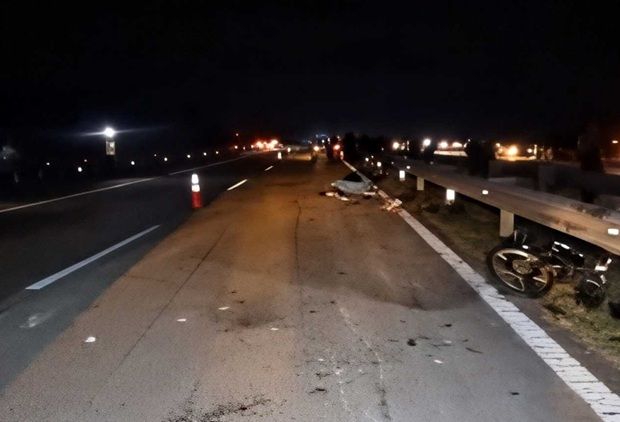
The East Coast Expressway turned deadly in the early hours of last Saturday when a motorcycle collision scattered debris across the road and claimed four lives, with another 13 people injured. The immediate aftermath brought the familiar chorus of public debate—social media erupted with questions about recklessness, negligence, and who bore responsibility for the tragedy. Yet amid the noise of judgment and blame, a more sobering reality remained largely unspoken: eight children, ranging in age from one to thirteen years old, had lost their fathers in a single moment, their futures fundamentally altered.
The broader conversation around such accidents typically centres on enforcement, rider behaviour, and road safety measures. These discussions matter, certainly, and accountability for dangerous driving must follow legal channels without question. The Social Security Organisation, PERKESO, takes no position against holding wrongdoers accountable. Yet there exists a parallel narrative that receives far less public attention—the financial and emotional devastation visited upon families left behind. In this case, eight young children now depend entirely on their mothers, who face the monumental challenge of single parenthood without the income their spouses once provided.
The immediate needs are elementary but unrelenting: milk for infants, rent payments, kindergarten fees, clothing as children grow, and nutrition to sustain their development. These are not luxuries but basic requirements that govern whether a child thrives or merely survives. As the years unfold and these children enter adolescence and eventually adulthood, educational expenses will multiply. School fees, textbooks, uniforms, and university costs accumulate into sums that can overwhelm a single income. The breadwinners who once bore these responsibilities with their labour are now permanently absent, leaving their families to navigate an uncertain financial landscape.
This is precisely where the concept of social security reveals its true purpose—a purpose that surveys consistently show most Malaysians misunderstand. Social security is not charity dispensed to the perpetually unfortunate, nor is it merely compensation paid after misfortune strikes. Rather, it represents a collective contract rooted in solidarity: the healthy support the ill, those untouched by disaster stand alongside those who suffer loss, and those still capable of earning help sustain those who have lost their capacity to work. When implemented thoughtfully, social security pledges that when tragedy threatens to demolish one family's stability, that family—particularly its vulnerable children—will not be abandoned to destitution.
For three of the deceased men in this incident, PERKESO's Survivors' Pension scheme now translates this principle into monthly financial support. The family of Che Mohd Suffian Che Gani will receive RM2,207.63 monthly, while Muhammad Hafiz Al Hakim Mazlan's family qualifies for RM1,258.33, and Mohd Aizat Husni's family for RM708.33. These payments are apportioned according to each widow's entitlement and her children's needs. The widows themselves receive monthly allocations of RM1,325, RM755, and RM425 respectively, support that will continue throughout their lifetimes. Over a thirty-year horizon, these pension streams represent RM477,000, RM271,800, and RM153,000 in total protection—figures that demonstrate how seemingly modest monthly payments accumulate into substantial family security.
Beyond the widow provisions, an additional RM1,670 monthly has been earmarked collectively for the eight orphaned children. Across the fifteen years typically allocated for child support, this allocation reaches RM300,600—capital that materially affects whether these children can complete their education, develop skills, and ultimately break free from poverty's grip. Considered comprehensively, PERKESO's commitments to the families affected by this single crash exceed RM1.2 million. For families facing immediate financial distress following unexpected loss, such support represents not luxury but survival.
It is worth pausing to consider what these figures mean in practical terms. When a worker contributes to PERKESO throughout his employment, the deductions appear small—almost negligible when viewed against a monthly salary. Workers rarely celebrate these contributions; they often resent them as automatic payroll deductions. Yet in moments precisely like this tragedy, those accumulated contributions transform into a lifeline. The modest sums withheld over years of labour now flow back as steady, predictable income streams protecting those left behind. This mechanism embodies the fundamental insight behind social insurance: protection is most valuable precisely when circumstances are most desperate.
The crash near the Jabor interchange also illuminates another dimension of social security's reach. Among the thirteen injured victims, five qualified for benefits under PERKESO's Lindung 24 Jam scheme. This development carries particular significance because the scheme's coverage recently expanded. Prior to June 1, workers injured in such accidents might have faced a different outcome—their applications potentially rejected through legal technicalities, their medical expenses borne entirely by their families, and their lost income uncompensated. The timing of this expansion means these five injured workers and their dependents now benefit from protection that would not have existed months earlier.
The Lindung 24 Jam scheme represents a recognition that protection must extend beyond the worst-case scenario of death. Serious injuries that impair a worker's capacity to earn can be nearly as devastating financially as death itself, yet victims often face longer-term needs. A worker paralysed or permanently disabled requires ongoing medical care, rehabilitation, assistive devices, and potentially home modifications. Their families lose income while expenses multiply. By expanding coverage to include injured workers, PERKESO acknowledges that financial protection matters across the spectrum of tragedy, not only at its most extreme.
For Malaysian society more broadly, this incident underscores why social security literacy remains a critical public health concern. Many workers view their contributions as forced payroll deductions rather than insurance they hope never to use. Employers often treat compliance as administrative burden rather than an expression of duty to their workforce. Policymakers sometimes hesitate to expand coverage, uncertain whether the political benefits justify the costs. Yet families facing the sudden loss of a breadwinner discover immediately that social security's value far exceeds its cost. The RM1.2 million PERKESO will distribute to families from this single crash represents not government waste but society's commitment to ensure that children do not pay with poverty for accidents they did nothing to cause.
The debate surrounding the crash itself—the questions of negligence, law enforcement, and road safety—remains important and necessary. Those responsible for reckless behaviour should face appropriate consequences. Yet the existence of that debate should not overshadow the equally important conversation about protection. When sixteen people were injured or killed on the East Coast Expressway, eight children lost fathers and five workers gained a second chance at financial security. This is not belittling the tragedy but recognising its full dimension. Social security transforms grief from total devastation into managed hardship, allowing grieving families to survive with dignity while honouring the contributions their lost loved ones made throughout their working lives.

