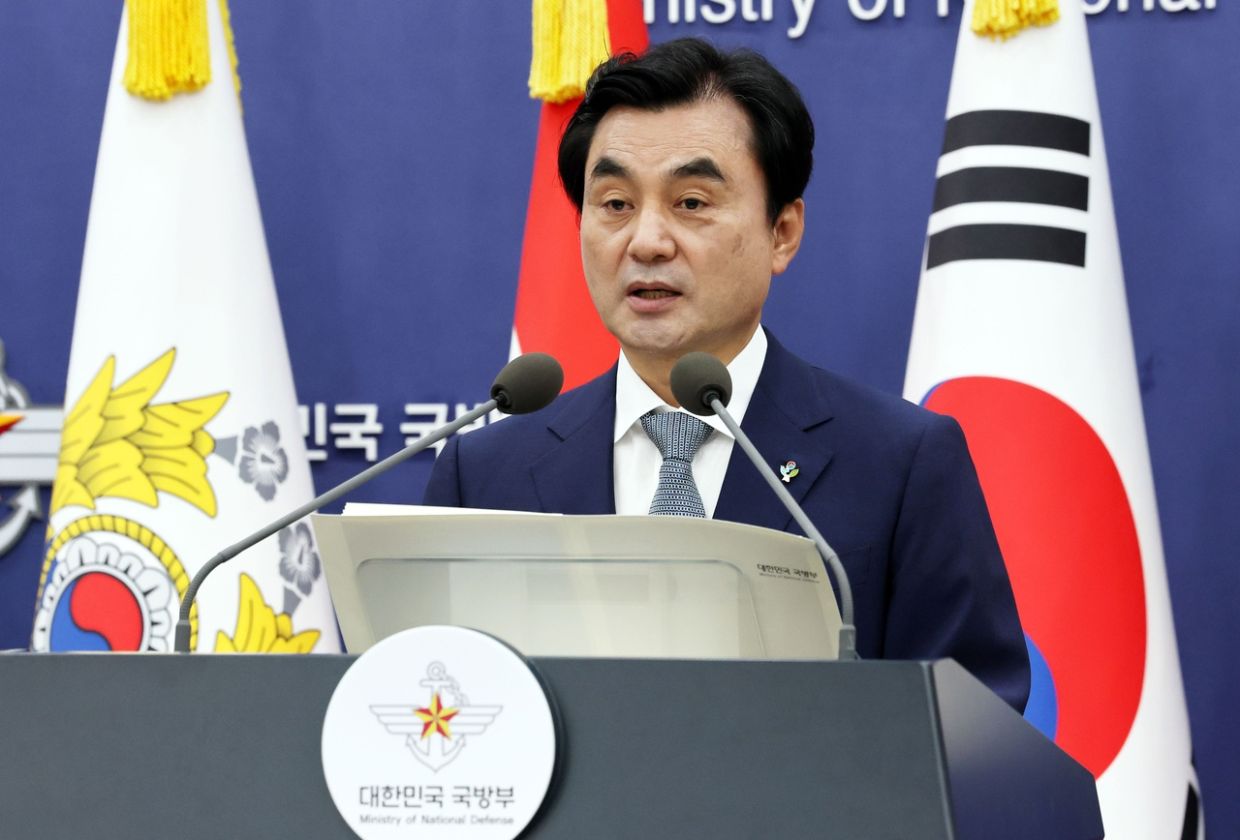
South Korea's defence establishment is embarking on one of its most significant military technology transformations in recent years, committing to the acquisition of more than 20,000 low-cost drones whilst simultaneously fast-tracking deployment of a homegrown long-range loitering munition system. Defence Minister Ahn Gyu-back announced the sweeping unmanned aerial systems strategy on Friday, signalling a fundamental shift in how Seoul approaches modern conflict and the emerging dominance of drone-centric warfare on contested battlefields.
The strategic pivot represents an acknowledgment by Seoul's military planners that the character of warfare has undergone profound change. Recent conflicts, particularly Russia's invasion of Ukraine and the escalating tensions between the United States and Iran, have demonstrated that commercially-available and low-cost unmanned systems can inflict substantial damage and reshape tactical calculations on the ground. Rather than relying exclusively on expensive, highly sophisticated military platforms, modern militaries increasingly recognise the operational value of deploying large numbers of cheaper, expendable drones that can overwhelm defences through sheer volume and distributed capability.
Under the new framework, South Korea intends to introduce these expendable unmanned systems—encompassing short-range reconnaissance aircraft and compact loitering munitions—across its forces by 2030. Concurrent with this procurement agenda, the ministry will prioritise the K-Lucas system, a Korean-developed long-range loitering munition designed to execute strategic strikes during future conflicts. The accelerated timeline for K-Lucas deployment underscores Seoul's determination to field indigenous defence technologies rather than depend entirely on foreign suppliers, a concern that has driven South Korean military procurement strategy for decades.
North Korea's own expansion of unmanned aerial capabilities forms the strategic backdrop for this initiative. Officials in Seoul view Pyongyang's growing inventory of drones as an escalating menace not only to military installations but to civilian infrastructure and populated areas. This assessment reflects genuine operational concerns: North Korean drones, whilst individually unsophisticated, pose risks that conventional air defences may struggle to counter, particularly in low-altitude or swarming scenarios. By developing counter-capabilities domestically and deploying defensive systems along the heavily fortified inter-Korean border, Seoul aims to close vulnerability gaps in its air defence architecture.
The Defence Ministry's approach extends beyond acquiring hardware. Beginning in 2025, South Korea will position counter-drone systems and small unmanned aircraft defence mechanisms in forward areas adjacent to the demilitarised zone. Simultaneously, officials are planning mid-to-long-term investments in directed-energy weapons such as laser and high-power microwave systems, technologies that could provide cost-effective answers to the proliferation of low-cost aerial threats. These efforts reflect a holistic recognition that addressing drone proliferation requires layered defences combining multiple technological approaches rather than singular solutions.
A critical component of the overhaul involves legislative reform designed to accelerate the testing and deployment of advanced unmanned systems. Deputy Defence Minister Kim Hong-cheol highlighted the mismatch between rapidly evolving drone technology and South Korea's traditionally lengthy military procurement processes. By permitting commercial off-the-shelf systems to undergo military evaluation and by streamlining certification pathways, Seoul hopes to compress the timeline between technological innovation and operational deployment. This represents a significant departure from conventional defence procurement methodology, which typically prioritises exhaustive testing over speed.
The human dimension of this transformation cannot be overlooked. South Korea's Defence Ministry intends to train 500,000 personnel as "drone operators," fundamentally altering how the military conceptualises individual combat capability. In this envisioned force structure, unmanned aerial systems function as extensions of soldier capability—a "second personal weapon" comparable to rifles or grenades. This doctrinal shift has profound implications for force composition, training regimens, and how military units organise themselves operationally. It suggests that future South Korean military effectiveness will depend substantially on broad-based drone proficiency distributed throughout the enlisted ranks rather than concentrated among specialist units.
The reorganisation of the Drone Operations Command itself reflects both practical military considerations and institutional lessons learned from recent controversies. The command will transition from an operational entity to the National Defence Drone Headquarters, functioning primarily as a policy and acquisition body. Operational responsibilities devolve to the Army, Navy, Air Force, and Marine Corps, permitting each service branch to develop drone tactics aligned with its particular missions and operational domains. The Army's ground-based needs, the Navy's maritime requirements, and the Air Force's air superiority considerations demand service-specific drone concepts rather than one-size-fits-all approaches.
This restructuring arrives amid investigations into the previous Drone Operations Command's alleged involvement in conducting reconnaissance missions over Pyongyang in October 2024. Those operations, allegedly orchestrated by former President Yoon Suk Yeol and former Defence Minister Kim Yong-hyun as part of a strategy to justify martial law declaration, exposed significant governance vulnerabilities and operational accountability gaps. The transition to policy-focused oversight whilst dispersing operational authority amongst service branches represents an attempt to prevent similar incidents by distributing decision-making and reducing concentrated power within any single military organisation.
For regional observers and Southeast Asian defence planners, South Korea's drone expansion carries broader implications. The Korean Peninsula remains one of Asia's most heavily militarised zones, and Seoul's accelerated development of unmanned capabilities will influence regional military balances and force-sizing calculations. Neighbouring nations monitoring these developments will likely assess their own requirements for comparable technologies, potentially triggering procurement cycles across the region. The precedent of shifting from expensive, limited-quantity platforms to numerous, low-cost expendable systems could reshape how regional militaries structure their arsenals, budgeting priorities, and technological development roadmaps.
Simultaneously, Seoul's emphasis on domestically-developed systems like K-Lucas reflects broader South Korean aspirations to advance technological independence and reduce reliance on foreign defence suppliers. The success of indigenous drone and loitering munition programmes could position South Korean defence companies competitively in regional and global markets, creating commercial export opportunities whilst enhancing national strategic autonomy. This dual objective—strengthening military capability whilst fostering a competitive defence-industrial base—guides the ministry's commitment to concentrated investment in drone technologies and supporting legislative frameworks.
The timeline for implementation matters considerably. By committing to 20,000-unit acquisition by 2030 and beginning counter-drone deployments in 2025, South Korea signals that it views the unmanned warfare challenge as urgent rather than distant. This accelerated pace reflects assessments that threats to security have intensified and that technological windows for maintaining competitive advantage may close relatively quickly. For military planners across the Asia-Pacific, Seoul's sense of strategic urgency and its resource commitments to unmanned systems represent important signals about how regional powers perceive contemporary security dynamics and where they believe military modernisation imperatives lie in coming years.

