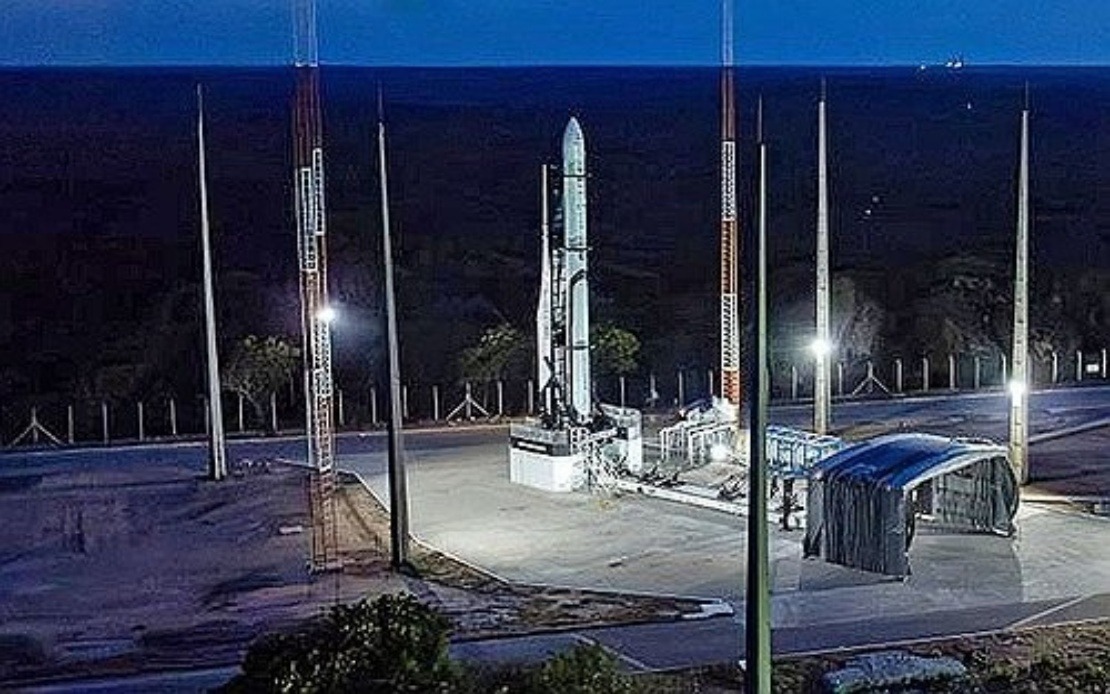
South Korea's defence ministry announced on Tuesday the postponement of a landmark space launch, deferring the maiden flight of its domestically developed Mir solid-fuel rocket due to unspecified safety complications that emerged in the final stages of pre-launch verification. The four-stage vehicle, which was positioned on a sea barge off Jeju Island's southern coastline awaiting a 2 pm departure, will be rescheduled for a date yet to be disclosed, representing a notable delay in Seoul's strategic aerospace ambitions.
The cancellation marks a critical juncture for South Korea's broader initiative to establish autonomous surveillance capabilities independent of allied intelligence sharing arrangements. Officials acknowledged that technical issues surfaced during the comprehensive safety checks preceding liftoff, prompting the decision to ground the rocket rather than proceed with uncertain conditions. The ministry indicated that revised launch parameters would be communicated in due course, though no timeline was specified for the rescheduled attempt.
The Mir programme represents a cornerstone of South Korea's military modernisation strategy, designed to deploy solid-propellant vehicles capable of placing compact reconnaissance satellites into low-Earth orbits below 500 kilometres altitude. Unlike liquid-fuelled counterparts, solid-fuel systems offer structural simplicity and extended storage durability, enabling rapid mobilisation when operational necessities demand swift satellite positioning. This technological pathway has gained strategic relevance for Seoul as it seeks to reduce dependence on external intelligence assets while enhancing real-time monitoring of peninsular security dynamics.
Prior developmental phases conducted throughout 2022 and 2023 had tested partial three-stage configurations, accumulating empirical data that informed the current four-stage integrated design. Tuesday's intended launch represented a qualitative leap forward, validating the complete assembled system under operational conditions. The postponement therefore disrupts the testing timeline that Seoul had established to demonstrate technological maturity before scaling production and operational deployment phases.
South Korea's aspirations extend well beyond this singular launch event. The Mir initiative envisions constellation deployment of approximately 60 compact spy satellites throughout the 2030s, complementing Seoul's existing fleet of five larger military reconnaissance platforms already orbiting Earth. This dual-layer architecture reflects contemporary intelligence doctrine emphasising persistent, granular observation networks capable of detecting emerging threats with minimal temporal gaps and enhanced spatial resolution across strategically sensitive regions.
Parallel to the Mir programme, South Korea has successfully demonstrated satellite launch proficiency through commercial partnerships, specifically deploying five reconnaissance vehicles aboard SpaceX's Falcon 9 platforms as recently as November of the previous year. These proven capabilities provide interim surveillance capacity while domestic solid-fuel systems undergo development and operational validation. Nevertheless, achieving indigenous launch capability remains a cornerstone national objective, reducing technological vulnerability and enhancing strategic autonomy in critical security domains.
The geopolitical context framing this programme is particularly acute for Malaysian and broader Southeast Asian observers. North Korea's expanding missile capabilities and persistent intelligence activities targeting the peninsula create urgent operational pressures on Seoul to establish comprehensive monitoring systems. Consequently, indigenous satellite networks transcend purely technical achievement, embodying strategic imperatives that reflect evolving power dynamics on the Korean peninsula and broader regional security architectures involving major powers competing for influence and technological dominance.
Solid-fuel rocket technology occupies a distinct position within aerospace development hierarchies, offering operational advantages that justify sustained investment despite technical complexity. Extended shelf-life without degradation enables strategic stockpiling and rapid deployment protocols unavailable with cryogenic liquid-fuelled systems requiring continuous maintenance and precise pre-launch procedures. These characteristics render solid-propellant vehicles particularly suited to military applications where responsiveness to emerging threats can determine operational success or failure in time-sensitive scenarios.
The postponement reflects contemporary aerospace industry realities where launch reliability constitutes an absolute prerequisite for programme continuation and stakeholder confidence. South Korea's defence establishment exercises stringent safety oversight to prevent catastrophic failures that could jeopardise both national investments and personnel safety. This conservative approach, while introducing schedule delays, ultimately strengthens public confidence in institutional competence and builds international credibility regarding Seoul's technological capabilities and operational standards.
Looking ahead, successful Mir deployment would significantly reshape South Korea's strategic position regarding autonomous surveillance and threat detection capabilities. Malaysian policymakers monitoring regional military developments should recognise that Seoul's advancing space capabilities form part of broader regional technology competitions involving multiple powers pursuing satellite networks and space-based systems for commercial, scientific, and military purposes. These trends underscore accelerating aerospace industrialisation across Northeast Asia and implications for regional security balances and technological dependencies.

