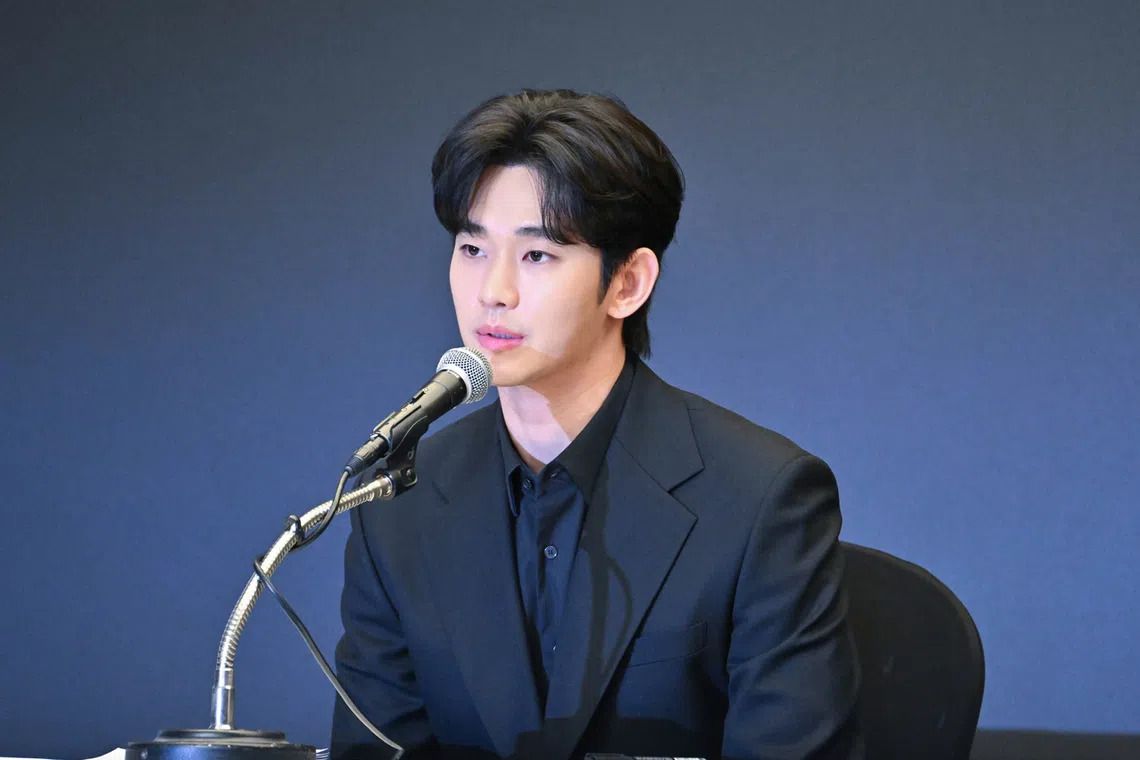
The legal troubles of South Korean actor Kim Soo-hyun have effectively ended with the Seoul Seongdong Police Station's decision to shelve the case against him. Following a comprehensive investigation into allegations that he breached the Child Welfare Act, authorities determined there was insufficient evidence to justify forwarding the matter to prosecutors. The 38-year-old actor faced scrutiny over claims stemming from a complaint registered in May 2025, but the police's conclusion now permits him to move forward without the prospect of criminal charges.
The allegations originated from the family of Kim Sae-ron, a fellow South Korean actress who was found dead at her home in Seoul's Seongdong district in February 2025 at just 24 years old. Her family lodged the complaint accusing Kim Soo-hyun of maintaining a romantic relationship with Kim Sae-ron when she was only 15 years old, alleging the connection had begun during her second year of middle school. Beyond the Child Welfare Act violation, they also levelled additional charges against him, creating what appeared to be a serious legal jeopardy for the established actor.
During the investigation period, Kim Soo-hyun's legal representatives adopted a nuanced defensive strategy. While conceding that the two individuals had indeed dated at some point, they consistently maintained that their romantic involvement did not commence while Kim Sae-ron was underage. This acknowledgment of the relationship itself, combined with the categorical denial of its timing, formed the crux of his defence throughout the inquiry.
A particularly contentious element of the case centred on an audio recording that Kim Sae-ron's family had released to support their accusations. In the recording, a voice purportedly belonging to Kim Sae-ron detailed claims that she had been in a relationship with Kim Soo-hyun since her middle school years. However, Kim Soo-hyun's team presented a counterargument that proved pivotal to the investigation's outcome: they asserted that the audio file had been artificially created using artificial intelligence technology. This claim about the recording's authenticity became instrumental in casting doubt on the complainants' evidence.
The resolution of this case carries particular resonance in South Korean society, where questions about celebrity conduct and child protection laws have become increasingly scrutinised by the public. The Child Welfare Act represents a legal mechanism designed to shield minors from exploitation and inappropriate relationships with older individuals. The case's dismissal therefore suggests that the investigative authorities found the evidence insufficient to establish criminal culpability according to the stringent standards required for prosecution.
Kim Sae-ron's life had been marked by significant challenges beyond this controversy. Her acting career had substantially stalled following a May 2022 incident in which she was apprehended for drink driving, an occurrence that had severe repercussions for her public standing and professional opportunities in South Korea's entertainment industry. Her tragic death in early 2025 occurred during a period when she had largely withdrawn from the public spotlight, with limited work prospects available to her.
The clearance of Kim Soo-hyun signals a shift in his own trajectory, as he has begun reintegrating himself into public and professional life. Following roughly a year of relative withdrawal from the entertainment world, the actor commenced his return to visibility in July 2025. His re-emergence was marked by participation in a commercial project for a Philippine fashion brand, filmed on July 14, suggesting that both brands and production companies were prepared to move forward with professional engagements following the police's decision not to prosecute.
For Malaysian and Southeast Asian observers, this case illuminates broader questions about celebrity accountability, digital evidence in contemporary legal disputes, and the intersection of entertainment industry reputation management with criminal investigation procedures. The application of artificial intelligence analysis as a defence strategy represents a novel frontier in high-profile legal cases across the region, where deep-fake technology and manipulated audio or video evidence increasingly feature in disputes involving public figures.
The dismissal also underscores the complexity of investigating allegations that emerge after significant time lapses, particularly when primary witnesses are unavailable to provide testimony. The circumstances surrounding Kim Sae-ron's death, which occurred prior to the formal lodging of the complaint, created an inherently asymmetrical investigation wherein the complainants could not be directly questioned by prosecutors. This procedural reality may have influenced the police's assessment of whether sufficient grounds existed to pursue the matter further through the judicial system.
Looking forward, the case's resolution permits Kim Soo-hyun to pursue his professional interests without the shadow of pending criminal proceedings. His participation in commercial projects and potential return to acting represent a cautious restoration of his career, though the reputational implications of the allegations themselves may persist within industry circles and public perception. The case also leaves unresolved questions about the appropriate role of social media allegations, family-initiated complaints, and audio evidence in contemporary celebrity controversies across East and Southeast Asia.

