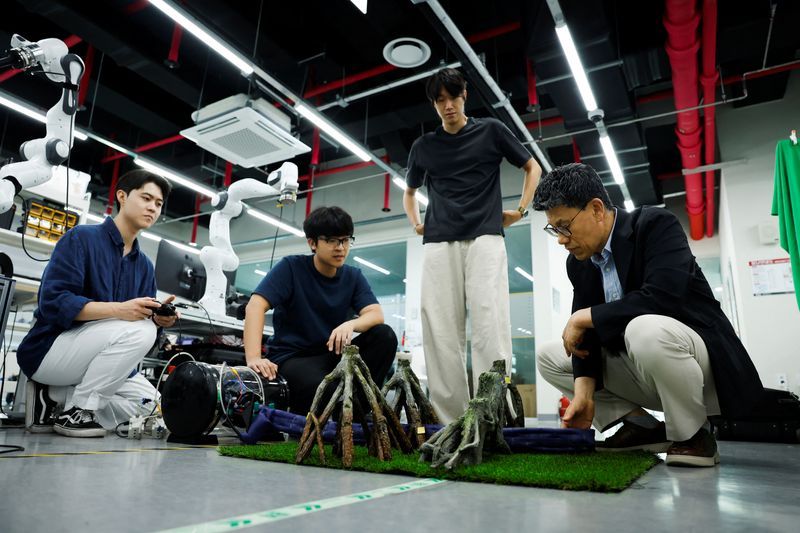
A collaboration between South Korea's Korea Advanced Institute of Science and Technology (KAIST) and Stanford University has produced a groundbreaking robotic system capable of dressing a wearer without any manual assistance, potentially transforming how protective equipment is donned in critical environments from semiconductor facilities to emergency response situations.
The innovation centres on soft, pneumatic "vines" embedded directly into garments that mimic the climbing motion of ivy plants. These flexible appendages, powered by compressed air, glide fabric smoothly across the wearer's body by inverting the clothing as they advance. The entire process, from initiation to complete coverage, requires only approximately ten seconds—a significant efficiency gain for operations where rapid equipment changes are essential.
The inspiration for this breakthrough emerged from an everyday experience. Kim Nam Gyun, the postdoctoral researcher leading the project at KAIST, recognised the challenge of managing clothing during mundane activities like cycling in sudden rain. This observation sparked the conceptual leap toward automating the dressing process entirely, transforming a frustration into a technological solution with far broader implications.
Unlike conventional robotic systems that rely on sophisticated control algorithms and require users to remain stationary during operation, this vine-based approach functions through elegant mechanical principles. The system advances progressively at its tip rather than repositioning its entire body, allowing it to maintain stable contact with curved surfaces and irregular body contours. This design choice eliminates the need for complex computational oversight while improving practical usability.
Professor Ryu Jee-Hwan from KAIST's civil and environmental engineering department emphasises the system's remarkable adaptability to environmental variables. The vine robot successfully navigates narrow openings, maintains contact across slippery surfaces, manages adhesive materials, and functions on inclined planes without requiring environmental modifications. This versatility stems from its bio-inspired design that prioritises mechanical stability over digital sophistication.
For Malaysian and Southeast Asian readers, this technology carries particular relevance given the region's expanding semiconductor manufacturing sector and growing emphasis on worker safety standards. Industries requiring rapid equipment changes, including emergency response services and high-contamination environments, represent immediate applications. The technology's ability to function without constant user coordination addresses challenges in tropical climates where heat and humidity complicate standard protective equipment procedures.
The research team envisions multiple deployment scenarios beyond emergency services. Semiconductor cleanrooms represent an obvious application—workers could transition between contamination levels more efficiently while maintaining environmental integrity. Hospital settings, particularly in infectious disease management, could benefit from rapid, hands-free protective equipment deployment. Search and rescue operations in challenging terrain might similarly leverage the technology's ability to function during dynamic movement.
The broader implications extend beyond immediate practical applications. Professor Ryu notes that contemporary technological discourse disproportionately emphasises software and artificial intelligence innovations, often overshadowing mechanical engineering achievements. This project demonstrates how classical mechanical principles, combined with biomimetic design, can produce revolutionary capabilities without requiring computational intensity.
The research, published in the peer-reviewed journal IEEE Robotics and Automation Letters, underwent rigorous scientific validation before public announcement. This publication pathway ensures the technology meets established standards for innovation credibility, distinguishing it from speculative concepts and supporting its path toward commercialisation and practical deployment.
The most compelling aspect of this innovation lies in its accessibility. By eliminating the need for users to remain stationary and removing dependence on complex control systems, the technology becomes practical in real-world scenarios where perfect conditions cannot be guaranteed. This represents a fundamental shift from laboratory demonstrations toward genuinely deployable systems that function amid workplace complexity.
As global supply chains evolve and safety standards intensify across manufacturing sectors, technologies enabling rapid equipment changes without compromising contamination control gain strategic importance. For Southeast Asian economies strengthening their industrial base and competing in advanced manufacturing, such innovations represent precisely the type of technological capability that enhances competitiveness while improving worker welfare.
The KAIST-Stanford partnership also underscores the value of international scientific collaboration in addressing universal challenges. Both institutions brought complementary expertise—KAIST's mechanical engineering foundations and Stanford's innovation ecosystem—creating conditions for breakthrough discovery that neither institution might have independently achieved.
Looking forward, commercialisation remains the critical next phase. The technology's transition from research demonstration to market-available products will determine its ultimate impact across industries. For organisations in Malaysia and throughout Southeast Asia seeking to modernise operations and enhance worker safety, this development merits close monitoring as implementation pathways emerge.

