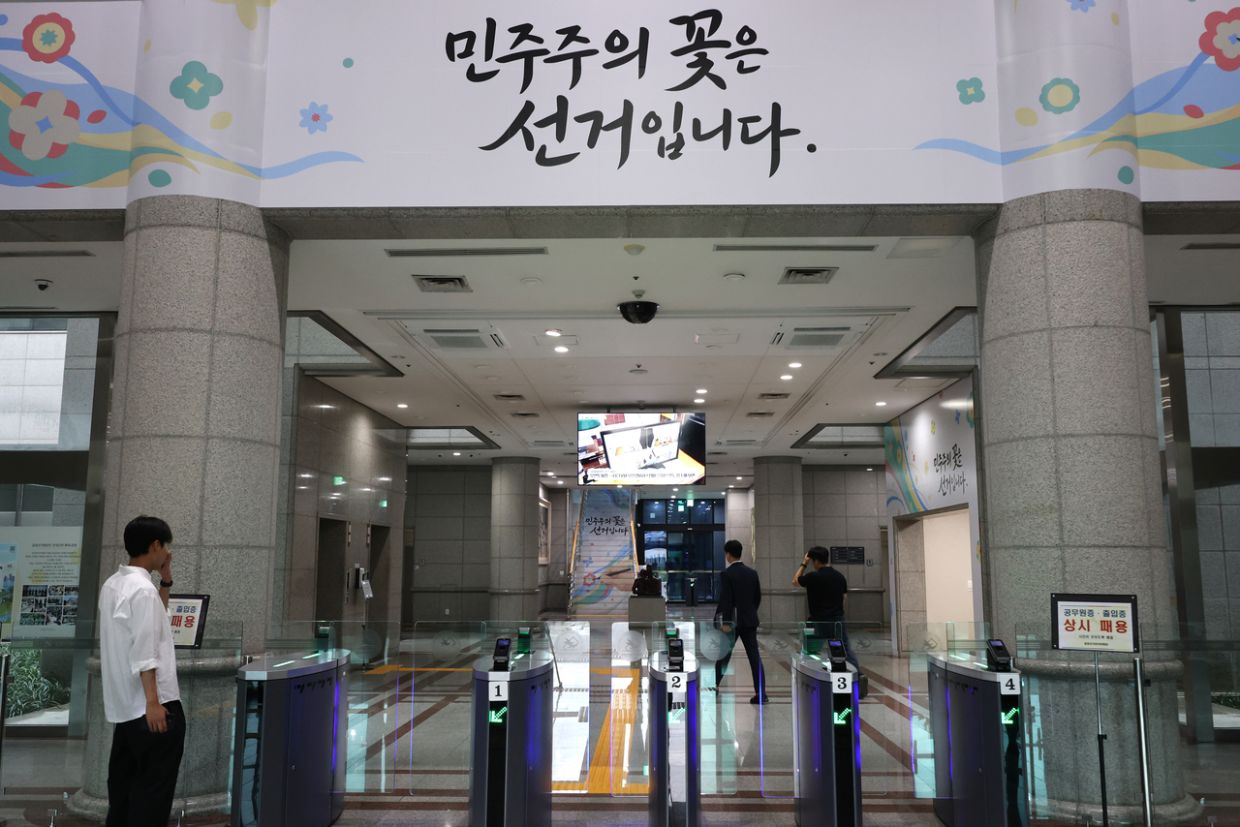
South Korean law enforcement has intensified its investigation into voting irregularities that marred the June 3 local elections, with prosecutors and police executing a search warrant at the National Election Commission headquarters in Gwacheon near Seoul on Thursday. The operation marks an escalation in efforts to uncover the full scope of what authorities describe as deliberate data falsification by commission employees attempting to mask underlying problems with voter registration tallies.
The raid represents a significant moment in the electoral integrity saga, as investigators believe multiple NEC staff members systematically altered statistics within the institution's computer systems. Rather than transparently reporting discrepancies or addressing root causes of the shortfall, these individuals allegedly chose concealment—a decision that could have broader ramifications for public trust in South Korea's electoral machinery and the independence of institutions designed to safeguard democratic processes.
The immediate trigger for the investigation was a troubling pattern that emerged on polling day itself. Across numerous voting stations scattered throughout the country, there proved to be insufficient ballots to accommodate all eligible voters attempting to participate. This left some citizens unable to cast their votes despite presenting themselves at designated polling stations at appropriate times. Such occurrences undermine the fundamental principle of universal suffrage and raise legitimate questions about procedural competence at the institutional level.
What transforms this administrative failure into a potential corruption case is the alleged post-election response. Rather than conducting a transparent review of how ballot supplies were calculated and distributed, or implementing immediate corrective measures for future elections, staff members reportedly entered false figures into the NEC's electronic record-keeping systems. This action suggests an attempt to retrospectively alter the official narrative about what occurred—not merely a clerical error, but a calculated effort to obscure accountability.
For Malaysian observers, this episode offers relevant cautionary context regarding electoral administration. Southeast Asian democracies, including Malaysia, depend fundamentally on the integrity and independence of election management bodies. When such institutions either fail to execute basic logistical functions or subsequently attempt to conceal those failures through data manipulation, the entire electoral enterprise becomes compromised. Public confidence erodes not merely from the initial mistake, but from the institutional response suggesting a preference for image management over truthfulness.
The joint prosecution-police task force structure indicates that South Korean authorities consider this matter serious enough to warrant coordinated, multi-agency action. This approach suggests that investigators view the data manipulation as potentially crossing thresholds that implicate criminal law rather than merely administrative negligence. The scale of the operation—securing the election commission's headquarters to gather evidence—underscores the volume of digital material and documentation authorities believe necessary to establish culpability.
The implications for South Korea extend beyond the immediate case. Election commissions throughout developed democracies increasingly handle sensitive data and maintain extensive digital records. When staff within such bodies lack either the integrity to resist pressure or the organizational safeguards to prevent falsification, it creates systemic vulnerability. The NEC serves as the public face of electoral legitimacy in South Korea; any perception that its data cannot be trusted fundamentally undermines its credibility regardless of how transparent it attempts to be in future reporting.
Regional analysts have noted that both East Asian and Southeast Asian nations have occasionally struggled with election administration challenges, whether through logistical shortfalls, technology implementation issues, or questions surrounding information management. The South Korean case illustrates how quickly an operational failure transforms into an institutional crisis when coupled with perceived attempts at concealment. This lesson resonates particularly for developing democracies still refining their electoral infrastructure and institutional cultures.
The investigation's progression will likely determine whether individual staff members acted independently or whether systemic pressures within the NEC encouraged or enabled the data manipulation. Understanding the motivational and institutional context matters considerably for assessing whether this represents isolated malfeasance or signals deeper governance problems requiring structural reform. South Korean lawmakers and the public will be watching closely as prosecutors build their case.
Looking forward, this episode may catalyze strengthened data security protocols, enhanced auditing procedures, and clearer accountability frameworks within electoral bodies across the region. For citizens across Southeast Asia and East Asia, the South Korean case serves as a reminder that electoral integrity depends not only on robust procedures but equally on institutional cultures that prioritize honesty over reputation management and accountability over concealment.

