Annie Ko's rescue of her Labrador DeeJay in 2015 epitomises a profound cultural shift now transforming South Korea. The musician, working with Humane World for Animals, witnessed the trembling puppy emerge from a cramped cage at a Wonju dog meat farm where he had spent three months confined alongside six siblings. Today, as DeeJay thrives in Ko's Seoul home, the industry that once bred him for slaughter is collapsing. From February 2027, South Korea will become one of the first countries to comprehensively outlaw dog meat production, marking the end of a tradition stretching back centuries and representing a watershed moment in the nation's relationship with animal welfare.
The legislative victory materialised in January 2024 after decades of activism and increasingly vocal public opposition, particularly among younger generations. The government granted dog meat farmers a three-year transition period, providing what amounts to a carefully managed industry shutdown rather than an abrupt prohibition. The Ministry of Agriculture, Food and Rural Affairs reported that by May 2026, more than eighty percent of approximately 1,500 identified dog meat farms had ceased operations, leaving fewer than 300 still functioning. This dramatic contraction reflects both the inevitability of the legal deadline and the practical incentives offered by Seoul to accelerate closure, including compensation of up to 600,000 won per dog, subsidised loans, and job-retraining programmes.
The economic cushion provided by the government was designed to ease the transition for farmers whose livelihoods depended on dog breeding. Yet the data suggests these measures have worked only partially. Many operators closed voluntarily rather than waiting for the deadline, possibly recognising that sentiment had irreversibly turned against them. The speed of farm closures has created unexpected consequences further down the supply chain, where retailers and restaurateurs now face acute sourcing challenges that inflate costs and erode already fragile profit margins. What was once a stable, if increasingly controversial, commercial ecosystem has fragmented into desperation.
In Seoul's Gyeongdong Market, one of the capital's last remaining dog meat vendors described the transformation in stark economic terms. Prices have tripled since 2024, rising from approximately 20,000 won per kilogram to 60,000 won today, a trajectory that mirrors the tightening supply and evaporating demand. The vendor, unwilling to elaborate publicly on her dwindling business, simply noted the sensitivity of the subject matter—a telling reluctance that itself reflects how thoroughly the moral consensus has shifted. Where dog meat trading once occurred openly, it now operates in shadows, its practitioners aware they belong to a condemned enterprise counting down to obsolescence.
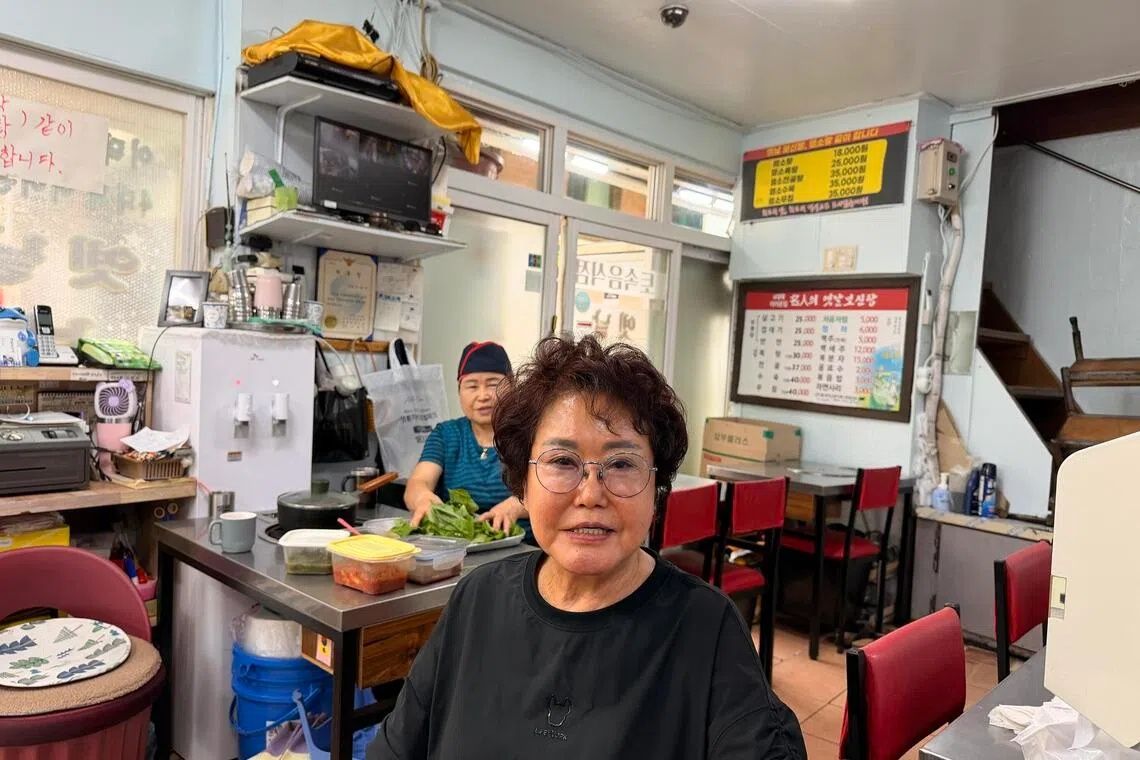
The restaurants serving boshintang, the traditional dog meat stew consumed during South Korea's three hottest summer days, face particularly acute hardship. Lee Deok-sung has operated her establishment near Dongdaemun Market for forty-five years, building a customer base across generations. This summer, during the boknal or "dog days" falling on July 15, July 25, and August 14, marked an exceptionally poor season. She gestured toward unsold meat trays and explained that she must now clear inventory by dinner service merely to break even—a razor-thin operating margin that leaves no room for error. Raising prices from 16,000 won to 25,000 won per bowl has driven some customers away, and she openly worried about survival once the ban takes effect.
Across the alley, Lee Kyung-ja's similarly venerable boshintang establishment, operating for over four decades, confronted the same bleak reality. The restaurant had days with no customers whatsoever. Both proprietors attempted diversification by introducing black goat stew, theoretically positioned as a successor product due to similarities in texture and gamey flavour. Yet the pivot failed to gain traction. Long-time patrons who still visited explicitly preferred dog meat, citing superior taste, while some mentioned that traditional Korean medicine practitioners continued recommending it for patients recovering from serious illness. At seventy-five years old, Lee Kyung-ja contemplated retirement, recognising that rebuilding a customer base at her age and simultaneously competing against a banned product would prove insurmountable.
The cultural roots of dog meat consumption run extraordinarily deep in Korea, complicating simple narratives about moral progress. Historical records document the practice stretching back at least to the Joseon Dynasty, with one of the most significant references appearing in the Donguibogam, a seventeenth-century medical compendium authored by royal physician Heo Jun. This respected text classified dog meat as a warming food capable of replenishing energy and vitality—a clinical framing that lent medical legitimacy to consumption practices. The tradition intensified during Japan's colonial occupation from 1910 to 1945 and in the post-Korean War era, when mass poverty and food insecurity created desperation for affordable protein sources. Dog meat emerged not as a luxury but as survival food, its role embedded in collective memory of national hardship.
Yet this historical context, while explaining the practice's persistence, does not excuse its continuation in a modern, prosperous nation. Younger South Koreans increasingly rejected their parents' pragmatic acceptance, viewing dog meat through the lens of pets and companionship rather than subsistence. This generational shift paralleled broader international pressure, particularly from Western countries where dog consumption was unthinkable. The combined force of domestic moral evolution and external criticism created unstoppable momentum toward prohibition, transforming what seemed politically immovable just fifteen years ago into inevitable law.
The implications for Southeast Asia merit careful consideration. Malaysia and other regional economies have occasionally faced international criticism over animal welfare practices, and the South Korean experience offers a cautionary tale about the velocity with which cultural practices can shift under sustained domestic and global pressure. South Korea's approach—combining legislation with economic support for affected workers rather than pure prohibition—provides a pragmatic model that respects both commercial realities and moral imperatives. The government recognised that criminalising tradition without providing alternatives would create political backlash and social division. Instead, it engineered managed decline through compensation and retraining.
For Malaysia and the region, this suggests several instructive lessons. First, generational change in values, particularly among educated urban populations, can outpace traditional practises rapidly. Second, when communities rely economically on practices increasingly viewed as unethical, governments must offer realistic transition pathways rather than abrupt enforcement. Third, international sentiment regarding animal welfare evolves constantly, and practices tolerated today may face severe reputational consequences tomorrow. South Korea's dog meat farmers did not anticipate the cultural tsunami that would eventually submerge their industry; they operated within what seemed like stable social parameters. Yet within a generation, the ground shifted completely.
The February 2027 deadline represents both an ending and a reckoning. Annie Ko's rescued Labrador DeeJay symbolises thousands of dogs who will no longer face farm confinement. Yet his story also encompasses the human displacement occurring among people whose economic survival depended on an industry now deemed incompatible with contemporary values. South Korea's handling of this transition—imperfect though it may be—demonstrates that managing such shifts requires government commitment, adequate resources, and genuine consideration for affected communities. As the remaining months until the deadline elapse, Seoul's dwindling dog meat restaurants and vendors will disappear into history, their closure marking not merely the end of a commercial enterprise but the conclusion of a centuries-long chapter in Korean culinary tradition.

