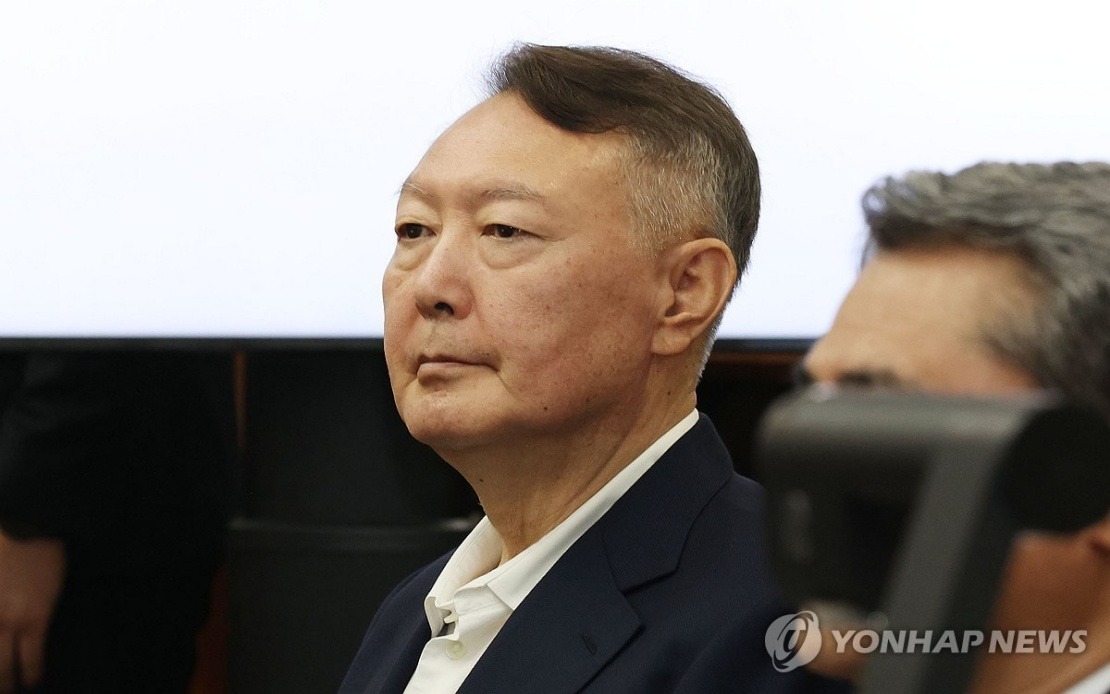
A Seoul district court has delivered a guilty verdict against former President Yoon Suk Yeol, sentencing him to two years in prison for accepting illegal political campaign funds disguised as complimentary opinion polls. The ruling from Seoul Central District Court on Monday represents a significant development in the broader legal jeopardy facing the ousted leader, who currently faces multiple trials following his abortive attempt to impose martial law in December 2024.
The case centres on funds that prosecutors alleged Yoon received through his connection with Myung Tae-kyun, a politically connected businessman who positioned himself as an influential power broker within South Korea's conservative circles. Prosecutors contended that between April 2021 and March 2022, Yoon and his wife, former first lady Kim Keon Hee, colluded to secure approximately 58 opinion polls worth roughly 270 million won, equivalent to about US$180,100. These surveys were provided at no cost, functioning as an unrecorded form of political support that violated campaign finance regulations.
During its deliberations, the court determined that Yoon had indeed received at least 14 of these opinion polls from Myung without payment, establishing a clear breach of the Political Funds Act. The judiciary accepted prosecutors' argument that this arrangement was far from innocent. Yoon had allegedly pledged political backing for former parliamentary representative Kim Young-sun's candidacy in the People Power Party's nomination process for a June 2022 legislative by-election. This quid pro quo arrangement—campaign support in exchange for valuable market research—constituted the crux of the illegal funds charge.
The sentencing decision carries particular significance because it diverges from how another court recently handled similar allegations against Yoon's spouse. In April, the Seoul High Court acquitted Kim Keon Hee on equivalent charges, reasoning that because Myung had distributed opinion polls to multiple recipients, the couple could not be deemed to have unlawfully profited from this arrangement. This distinction raises questions about consistency in how courts evaluate campaign finance violations, and prosecutors have already signalled their intention to challenge the acquittal through an appeal.
The court ordered Yoon to forfeit 13.96 million won in addition to serving his prison sentence, a measure designed to strip any gains derived from the violation. The power broker Myung received an 18-month prison sentence for his role in facilitating the illegal transfer of campaign resources. Notably, prosecutors had sought harsher penalties, requesting four years for Yoon and three years for Myung, suggesting the court exercised some leniency in its determination.
For Malaysian observers monitoring developments in South Korea's political system, this conviction underscores how even the highest offices provide no exemption from accountability when campaign finance rules are transgressed. The case demonstrates that wealthy intermediaries can serve as channels for channelling undisclosed support to political figures, a risk that transcends democratic systems across East Asia and Southeast Asia. The ruling signals to political actors across the region that regulatory bodies can effectively identify and prosecute such schemes, even when they are designed to obscure their true nature.
The guilty verdict represents merely one chapter in Yoon's expanding legal predicament. In February 2024, he received a life sentence for his role in orchestrating the martial law declaration, an extraordinary development in modern South Korean history. That conviction involved charges of leading an insurrection through his dramatic and ultimately short-lived imposition of emergency military rule. Facing simultaneous trials on multiple serious charges, Yoon remains imprisoned while his legal team pursues appeals across various cases.
The opinion polls case illustrates how prosecutors have constructed a comprehensive legal assault on Yoon's conduct, targeting everything from the dramatic and constitutionally audacious martial law attempt to more conventional political finance violations. This multi-pronged approach reflects the special counsel's determination to establish a pattern of rule-breaking rather than treating isolated incidents. The use of opinion polls as a vehicle for illegal funds represents an innovative circumvention strategy that prosecutors successfully exposed and persuaded courts to condemn.
The divergence between the acquittal of Yoon's wife and his conviction on similar grounds highlights the complexity of campaign finance jurisprudence. Courts must evaluate whether receiving something of value constitutes an illegal fund if it was also made available to others. The distinction ultimately hinges on whether the political figure received something they otherwise would have had to purchase, regardless of whether others also obtained it. This reasoning suggests prosecutors may face an uphill battle in overturning Kim's acquittal, though legal analysts predict the appeal will test the boundaries of how broadly courts interpret campaign finance violations.
Regional observers note that South Korea's willingness to prosecute and convict former presidents contrasts sharply with other nations in East and Southeast Asia, where such accountability remains rare. The case demonstrates institutional mechanisms designed to ensure no political actor, regardless of status, escapes consequences for violating electoral law. For Malaysia and other democracies in the region, South Korea's prosecutorial and judicial response offers both inspiration regarding the possibility of enforcing campaign finance rules and a sobering reminder of the complexity and duration such cases require.

