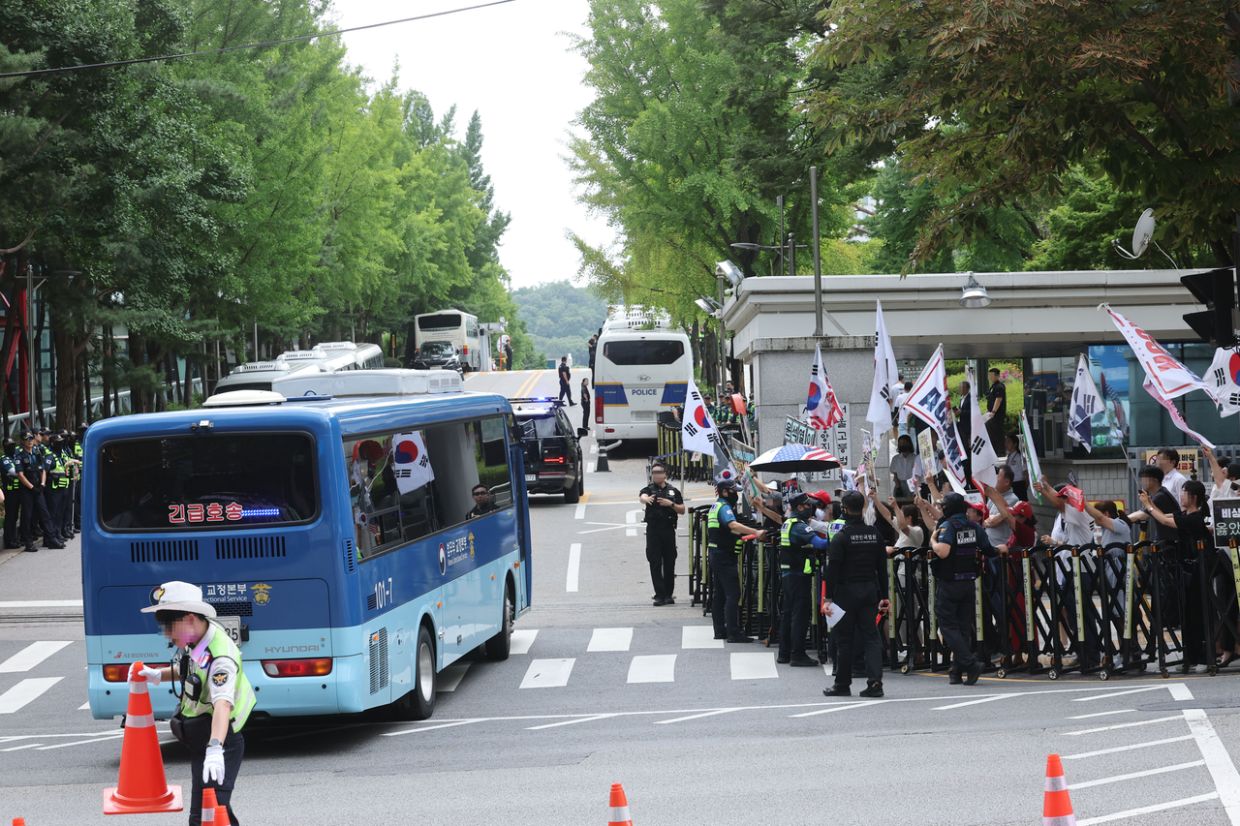
Former South Korean President Yoon Suk Yeol received a two-year prison sentence on Monday after the Seoul Central District Court found him guilty of illegally accepting political polling services valued at tens of millions of won during his successful 2022 presidential campaign. The conviction marks a significant moment in South Korea's ongoing reckoning with campaign finance violations and electoral misconduct among its highest political figures, a pattern that has repeatedly tested the country's democratic institutions and rule of law.
The court established that political broker Myung Tae-kyun provided 14 surveys worth 27.92 million won—approximately $18,600—to Yoon's campaign team without proper disclosure or payment, thereby violating the Political Funds Act. These polling services carried tangible value beyond their face cost, as professional opinion research can shape campaign strategy, messaging, and voter perception during critical electoral periods. The court's judgment recognised this reality and the broader implications for democratic fairness when candidates gain undisclosed advantages through in-kind contributions that circumvent campaign finance regulations.
Judge Lee Jin-gwan articulated the court's reasoning with explicit reference to polling's democratic significance, emphasising that survey credibility forms a foundational element of electoral legitimacy. When political actors obtain polling services outside lawful contribution channels, the judge explained, the resulting distortion of public opinion undermines the fairness and integrity of the entire election process. This interpretation reflects growing judicial concern across democracies about the capacity of unregulated information advantages to skew electoral competition in ways that ordinary voters cannot detect or counteract.
The prosecution had originally charged Yoon with conspiring alongside his wife, former first lady Kim Keon Hee, to receive 58 free surveys valued at over 270 million won between June 2021 and March 2022. However, the court found sufficient evidence only for 14 of the surveys, calculating the imputed financial benefit at 27.92 million won. This narrowing of charges between prosecution assertion and judicial finding illustrates the evidentiary demands courts impose when assessing campaign finance crimes, where documentation and proof of intent remain crucial to conviction.
Central to the court's judgment was its determination that Kim Keon Hee had authorised Myung to control the timing, content, methodology, and publication status of the polling work, and that Yoon was fully informed of this arrangement and implicitly consented to it. Rather than requiring explicit agreement among the three parties, the court identified a pattern of successive and tacit understanding that constituted a violation. This approach matters significantly for prosecutors pursuing campaign finance cases, as it demonstrates that formal documentation of wrongdoing need not exist if circumstantial evidence and conduct patterns establish coordination.
Beyond the polling services themselves, the court found evidence that Yoon promised political broker Myung favourable treatment for former lawmaker Kim Young-sun in exchange for the surveys. Specifically, the judgment determined that Yoon exerted influence over the People Power Party's nomination process through Chang Je-won, who then served as chief of staff to the president-elect, to secure Kim Young-sun's candidacy. This quid pro quo dimension—delivering political patronage in exchange for campaign support services—elevated the offence from technical campaign finance violation to a more systemic form of political corruption.
Remarkably, the court stated that proving an explicit quid pro quo arrangement was not legally necessary to establish a Political Funds Act violation. This ruling expands prosecutorial pathways in future cases, as prosecutors need not demonstrate a direct exchange of benefits but rather show that undisclosed campaign contributions were provided and received. The decision may influence how South Korean authorities approach other pending cases involving politicians and undisclosed in-kind campaign support.
Polling broker Myung Tae-kyun received an 18-month prison sentence and was taken into custody immediately following the verdict. His conviction underscores that intermediaries facilitating campaign finance violations face meaningful legal consequences, a signal that may deter future brokers from enabling illegal campaign support schemes. The differential sentence—two years for the candidate, 18 months for the service provider—reflects the court's judgment that the politician bore greater responsibility for orchestrating and benefiting from the arrangement.
The verdict's implications extend to Yoon's wife, whose separate case involving identical polling services produced starkly different outcomes. Kim Keon Hee was acquitted at both trial and appellate levels of the related Political Funds Act charge, a divergence the court explained by noting that prosecutors failed to prove she directly received a financial benefit equivalent to the surveys' cost or that the services were provided specifically in return for political favours. Judge Lee explicitly stated that the allegations in Kim's case and Yoon's case could not be regarded as identical, suggesting the courts perceived meaningful factual differences in their respective roles and benefits.
For Malaysian and Southeast Asian observers, the Yoon case illustrates enduring vulnerabilities in campaign finance frameworks across the region's democracies. South Korea's prosecution required years of investigation and multiple court proceedings to establish culpability for relatively modest in-kind contributions, a pattern that mirrors challenges confronting authorities in Malaysia, Indonesia, Thailand, and the Philippines. The reliance on circumstantial evidence and implied agreements reflects how difficult it remains to police campaign finance violations when no direct documentary trail exists, a persistent enforcement problem that affects countries across Asia.
The Supreme Court in South Korea is scheduled to issue its final ruling in Kim Keon Hee's case on Thursday, a decision that could either affirm her acquittal or overturn it and subject the former first lady to imprisonment. If the top court diverges from the lower courts' acquittals, it would signal that appellate review can reach different conclusions even when facing identical factual allegations, a development that would further complicate the legal landscape surrounding campaign finance enforcement among former Korean leaders.
Yoon Suk Yeol's conviction arrives amid broader South Korean political turbulence, including his controversial martial law declaration in December 2024 that intensified existing institutional tensions. The polling services case represents one of multiple legal jeopardies facing the former president, whose administration remains under intensive scrutiny from prosecutors and courts. For regional democracies grappling with their own political finance scandals, the Yoon verdict demonstrates that even sitting former presidents are not immune to prosecution, though appeals and extended legal processes remain standard features of high-profile cases.

