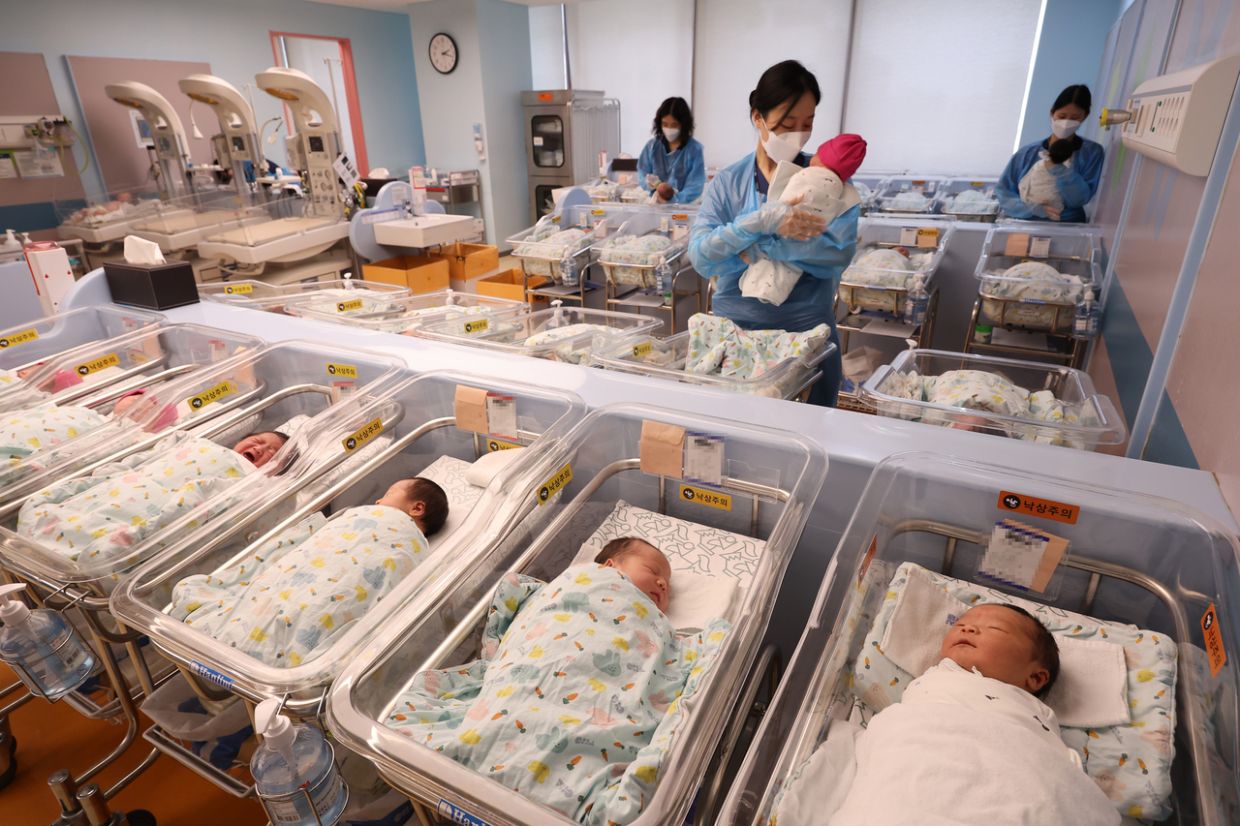
South Korea's fertility indicators are stirring cautious optimism after years of decline, with the quarterly birth rate climbing to 0.95 in early 2025—a notable improvement from the catastrophic 0.72 recorded in 2023. This trajectory suggests the annual fertility rate could surpass 0.9 for the first time since 2019, marking a symbolic psychological threshold for policymakers and demographers tracking the nation's population health. The Ministry of Data and Statistics recorded 0.93 in April and 0.80 in May, revealing month-to-month volatility typical of recovering trends, yet the overall momentum has captured official attention across Seoul's economic and social policy apparatus.
The rebound draws strength from identifiable demographic shifts. A rising cohort of marriages among couples in their thirties—many themselves children of South Korea's baby boom era—has directly boosted birth numbers, with recorded births climbing 15.2 percent in the January-to-May period compared to the same months the previous year. This uptick appears organic rather than policy-driven, emerging from a larger eligible population reaching reproductive prime and perhaps reflecting some stabilisation in women's economic participation or shifting attitudes toward family planning. However, South Korean authorities and independent researchers remain guarded, recognising that one year of recovery cannot unwind decades of cultural and economic forces pushing couples toward smaller families or delayed parenthood.
International comparisons now favour South Korea's position, albeit from a historically bleak baseline. The BirthGauge research organisation recently projected that Taiwan's fertility rate has slipped below South Korea's, ending Seoul's unenviable reign as the lowest among 93 economies surveyed. This reversal signals that South Korea's persistent policy initiatives—though modest—may be gaining marginal traction, even as the absolute numbers remain among the world's lowest. Regional competitors and international observers have begun treating South Korea's recovery as a potential bellwether for other East Asian economies wrestling with similar pressures of rapid urbanisation, female workforce participation, and high child-rearing costs.
Yet beneath these encouraging quarterly figures lies a demographic chasm that demographers argue cannot be bridged by fertility recovery alone. The population aged fourteen and younger contracted to just 5.22 million in 2024, representing a staggering 25-percent decline from ten years prior. Simultaneously, the elderly population—those aged sixty-five and above—ballooned by 62 percent over the same decade, surpassing ten million individuals. These twin movements reflect the irreversible age structure shift now embedded in South Korean society, where children constitute merely 10.1 percent of the population as of April 2025, down from 10.5 percent a year earlier despite the recent birth increase. The mathematics are unforgiving: even sustained improvements in current fertility rates will require decades to generate a proportionally larger working-age cohort capable of sustaining pension systems, healthcare infrastructure, and economic dynamism.
The structural imbalance between a shrinking youth population and an exploding elderly demographic has triggered urgent reassessments within South Korea's fiscal establishment. The Organisation for Economic Co-operation and Development, in its July 2025 economic survey of South Korea, explicitly called for strengthened fiscal frameworks alongside sweeping pension and tax reforms to manage the cascading costs of population ageing. Health expenditures, long-term care provision, and pension liabilities are projected to consume an ever-larger share of the national budget, crowding out investment in education, infrastructure, and innovation—the very sectors that might enhance South Korea's competitiveness in an increasingly multipolar economic landscape.
Beyond the numbers, demographers and labour economists increasingly argue that South Korea's policy response has been incomplete. Immigration policy, traditionally framed around filling discrete labour market gaps and maintaining strict skill-based selection criteria, must undergo philosophical reorientation. Lee Kyu-yong, a researcher at the Korea Labor Institute, articulated this perspective at a July forum, contending that immigration frameworks should prioritise immigrant integration, skills development, and long-term settlement pathways rather than treating workers as temporary plugs for short-term shortages. This reframing would align immigration more closely with how South Korea invests in the development and retention of its own young nationals, creating conditions for sustainable demographic renewal through managed migration rather than relying exclusively on organic birth rate recovery.
The implications extend across Southeast Asia and the broader Indo-Pacific region. South Korea's demographic trajectory has become a cautionary tale for wealthier East Asian and Southeast Asian economies that may follow similar pathways of low fertility, rapid ageing, and limited immigration infrastructure. Malaysia, with its younger demographic profile but rising urbanisation and female workforce participation, observes South Korea's policy struggles with particular attention. The South Korean experience demonstrates that cultural and economic incentives shaping family formation are extraordinarily difficult to reverse through government programmes alone, even when substantial subsidies for childcare, housing, and education are deployed. This realisation has prompted Malaysian policymakers to consider proactive immigration and integration strategies before demographic imbalance becomes as acute as South Korea's.
The government's stated expectation that the annual fertility rate could top 0.9 rests heavily on demographic momentum from larger age cohorts rather than genuine changes in fertility preferences among individual women. South Korean women surveyed consistently cite economic uncertainty, career concerns, and the perceived incompatibility of motherhood with professional ambition as primary deterrents to larger families. Housing affordability, particularly in Seoul's metropolitan region, remains prohibitively high, forcing young couples to delay family formation or abandon it altogether. These structural obstacles are not easily addressed through tax rebates or subsidised kindergarten fees; they require deeper transformations in workplace culture, gender equity, and urban affordability that span decades and multiple policy domains.
South Korea's gradual immigration policy shift, if implemented seriously, could offer a template for other developed Asian economies. Treating skilled migrants as long-term community members—investing in their language proficiency, professional credential recognition, and family settlement support—represents a fundamental departure from Asia's historical scepticism toward permanent migration. Yet this strategy demands political capital, as anti-immigrant sentiment occasionally flares in South Korean public discourse. The government's willingness to pursue comprehensive immigration reform alongside fertility rate monitoring will ultimately determine whether South Korea can stabilise its demographic foundation or merely slow an otherwise inexorable decline in workforce size and tax base.
Looking forward, the coming twelve months will prove decisive in determining whether South Korea's 2025 fertility recovery represents a genuine inflection point or a statistical flutter. If monthly figures remain robust and the annual rate surpasses 0.9, it would signal that cultural attitudes toward motherhood and family size may be stabilising after two decades of decline. Conversely, should the recovery plateau or reverse, it would reaffirm that South Korea faces a structural demographic challenge requiring integrated solutions spanning fiscal reform, immigration policy, and workplace culture—not fertility campaigns alone. For Malaysia and other regional economies watching closely, South Korea's experience underscores that demographic planning cannot be deferred to crisis point; it demands immediate, multifaceted policy action informed by evidence, international experience, and demographic realism.

