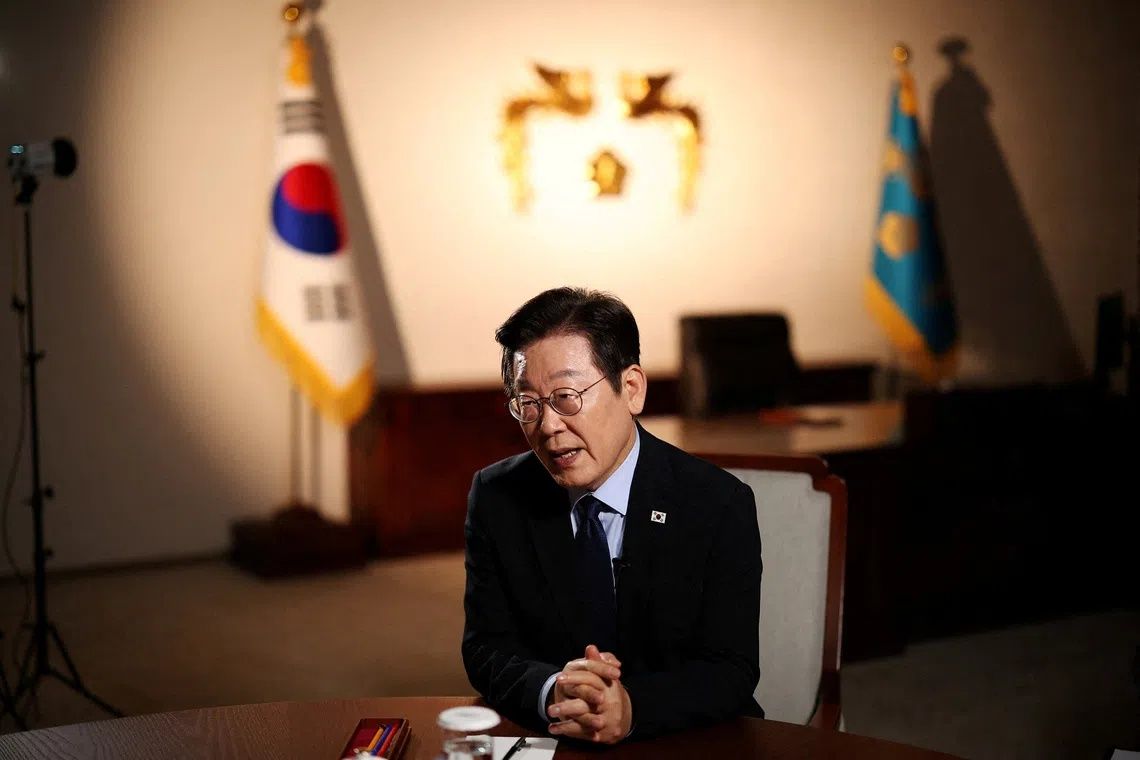
South Korean President Lee Jae Myung has signalled backing for a substantial constitutional overhaul that would reshape the country's presidential system, permitting leaders to serve four-year terms with the possibility of seeking re-election. According to Yonhap news agency, a presidential Blue House official disclosed this preference on Friday, underlining that the proposed framework represents the most widely acceptable model among competing reform proposals currently under discussion.
The announcement carries considerable weight in the context of South Korea's persistent constitutional debates. The nation's current presidential framework, adopted after decades of political evolution, restricts the head of state to a solitary five-year mandate with no opportunity for re-election. This arrangement, established to prevent authoritarian entrenchment, has itself become a lightning rod for criticism, with successive presidents facing investigations and legal challenges after departing office. Lee's position suggests recognition that this cycle demands recalibration.
Crucially, the proposed reforms would not simply extend or modify the executive's tenure. Rather, they represent a comprehensive recalibration of South Korea's power dynamics. The package includes deliberate measures to strengthen parliamentary authority, addressing longstanding complaints that the presidency has accumulated disproportionate power at the expense of legislative oversight. Critics have routinely characterised South Korea's system as an "imperial presidency," where occupants wield executive dominance largely unencumbered by meaningful legislative checks until their terms expire.
The Blue House official articulated this concern directly, indicating that Lee himself has become attuned to anxieties regarding executive overreach. By coupling re-election eligibility with enhanced parliamentary powers, the proposal attempts to introduce offsetting institutional restraints. Stronger legislative capacity would theoretically constrain presidential prerogatives and distribute authority more evenly across branches of government, creating more robust accountability mechanisms.
Amendment of South Korea's constitution represents an extraordinarily demanding undertaking. Parliamentary approval requires support from at least 200 lawmakers in a legislature of 300 members, effectively demanding supermajority consensus. This high threshold reflects constitutional designers' intent to prevent casual or partisan tampering with fundamental governance structures. Consequently, any successful reform necessarily demands genuine cross-party negotiation rather than unilateral executive initiative.
The Blue House official emphasised this political reality, stressing that constitutional reform must transpire through deliberative National Assembly processes grounded in genuine political consensus. This language signals recognition that Lee cannot simply impose constitutional preferences through executive authority, regardless of his current political standing. The emphasis on consensus-building suggests acknowledgment that durable constitutional change requires supporting coalitions extending across ideological boundaries.
For Malaysian observers, South Korea's constitutional predicament offers instructive parallels and contrasts. Like Malaysia, South Korea grapples with balancing executive autonomy against institutional accountability. Yet South Korea's single-term presidency creates distinct dynamics, producing lame-duck effects as leaders near departure and generating post-presidential prosecution patterns that Malaysia's system avoids through different mechanisms. Both nations confront how to maintain effective governance while preventing power concentration, though their constitutional architectures differ substantially.
The timing of Lee's intervention warrants consideration. South Korean presidential politics operate within intensified partisan polarisation, with substantial portions of the electorate viewing executive leadership through deeply sectional lenses. Constitutional reform efforts frequently become vehicles for partisan advantage-seeking despite rhetoric emphasising institutional principles. Lee's advocacy for re-election eligibility, combined with parliamentary empowerment language, could genuinely represent thoughtful constitutional philosophy or strategic repositioning aimed at improving his political prospects and party's future flexibility.
Regional constitutional architects across Southeast Asia monitor South Korea's reform efforts with varying degrees of interest. The nation's experience suggests that presidential term limitations, while constraining individual leaders, generate their own institutional pathologies including lame-duck governance deterioration and prosecutorial cycles targeting departing presidents. Several neighbouring democracies confront comparable questions regarding optimal presidential term structures and the balance between preventing authoritarian accumulation and enabling effective governance continuity.
The proposed framework's emphasis on parliamentary strengthening reflects sophisticated constitutional thinking about power distribution. Stronger legislatures capable of constraining executive initiative require robust committee systems, enhanced oversight mechanisms, and meaningful budgetary authority. South Korea's National Assembly has gradually accumulated such prerogatives, yet structural imbalances favouring presidential authority persist. Genuine parliamentary empowerment demands institutional investments and cultural shifts regarding legislative capacity.
Successful constitutional implementation requires more than technical amendments. South Korea would need developing supporting institutional practices, legislative expertise expansion, and cultural recognition of parliament's enhanced role. Presidential systems that formally grant strong parliamentary powers yet culturally defer to executive leadership often experience implementation failures as customary practices diverge from constitutional text. Lee's proposal implicitly assumes that constitutional restructuring would alter governmental behaviour patterns accordingly.
The reform proposal's prospects remain genuinely uncertain despite official backing. Opposing political factions may view re-election eligibility with suspicion regardless of parliamentary empowerment rhetoric, fearing extended Lee dominance. Constitutional negotiations frequently dissolve amid partisan recrimination when genuine consensus evaporates. The 200-lawmaker requirement ensures that minority coalitions cannot impose constitutional preferences, necessitating negotiation across genuine political divides. Whether such consensus emerges remains an open question with significant implications for South Korea's democratic trajectory.

