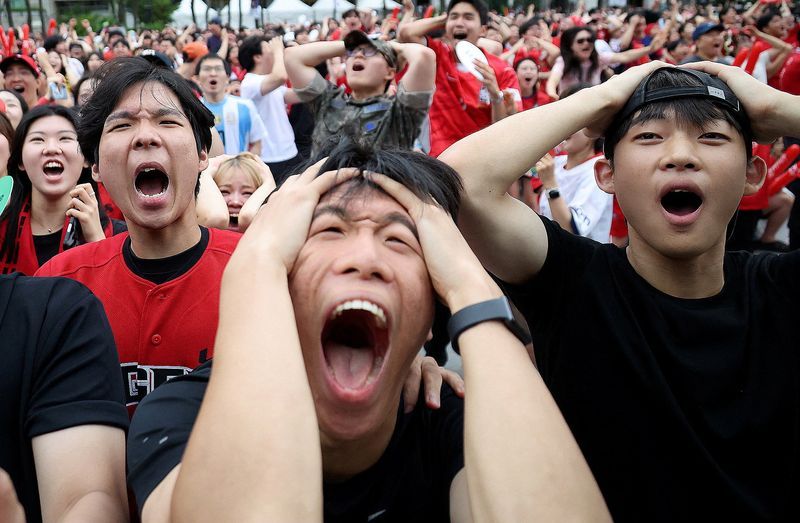
South Korean President Lee Jae Myung has ordered a formal investigation by the Ministry of Culture, Sports and Tourism following his country's shock elimination from the World Cup, casting blame on what he characterises as a fundamentally broken system of personnel appointments within the sports administration. The announcement came after the national team's failure to advance from Group A despite being widely considered capable of reaching the knockout stage, a result that has triggered significant public anger and calls for accountability across South Korea's football establishment.
The team's elimination became mathematically certain after consecutive defeats to Mexico and South Africa left South Korea finishing third in their group, outside the quota of eight best third-placed teams that qualify for the round of 32. This unexpected outcome particularly stung given that the group composition was perceived as manageable, raising questions about tactical decisions, player selection, and overall team management during the tournament. For a country with South Korea's footballing infrastructure and historical international competitiveness, the early exit represents an embarrassing setback that has reverberated well beyond sports circles into the political realm.
President Lee's intervention reflects how deeply embedded football success has become in national pride and political discourse across East Asia. His statement on social media platform X expressed astonishment at the result, declaring himself "utterly baffled" by an outcome that contradicted pre-tournament expectations. Beyond mere disappointment, however, the President seized on the performance collapse to launch a broader critique of meritocracy within South Korea's sports governance structures, suggesting that the failures on the field were symptomatic of deeper institutional problems regarding how leaders are selected and held accountable.
The focal point of Lee's criticism is coach Hong Myung-bo, whose reappointment as national team manager in 2024 had already generated controversy within South Korean media circles. Reports at the time suggested the hiring process lacked transparency and may have prioritised political or personal connections over competitive qualifications. Hong has consistently denied all allegations of improper conduct in his appointment, but the public momentum against him intensified dramatically following the World Cup exit. The controversy illustrates how appointment decisions in high-profile sporting roles become politicised in South Korea, where football serves as both a national pastime and a stage for questions about governance quality.
Lee's broader argument transcends the specifics of any single coaching decision. He contends that South Korea's institutional culture systematically fails to distinguish between public interest and private advantage, allowing incompetent individuals to ascend to positions of leadership when connections matter more than competence. This critique resonates with ongoing South Korean political debates about corruption, nepotism, and transparency in both public and private sectors. The President used the football debacle as a vehicle to articulate a wider concern about accountability mechanisms and the difficulty of monitoring those wielding appointment authority.
Public sentiment has crystallised into concrete action. A petition calling for Hong's dismissal was posted on the National Assembly website and rapidly accumulated sufficient signatures to trigger an initial formal review process. More colourfully, social media posts have documented South Korean shop owners displaying signs explicitly banning the coach from their premises, a striking visual representation of the intensity of public disappointment. This grassroots backlash suggests that Lee's intervention, while surprising from a sitting president, reflects genuine and widespread public anger rather than political opportunism disconnected from popular sentiment.
For Malaysia and other Southeast Asian nations observing South Korea's response, the episode offers instructive lessons about how national football performance becomes entangled with questions of institutional competence and public trust. South Korea's willingness to subject sports management to presidential scrutiny and government investigation demonstrates both the importance assigned to international football success and the way such failures can trigger broader institutional audits. Countries across the region with similar aspirations for football advancement might consider whether their own governance structures adequately balance meritocratic selection with effective oversight.
The investigation Lee has ordered will examine not merely the World Cup performance itself but the circumstances surrounding Hong's appointment and the decision-making processes within the Korea Football Association and relevant government bodies. By demanding analysis of root causes and preventative measures, the President is signalling that any outcome report must move beyond assigning individual blame and instead propose systemic reforms to prevent similar failures recurring. This approach could reshape how South Korean sports organisations approach hiring, potentially establishing new transparency standards and accountability frameworks.
The timing of Lee's intervention is also politically significant within South Korea's domestic context. By positioning himself as championing public interest against institutional failures and bureaucratic opacity, the President associates himself with anti-corruption sentiment. This move simultaneously demonstrates responsiveness to public disappointment while advancing a narrative about the need for stronger oversight and accountability mechanisms more broadly. The World Cup exit thus becomes a springboard for wider governance discussions extending far beyond football.
For international football observers, South Korea's response underscores how deeply national teams have become intertwined with state identity and political legitimacy in East Asia. The expectation that a sitting president would directly intervene in coaching matters reflects assumptions about collective responsibility for national sporting performance that might seem extraordinary in other cultural contexts. Yet this integration of football with national prestige remains characteristic across much of Asia, where World Cup participation serves as a proxy for demonstrating international competitiveness and organisational capability.
The investigation process itself will likely consume significant political and media attention over coming months, with implications for how South Korea structures its sports governance going forward. Beyond the immediate question of Hong's future, the inquiry may catalyse broader reforms in how national team managers are selected, evaluated, and held accountable. Should the investigation corroborate concerns about the appointment process lacking proper competitive scrutiny, it could precipitate changes affecting not only football but other national sports programmes operating under similar institutional frameworks.

