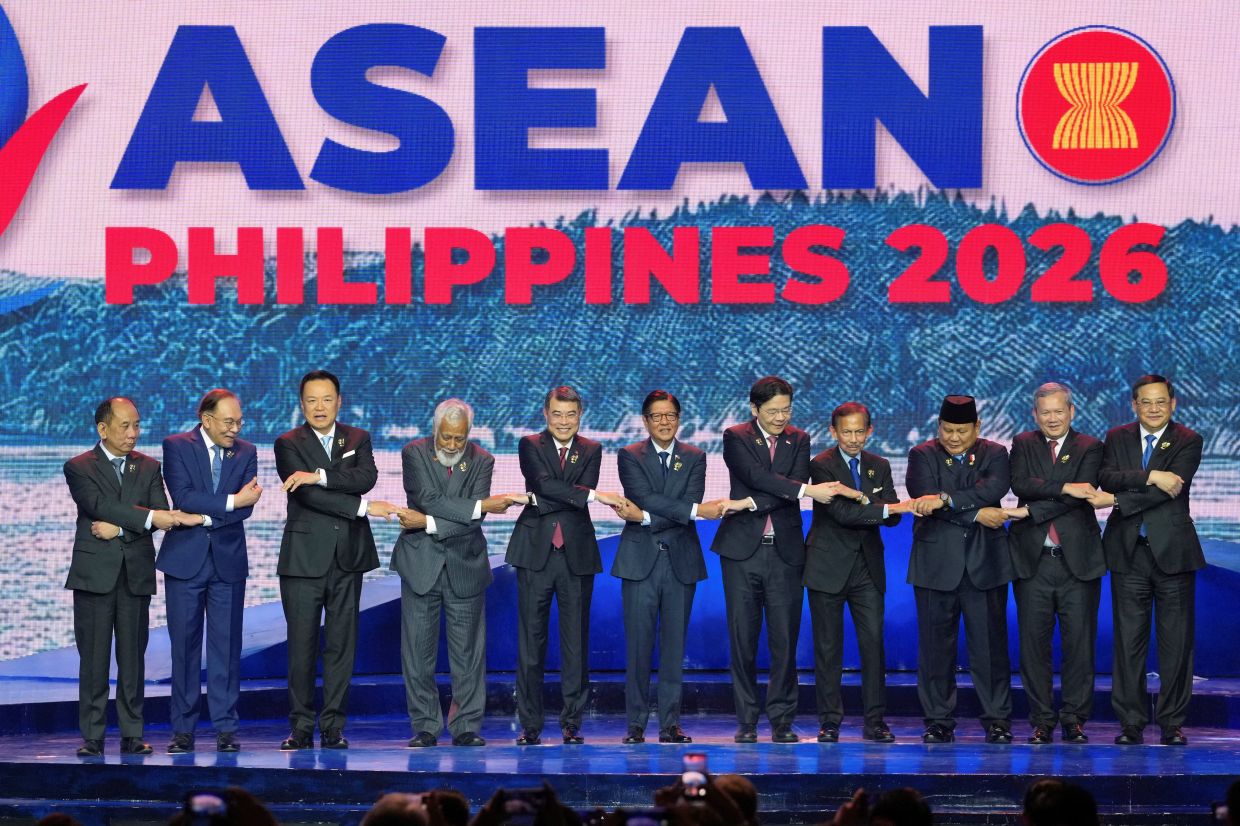
The Association of Southeast Asian Nations convened its annual ministerial gathering in Manila this week with an unusually crowded agenda reflecting the geopolitical turmoil engulfing the Indo-Pacific and beyond. The three-day session brought together the region's top diplomats alongside major international players including U.S. Secretary of State Marco Rubio, Chinese Foreign Minister Wang Yi, Russian Foreign Minister Sergey Lavrov, and representatives from the European Union. The Philippines, holding the ASEAN chair for 2025, positioned itself as a crucial venue for dialogue at a moment when fraying diplomatic channels risk allowing multiple crises to escalate simultaneously.
Central to the ministers' concerns was the deteriorating situation in the Middle East, where renewed hostilities between the United States and Iran have reignited fears of broader regional conflict. The escalating tensions pose an acute threat to Southeast Asia's economic lifeline, as roughly one-fifth of the world's crude oil passes through the Strait of Hormuz before reaching regional markets. The bloc's 680 million inhabitants depend substantially on Middle Eastern hydrocarbons for energy security and industrial production, making even temporary supply disruptions economically painful. When the Philippines faced fuel shortages earlier in the year, President Ferdinand Marcos Jr. was compelled to declare a national energy emergency in March, underscoring how vulnerable the region remains to Middle Eastern instability. ASEAN leaders planned to issue a joint statement expressing alarm at developments and calling for renewed diplomatic engagement between Washington and Tehran, signalling the bloc's preference for de-escalation over further military confrontation.
The Middle East crisis carries particular significance for Southeast Asia because it has exposed apparent gaps in America's strategic attention to the Indo-Pacific region. The Trump administration's military focus on containing Iranian actions has prompted regional anxiety that Washington may lack bandwidth to address China's increasingly assertive posture in contested waters closer to home. Philippine and Vietnamese officials have grown particularly vocal about Chinese coast guard and military activities in the South China Sea, where territorial claims overlap among multiple claimants. By attending the Manila talks personally, Secretary Rubio sought to reassure ASEAN members that the United States remains committed to the region's security architecture and retains the capacity to balance its global obligations with its stated Indo-Pacific strategy of maintaining a free and open region. His State Department characterised the visit as reaffirming a core American priority: ensuring that regional waters remain accessible to international commerce and that smaller nations retain agency in their own backyards.
The diplomatic calculus surrounding U.S.-China engagement remained fluid and uncertain heading into the meetings. Rubio indicated openness to meeting Wang Yi but stopped short of confirming concrete arrangements, reflecting broader ambiguity about whether the new American administration would pursue dialogue or confrontation with Beijing. The secretary refrained from committing to revisiting Trump's disputes with China over 2020 election interference, though he acknowledged that bilateral irritants were inevitable between major powers. His framing emphasised that dialogue itself constituted a shared responsibility, suggesting a preference for managed competition over zero-sum antagonism. Yet this measured posture masked deeper structural tensions: the Quad alignment of America, India, Japan and Australia, which Rubio was scheduled to coordinate with on the Manila sidelines, remains explicitly designed as a counterweight to Chinese influence and has drawn repeated protests from Beijing as a containment strategy.
These external great-power competitions overlay ASEAN's own internal crises, particularly Myanmar's unresolved civil war. Since the military coup in February 2021 that deposed Aung San Suu Kyi's democratically elected government, the Assistance Association for Political Prisoners has documented more than 8,100 deaths resulting from fighting, with an additional 22,500 individuals held in detention. ASEAN's signature 2021 five-point peace consensus has achieved little concrete progress, primarily because the Myanmar junta has disregarded crucial provisions calling for ceasefire, humanitarian access and dialogue. The military government's non-compliance prompted the bloc to exclude Myanmar's leaders from high-level summits, a rare punitive measure within an organisation traditionally committed to non-interference. Yet this principled stance created a diplomatic trap: marginalising Myanmar's representatives seemed only to entrench their intransigence while excluding ASEAN from influence over developments affecting millions of civilians.
Attempting to break this deadlock, Philippine Foreign Secretary Theresa Lazaro, acting as ASEAN's special envoy, met Myanmar's Foreign Minister Tin Maung Swe in Bangkok this month—the first high-level engagement in five years—to restart discussions about violence reduction and inclusive dialogue. Lazaro subsequently travelled to the Thai resort city of Pattaya to consult with representatives from Myanmar's ethnic armed organisations, signalling ASEAN's willingness to engage all parties to the conflict rather than rely exclusively on diplomatic isolation. However, international human rights organisations swiftly condemned the moves, arguing that ASEAN was effectively abandoning its own institutional ban against engaging Myanmar's senior officials without extracting meaningful concessions. Lazaro defended the shift by arguing that pragmatic diplomacy with all conflict parties represented the only viable pathway toward peace, insisting that renewed engagement did not constitute abandonment of the five-point framework. This tension between punitive isolation and constructive engagement will likely persist, as Myanmar shows no signs of voluntarily changing course regardless of diplomatic carrots or sticks ASEAN deploys.
Equally vexing for ASEAN is the South China Sea code of conduct negotiations with Beijing, which have dragged on for years without yielding enforceable mechanisms to prevent military incidents or establish dispute-resolution procedures. The territorial standoffs involve overlapping claims from China, Taiwan, Brunei, Malaysia, the Philippines and Vietnam, with recent years witnessing an alarming uptick in confrontations between Chinese and Philippine government vessels in the Spratly Islands and other contested zones. Wang Yi's attendance provided an opportunity for ASEAN ministers to press China on the pace and substance of negotiations, though analysts remain sceptical that any breakthrough is imminent. China has shown reluctance to accept binding constraints on its freedom of action in waters it historically claims, while smaller ASEAN members seek guarantees against coercion. The bloc's capacity to maintain united messaging on this issue remains fragile, as some members prioritise economic ties with Beijing over maritime assertiveness.
The Manila talks thus encapsulated the fundamental strategic dilemma confronting Southeast Asia in 2025: the region must simultaneously manage its exposure to Middle Eastern energy shocks and great-power competition, navigate Myanmar's humanitarian catastrophe and civilisational fracture, and forge sustainable arrangements governing its own disputed waterways. No single forum or institution can resolve all these interconnected crises, yet ASEAN remains the primary vehicle through which the region attempts collective action. The bloc's success in generating consensus statements and keeping diplomatic channels open, while modest, matters more in environments of heightened tension. Whether Rubio's visit and the ministerial discussions yield meaningful policy shifts or merely ritualistic reaffirmations of existing positions will become clear in coming months as various diplomatic tracks proceed in parallel.

