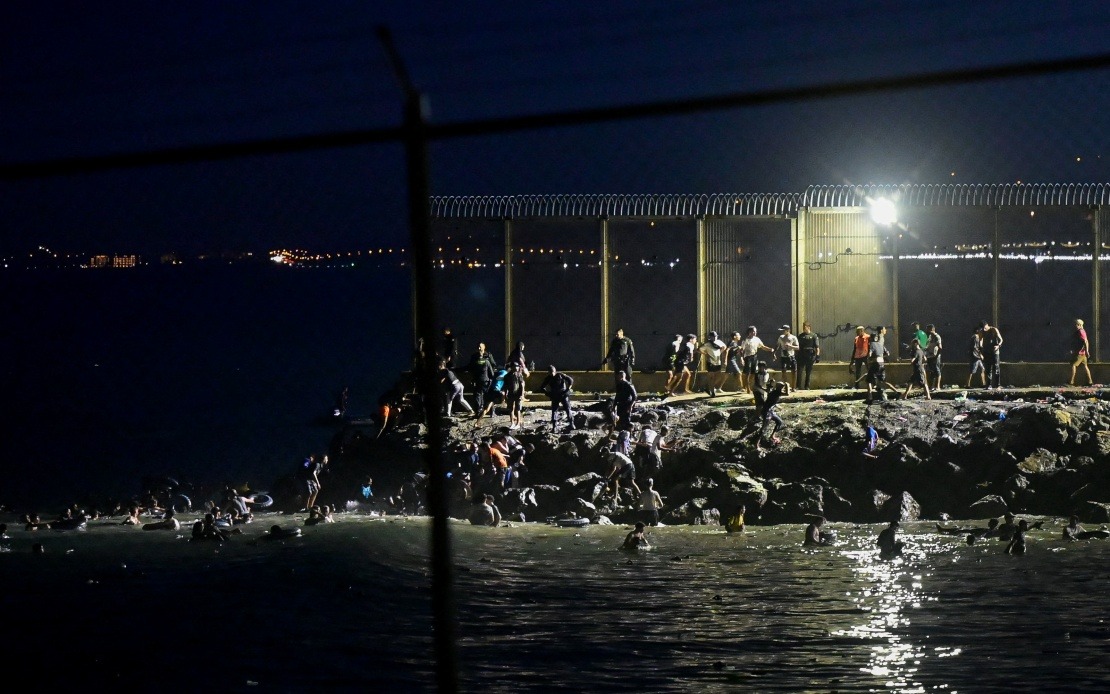
Spain's government has initiated a comprehensive emergency response after a dramatic surge in border-crossing attempts at Ceuta, the Spanish enclave on Morocco's northern coast, with Prime Minister Pedro Sanchez announcing that authorities are deploying all available resources to manage the unfolding situation. The incident marks a critical juncture in Spain's ongoing struggle to manage migration pressures at its North African territories, raising serious questions about border security and regional cooperation in the Mediterranean.
Thursday's events saw thousands of young Moroccan nationals gather near the Castillejos border crossing in what appeared to be an orchestrated effort to breach into Ceuta. Witnesses reported that hundreds of migrants scaled the border fencing while others waded into the sea in an attempt to reach Spanish territory through the waters surrounding the enclave. This multi-pronged approach reflected careful coordination and determination, presenting Spanish security forces with unprecedented logistical challenges in containing the movement across multiple access points simultaneously.
In response, Sanchez moved swiftly to signal the government's seriousness about restoring order. Speaking via social media, he pledged that Madrid would provide immediate assistance while working in tandem with both Moroccan authorities and international partners. The Spanish government simultaneously announced that military units would be deployed alongside the Civil Guard to reinforce border defences and maintain security throughout Ceuta. This escalation underscores the severity with which Spanish officials regard the situation, typically reserved for crises of significant magnitude.
Moroccan security forces responded to the influx by establishing perimeter barriers in several locations and apprehending numerous individuals attempting to cross. However, reports indicate that despite these interventions, multiple groups managed to press forward toward the border, suggesting that Moroccan authorities, while taking action, may have struggled to contain the sheer volume of migrants involved in the crossing attempt. This patchy enforcement reflects the enormous practical difficulty of preventing thousands of determined individuals from reaching a border simultaneously.
Ceuta's regional leadership had formally requested additional support from Spain's central government in Madrid, having assessed that the situation had evolved beyond the capacity of existing local resources to manage effectively. The escalation represented not an isolated incident but rather the culmination of mounting pressures that had been building across recent weeks. This crisis thus carries the weight of accumulated tension rather than serving as a sudden anomaly, suggesting systemic vulnerabilities in existing border management frameworks.
Prime Minister Sanchez and Interior Minister Fernando Grande-Marlaska scheduled a Friday visit to Ceuta to conduct a direct assessment of conditions on the ground. Such high-level visits by key government officials serve multiple purposes simultaneously: they demonstrate political commitment to resolving the crisis, provide senior policymakers with firsthand intelligence, and signal to both the domestic electorate and international observers that Madrid treats the situation with appropriate gravity. The timing and symbolism of such visits carry weight in Spain's political landscape, particularly given the sensitivity of migration questions among voters.
For Malaysian and Southeast Asian observers, Spain's crisis carries instructive lessons regarding border management in regions experiencing significant migration pressures. Like Malaysia, which faces its own complexities at sea routes and land frontiers, Spain demonstrates how rapidly migration situations can escalate when coordinated movements occur. The Spanish enclave's geographic position—surrounded by Moroccan territory—creates vulnerabilities analogous to those confronting Southeast Asian nations managing maritime boundaries and cross-border population movements.
The broader implications extend beyond immediate security concerns. Spain's reliance on cooperation with Moroccan authorities highlights how transnational border challenges demand collaborative approaches rather than unilateral action alone. For Southeast Asian policymakers, this underscores the necessity of maintaining robust diplomatic channels and coordination mechanisms with neighbouring states, even when underlying tensions exist. The migration pressures affecting Spain stem partly from broader regional instability and economic disparities in North Africa—dynamics that parallel conditions driving migration throughout Asia and toward Southeast Asian destinations.
Ceuta's status as a Spanish possession within African geography creates diplomatic and legal complexities that differ from but parallel issues affecting Southeast Asian territories. The enclave's contested status and ongoing tensions with Morocco regarding sovereignty add layers of complication to what might otherwise be handled as a conventional border management exercise. This illustrates how territorial disputes and historical grievances can intersect with contemporary migration challenges, creating situations where simple enforcement approaches prove insufficient.
The incident also demonstrates how social media and coordinated messaging can mobilise large numbers of people toward specific objectives. The apparent coordination visible in Thursday's events suggests organisational capacity among migrant networks—a phenomenon increasingly observed across global migration routes. Southeast Asian authorities monitoring such patterns may recognise parallels to their own experiences managing organised migrant movements through regional waters and overland routes.
Spain's activation of military resources signals recognition that civilian law enforcement alone cannot adequately respond to mass migration events. This escalatory step reflects difficult choices that border states must make when conventional tools prove insufficient. The political dimensions of such escalation merit careful consideration, as military deployment at borders carries significant implications for how both domestic and international audiences perceive government competence and resolve.
Looking forward, Spain's approach will require sustained coordination with Morocco to address root causes driving such mass movement attempts. Temporary security measures alone cannot resolve underlying factors motivating thousands to risk dangerous border crossing attempts. Sustainable solutions demand engagement with economic development, regional stability initiatives, and managed migration frameworks—challenges requiring patience and long-term commitment beyond emergency response phases that characterise immediate crisis management.
The unfolding situation at Ceuta ultimately reflects broader patterns reshaping global geography and international relations. Migration pressures, territorial sovereignty questions, and the tension between mobility and border control will continue defining relationships between neighbouring states throughout Asia, Africa, and beyond. Spain's response will likely influence policy approaches across the Mediterranean region and potentially affect how other nations develop their own border security strategies in an era of increasing migration pressures.

