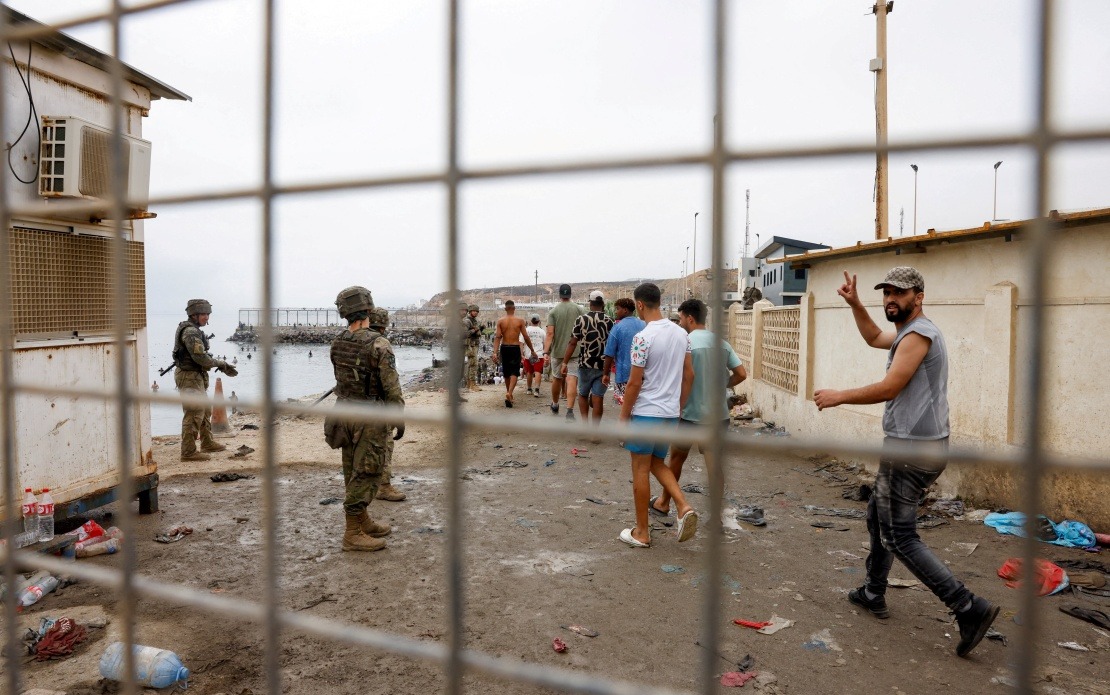
Spanish Foreign Minister Jose Manuel Albares declared on Friday that almost all migrants who had entered Ceuta have now returned to Morocco, using the announcement to counter what he characterized as false narratives surrounding the migration incident. The minister emphasized that Spain maintains robust control mechanisms at its territorial boundaries, insisting that the Schengen Area's integrity remains fully intact despite the recent crisis that unfolded at the Mediterranean crossing point.
The cross-border movement revealed sharp security vulnerabilities at one of Spain's most sensitive geopolitical flashpoints. Albares stressed that travelling from either Ceuta or Melilla, Spain's other North African enclave, to the Iberian mainland requires mandatory identification checks at police checkpoints—a safeguard he highlighted as working effectively even during the unprecedented influx. His remarks on social media appeared designed to reassure both Spanish citizens and European partners concerned about border security standards.
Dozens of migrants began moving back toward the Morocco-Ceuta boundary on Friday afternoon, according to Spanish news reports, with authorities attributing the voluntary return to multiple practical factors beyond security considerations. The lack of functioning commercial infrastructure—including closed shops, supermarkets, and restaurants—made it impossible for the newly arrived migrants to access basic necessities or sustenance within Ceuta. This combination of limited services and the existing bilateral repatriation framework between Spain and Morocco created conditions favouring orderly return rather than prolonged stays.
Spain's security apparatus mobilized swiftly to manage the situation and prevent further unauthorized maritime crossings. Military and Civil Guard personnel, including the Army's Regulares Group No. 54, were deployed strategically along Tarajal beach to intercept any additional groups attempting to enter by sea. This enhanced coastal presence represented a significant operational response aimed at restoring border control and preventing further security breaches.
The migration episode, which began Thursday and peaked Friday, resulted in significant loss of life according to Spanish authorities, who reported at least 57 deaths connected to the crisis. These fatalities highlight the dangerous conditions migrants face during attempted Mediterranean crossings, underscoring broader humanitarian concerns surrounding irregular migration routes through North Africa. The scale of casualties underscores why European nations remain deeply invested in border security and managing irregular arrivals.
Prime Minister Pedro Sanchez adopted notably forceful language in characterizing the incident, describing the sudden mass arrival not merely as a migration challenge but as "an attack" on Spain and "a violation of Spain's territorial integrity." This framing elevated the incident beyond routine border management, positioning it as a deliberate political or security challenge requiring decisive state response. Sanchez pledged to restore normalcy throughout Ceuta with maximum speed, signalling the government's determination to prevent any recurrence.
The repatriation agreement between Spain and Morocco provided the formal mechanism enabling the orderly return process. Such bilateral arrangements represent crucial tools for European nations managing irregular migration, allowing for coordinated responses rather than unilateral actions. The agreement's effectiveness during this crisis demonstrates the value of institutional cooperation despite occasional diplomatic tensions between Madrid and Rabat over Western Sahara and other geopolitical issues.
For Malaysia and Southeast Asian observers, Spain's experience offers instructive lessons about border management and migration pressure. Although the geographic and demographic contexts differ substantially, the incident illustrates how quickly migration crises can escalate and how dependent border security remains on both technological capacity and international cooperation. Malaysia, which hosts significant migrant populations and faces regular maritime crossing attempts in the Strait of Malacca, confronts comparable challenges requiring coordinated regional responses.
The Ceuta incident also reflects broader European tensions over immigration policy and burden-sharing. Smaller border nations like Spain bear disproportionate security and administrative costs when migrants concentrate at single crossing points, amplifying political pressure on national governments. This dynamic resonates across Southeast Asia, where transit countries like Thailand and Malaysia experience similar strains from irregular migration flows.
Spain's response demonstrates both the capability and limitations of national border enforcement. Despite sophisticated checkpoint systems and military deployment, the sheer volume of migrants created operational challenges and tragic outcomes. This reality applies equally to Southeast Asian nations grappling with migration management across land and maritime boundaries, suggesting that technical solutions alone prove insufficient without addressing root causes of irregular migration.

