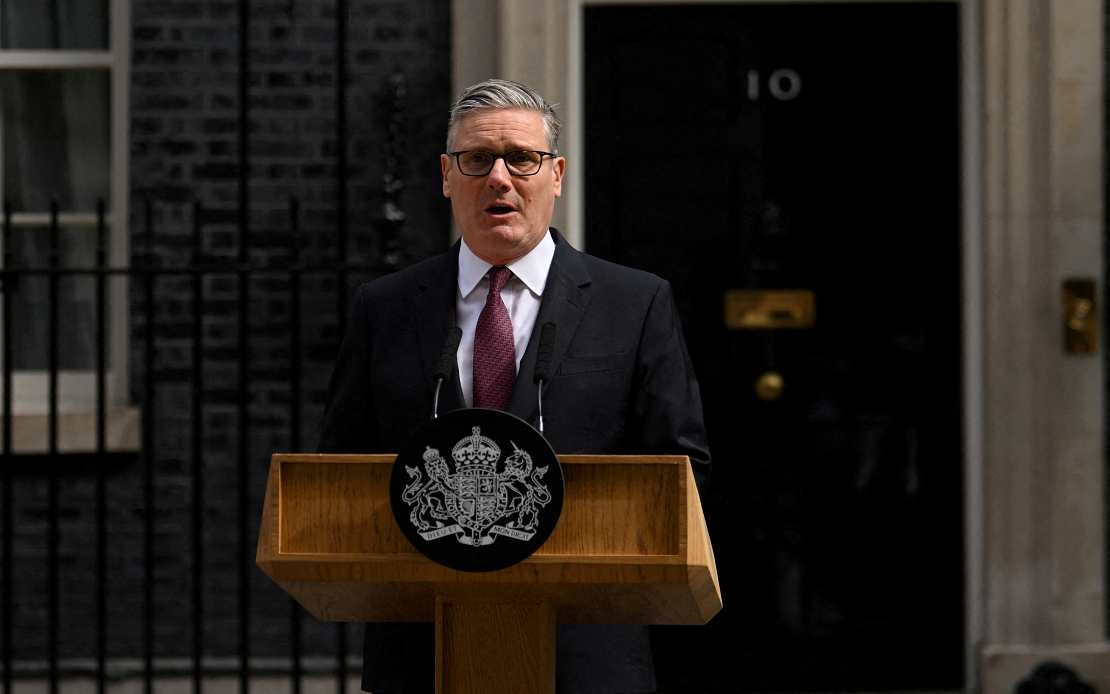
Keir Starmer has formally ended his tenure as British Prime Minister, delivering a valedictory address at Downing Street on Monday before proceeding to Buckingham Palace to submit his resignation to King Charles. In remarks marked by quiet satisfaction, Starmer characterised his departure as the conclusion of a significant political chapter, stating that his work had reached completion and that he was departing "with a smile." The transition marks another pivotal moment in British politics as the Labour Party prepares to hand leadership to Andy Burnham.
Starmer's decision to step aside comes after leading the Labour Party through an extraordinary transformation. The party had suffered a devastating electoral defeat in 2019, finding itself marginalised and requiring fundamental restructuring. Over the subsequent years, Starmer methodically rebuilt Labour's organisational capacity and policy platform, positioning the party as a credible alternative government. His efforts culminated in a decisive general election victory in 2024, delivering Labour a commanding mandate after years of Conservative governance.
During his remarks at Number 10, Starmer reflected on the achievements of his administration, contending that Britain had become "stronger and fairer" during his stewardship compared to the condition in which he inherited it. The prime minister emphasised that serving the nation in this capacity had been "the privilege of my life," a sentiment delivered with visible emotion as his wife Victoria stood beside him alongside Cabinet colleagues and personal friends who had gathered to mark the occasion. His language throughout the brief address struck a tone of deliberate finality rather than regret, suggesting a planned transition rather than a forced departure.
The mechanics of Starmer's departure followed constitutional convention precisely. After concluding his remarks in Downing Street, the departing premier travelled to Buckingham Palace where he formally tendered his resignation to King Charles III. This procedural step allowed the Crown to facilitate the orderly transition of executive authority, with the monarch subsequently inviting Burnham to form a government. The choreography of these transitions remains one of the distinctive features of the British constitutional system, maintaining institutional continuity even during significant political change.
Andy Burnham emerges as Starmer's successor positioned with substantial institutional backing and parliamentary support. As the designated heir apparent within the Labour Party structure, Burnham represents a continuation of the party's ideological direction while bringing his own distinct political identity and priorities. His elevation to the premiership carries particular significance given his extensive experience in senior government positions and his cultivation of a political brand that emphasises regional regeneration and working-class representation within the Labour coalition.
The transition between Starmer and Burnham occurs against a backdrop of evolving economic and social circumstances facing the United Kingdom. Labour's 2024 electoral victory provided the party with substantial parliamentary numbers and a clear mandate for governance, yet the intervening period has presented a complex array of policy challenges requiring sustained executive attention. The incoming administration under Burnham will inherit both the opportunities and constraints that accompany significant electoral mandates, particularly regarding parliamentary time and public expectations for transformative change.
For Malaysian observers and Southeast Asian readers, the British political transition illustrates patterns relevant to regional governance dynamics. The Labour Party's institutional discipline in managing a controlled succession demonstrates how established political parties navigate leadership transitions while maintaining organisational coherence. The contrast between the chaos sometimes characterised by unplanned leadership changes and the orderly process undertaken by the Labour Party highlights the significance of institutional strength and party discipline in managing democratic governance effectively.
Starmer's explicit framing of his departure as representing completed work rather than interrupted ambitions reflects his assessment of the Labour government's foundational accomplishments. The party leader appears to have calculated that the structural tasks of returning Labour to electoral viability and securing an initial mandate have been substantially achieved, with succession positioning Burnham to build upon these foundations during subsequent years of governance. This approach differs sharply from many political transitions driven by crisis, defeat, or terminal loss of parliamentary confidence.
The implications of this transition extend beyond Westminster corridors. British political stability carries significance for international relationships and economic policy coordination within Europe and the Commonwealth. The orderly transition from Starmer to Burnham suggests continuity in governmental orientation and institutional capacity, providing reassurance to international partners regarding the consistency of British foreign policy, trade relationships, and diplomatic engagement. For Malaysian policymakers engaged in bilateral relationships with the United Kingdom, this transition provides clarity regarding points of contact and administrative continuity.
Burnham's assumption of the premiership will inevitably reflect his distinct political priorities and governing style, which may introduce nuances into Labour's policy implementation across diverse portfolio areas. His background in regional governance and urban policy suggests potential emphasis on devolved decision-making and place-based policy approaches, distinctions that may gradually reshape the character of Labour governance while maintaining fidelity to the party's core electoral commitments and policy framework established during the 2024 campaign.
The British Labour Party's successful management of this transition underscores the party's institutional maturity following the earlier period of internal disorder and factional tensions that characterised its years in opposition. By executing a planned, orderly succession process, Labour demonstrates reconstructed organisational capacity and internal discipline. This institutional strength enhances the party's capacity to sustain governance across multiple electoral cycles and policy challenges, positioning it as a stabilising force within British politics following the extended period of Conservative government that preceded the 2024 election.

