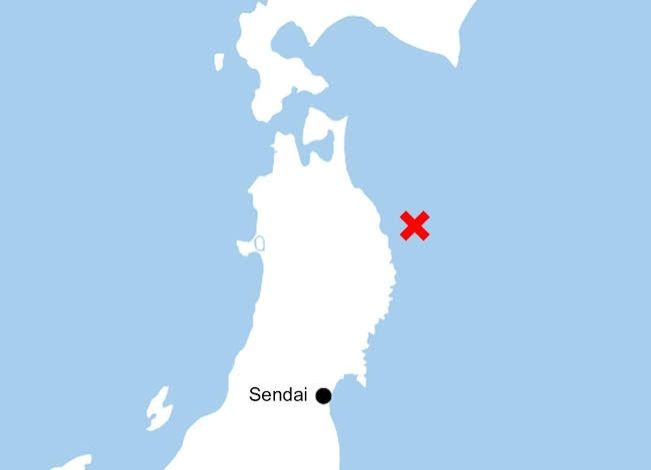
A powerful 7.2-magnitude earthquake rumbled beneath the seas off Japan's northern Iwate prefecture on Thursday morning, rattling infrastructure across hundreds of miles but ultimately sparing the nation from serious harm. The Japan Meteorological Agency initially measured the seismic event at magnitude 6.9 before revising upward to 7.2, locating the epicentre 44 kilometres below the ocean floor. The tremor struck at 7:30 am local time, with residents across the region and even in distant Tokyo reporting noticeable shaking. Despite the considerable force of the earthquake, authorities confirmed no tsunami warning was necessary, and Prime Minister Sanae Takaichi's government moved swiftly to assess damage across affected prefectures.
The quake's impact manifested primarily through minor disruptions and scattered property damage rather than catastrophic harm. Kitchen cupboards throughout Aomori and Iwate prefectures disgorged their contents onto floors, with saucepans and household goods strewn across homes and retail establishments captured on television coverage. Mutsumi Shimohata, a 61-year-old food processing employee in Hashikami, Aomori prefecture, described how an alarm on her smartphone triggered instantly as tremors began, with only a picture frame dislodged in her residence. Yet her workplace suffered more significantly, with the automated entrance door ceasing to function and portions of the office ceiling collapsing, prompting her employer to order staff to remain home on standby pending repairs.
Emergency response services fielded multiple calls across northern communities, though most incidents reflected the earthquake's disruptive rather than destructive character. Hashikami and Hachinohe fire departments received at least four emergency calls, including reports of individuals temporarily trapped within a lift. Rescue personnel also responded to instances of doors jamming and a tanker truck overturning on roadways. A primary school in Hashikami temporarily closed as a precautionary measure following the seismic event. Some bullet train services operated by Japan Railways suspended operations during and immediately after the earthquake, though regular passenger traffic in major cities including Hachinohe continued with traffic signals and transportation infrastructure functioning normally throughout the affected region.
The tremors registered at the upper sixth level on Japan's seven-point Shindo intensity scale in Aomori prefecture, a classification indicating potential for serious disruption. At this intensity threshold, residents may struggle to maintain balance without support and risk being thrown to the ground, while unsecured furniture typically topples and window panes may fracture. The Japan Meteorological Agency's intensity scale provides a practical measure of earthquake consequences based on human experience and structural vulnerability rather than purely scientific magnitude calculations. Understanding this distinction matters for regional emergency planning, as moderate-magnitude quakes striking at shallow depths in populated areas can produce greater intensity readings than deep-seated events of similar magnitude.
Nuclear safety authorities moved quickly to confirm that no abnormalities occurred at power stations throughout the affected region, addressing a critical concern for Japan given the nation's heavy reliance on atomic energy and its traumatic history with reactor accidents. The Nuclear Regulation Authority's rapid assessment and public confirmation represented a standard protocol following significant seismic events, reflecting hard-learned lessons from the 2011 Fukushima disaster. Transparency regarding nuclear facility status has become essential for public confidence in Japan's energy infrastructure, particularly in seismically active northern regions where multiple reactors operate.
Government spokesman Minoru Kihara cautioned that while no human casualties had been confirmed, authorities would maintain vigilant monitoring of damage assessments across affected localities. Prime Minister Takaichi directed all ministries and government agencies to coordinate closely with prefectural and municipal authorities, ensuring a comprehensive damage survey and rapid response to any emerging needs. The Prime Minister additionally issued a public alert through social media platform X, advising residents in areas experiencing strong shaking to remain prepared for potential aftershocks of comparable intensity. This guidance reflects standard earthquake response protocols, as major seismic events frequently spawn secondary tremors capable of causing additional structural damage to buildings already compromised by initial impacts.
Japan's vulnerability to seismic activity stems from its precarious geographical position atop converging tectonic plates along the Pacific Ring of Fire's western margin. The archipelago occupies one of Earth's most seismically active zones, where four major plates—the Pacific, Philippine, Eurasian, and North American—interact and constantly shift. This tectonic complexity generates approximately 18 per cent of the world's earthquakes annually, translating to hundreds of seismic events striking Japanese territory each year. The vast majority register below intensity levels causing perceptible damage, yet Japan's dense population concentration in urban centres means even moderate earthquakes carry potential for significant consequences.
National memory of the catastrophic 2011 Tōhoku earthquake and tsunami remains vivid throughout Japanese society, shaping public policy and emergency preparedness frameworks. That magnitude 9.0 undersea event triggered a tsunami that killed approximately 18,500 people and left thousands more missing, while simultaneously breaching the Fukushima Daiichi nuclear facility's defences and triggering the worst nuclear accident since Chornobyl. The 2011 disaster fundamentally transformed Japan's approach to earthquake hazard assessment, tsunami warning systems, and nuclear safety protocols, establishing higher engineering standards for critical infrastructure throughout seismically active zones.
More recently, Japan experienced another potent reminder of its seismic vulnerability when a magnitude 7.7 earthquake struck in April 2024, injuring at least ten people and triggering noticeable shaking in distant Tokyo. That springtime event prompted authorities to issue a special advisory warning residents and businesses of elevated probabilities for substantially larger earthquakes exceeding magnitude 8.0 within the affected region. The advisory's one-week duration reflected uncertainty inherent in earthquake forecasting, as scientists cannot predict with precision when, where, or at what magnitude subsequent major events will occur. Seismologists instead rely on probability assessments based on historical rupture patterns and crustal strain measurements, tools that provide general guidance rather than definitive forecasts.
For Malaysian and Southeast Asian observers, Thursday's earthquake underscores the dramatic contrasts in seismic hazard between regions. While the Philippines and Indonesia experience comparable or greater earthquake frequencies due to their locations along the Ring of Fire, Malaysia's position on the stable interior of the Eurasian plate insulates the nation from major seismic threats. This fundamental geological distinction explains Malaysia's relatively minor earthquake history and minimal earthquake engineering requirements compared to Japan's comprehensive structural standards. However, the broader lesson extends beyond pure geology: Japan's sophisticated earthquake early warning systems, rigorous building codes, and public preparedness education represent best practices that all nations in seismically active regions might emulate.
Thursday's 7.2-magnitude event ultimately demonstrated the resilience of modern Japanese infrastructure when confronted with significant seismic challenges. Advanced building standards, strict earthquake engineering regulations, and routine public drills have transformed Japan from a nation where major earthquakes inevitably produced mass casualties into a country where magnitude 7+ events now typically cause limited direct harm. Nonetheless, the experience also reinforced that seismic hazard management remains an ongoing process requiring constant vigilance, continuous infrastructure improvement, and sustained public awareness. As Japan's archipelago continues its perpetual dance atop shifting tectonic plates, such reminders serve as essential motivations for maintaining the vigilance and preparedness that have become hallmarks of Japanese disaster management.

